

‘So long as the English tongue survives, the word Dunkirk will be spoken with reverence. In that harbour... the soul of democracy fell away. There, beaten but unconquered, in shining splendour, she faced the enemy, this shining thing in the souls of free men which Hitler cannot command. It is in the great tradition of democracy. It is a future. It is victory.’
New York Times, 1st June 1940
The so-called and often at the time derided 'phoney war' which had seen the British Expeditionary Force (B.E.F) in Europe largely inactive over the conflict's first few months, came to an abrupt end on May 10th 1940 when Germany launched an attack called Blitzkrieg (lightning war). Commanded by General 'Fast Heinz' Guderian, Panzer tanks by-passed the much vaunted Maginot Line of fortifications and smashed through the Ardennes Forest previously believed impenetrable.
His crews fueled by Pervitin, a methamphetamine derivitive which allowed troops to fight for days without sleep, Guderian crossed the Meuse at Sedan, encountering litle French resistance. He ignored conservative military counsel and orders to restrain his advance, advising men to look neither right nor left but only forward. In seventeen days, the Germans were almost at the Channel. The speed of this advance cut the British and French armies in two.
With German troops pushing from the south, Allied forces were forced back towards the northern French coast. Senior British politicians were becoming increasingly alarmed by the apparently defeafist attitudes of their French counterparts. Therefore, on May 16th, the B.E.F. was ordered to fall back to the River Escault (the 'E' Line) to ensure a straight line was maintained between the Belgians to the north and the French 1st Army to the south. On May 26th, the British commander ordered a retreat to Dunkirk for evacuation.
Two factors contributed to the eventual success of Operation Dynamo - the Dunkirk evacuation. Firstly, allied troops fought a series of determined battles to slow down the German advance - at Boulogne where a three day delay was achieved, Calais (four days), the Merville Canal/Attaque and Wormhout which both slowed down further the German advance. At Lille, French heroics are believed to have allowed an extra 100,000 men to escape.
Secondly, the enemy unexpectedly called the Halt Order of 24th May 1940 which is widely considered one of Germany's greatest military blunders of World War Two. It compelled advanced German Panzer divisions to stop just 15 miles (24 km) outside of Dunkirk and hold their positions for 72 hours. This unexpected pause infuriated Panzer tank crews and enraged Franz Halder, German Chief of Staff.
While postwar history often blamed Adolf Hitler entirely, evidence reveals it was a collective decision born from a German command crisis. Hitler disagreed with the Halt order but endorsed it because it had been issued by a subordinate (von Brauchitsch) without his approval. As James Holland put it 'Incredibly, Hitler a hair's breadth away from achieving one of the most complete and remarkable victories ever, was prepared to sacrifice this... to put von Brauchlitsch and Halder back in their boxes.' [1]
This apparent German tactical error gave Allied forces a critical three day window to construct a defensive perimeter which utilized canals and marshes to halt advancing German forces until the rescue of over 338,000 troops was completed. The perimeter was heavily fortified to prevent the German army from reaching the beaches and harbour. The outer line was approximately 25 miles long and 8 miles deep, anchored by natural waterways and canals. The French army held the western flank (running from Mardyck to Bergues), while the British took the eastern sector (from Bergues to Nieuport).
Operation Dynamo could now be launched although the situation at Dunkirk was still grim. German planes bombed the port and beaches every day. The water along the beaches was too shallow for large warships to get close. To solve this, the British sent out a massive call for help. Hundreds of civilian "little ships"—like fishing boats, lifeboats, and pleasure yachts—sailed across the English Channel. These small boats picked up soldiers from the shallow beaches and carried them to larger warships waiting in deep water. 98,800 men were recued by this flotilla.
Soldiers also lined up along the eastern breakwater, a half mile long stone and timber structure called the Mole, to climb directly on to ships. Despite facing intense, relentless bombardment and attacks from the Luftwaffe, military personnel continually repaired the Mole with wooden planks so that troops could walk to the very end to board rescue vessels. 239,800 troops, 70% of those saved at Dunkirk, were lifted off the mole before Operation Dynamo ended on June 4th 1940.
So far, as research continues, 143 Operation Dynamo fatalities with strong Nottinghamshire connections have been identified. Local men (2), it seems, were involved throughout the 1940 Dunkirk withdrawal and evacuation.
Notes
James Holland, The Battle Of Britain, Five Months Which Changed History, (Great Britain: Corgi Books, 2011 first pub. Bantam Press, 2010) p.262
Nottingham's Harry Nicholls (1915-1975) was awarded a Victoria Cross for heroically attacking enemy forces near the Escault river on May 21st 1940 during 3/Grenadier Guards' retreat towards Dunkirk.
For more information about Nicholls and other Nottinghamshire VC winners, see
https://www.nottinghamshire.gov.uk/culture-leisure/heritage/remembering-ww1/the-victoria-cross
David Nunn
- Names on this memorial
- Location
- Photographs
- Cyril Aldridge
- William Ernest Allwood
- Arthur Bacon
- William Henry Baggaley
- James Bates
- Eric Bennett
- John Evelyn Blake
- Frederick Bleasdale
- George Edward Blount
- George Stanley Boden
- Hambleton Edwin Neville Bousfield
- Arthur Bradley
- Samuel Bradley
- John Joseph Brady
- Ernest Arthur Braithwaite
- William Thomas Brealey
- Joseph Britten
- James William Brothwell
- James Douglas Brown
- William Noah Buckley
- William Henry Bugg
- Frederick Butler
- Wallace Chapman
- George Edward Clarke
- Wilfred Clarke
- Robert Corbett
- Derek Craig-Hamilton
- William Crockett
- Robert Crudgington
- Leonard Fenn Cumbers
- George Dean
- Bernard Cope Dixon
- William Kenneth Don
- Thomas Douglas
- Howard William Dove
- John Geoffrey Draycott
- John Maurice Dunderdale
- William Archibald Dutton
- Joseph Elliott
- George Albert Ellis
- John Falla
- Charles Thomas Feveryear
- Horace William Fokes
- George Footitt
- Leslie Ford
- Harlod Fores
- Thomas Foster
- Frederick Freeman
- George Futtit
- William Henry Gasson
- Kenneth William George
- Jabez Edward Gibbens
- Sydney Alfred Glover
- Frederick William Green
- Arthur Gregory
- John Leslie Grimley
- Stanley Melvin Guest
- Joseph Freitas Guimaraes Hackett
- Charles William Handley
- Mark Hargreaves
- John Wyndham Hartigan
- Frederick Hartshorn
- Claude Hawksworth
- William Hollingworth
- Harry Hurst
- Charles Ince
- Philip James Isaacs
- Thomas Jarvis
- Leonard Jenkins
- Stanley Jenkinson
- Tom Johnson
- Frederick Jones
- Jack Jones
- James John Jones
- Stanley Jones
- William Jones
- Ronald Kirkby
- William Edward Lea
- Frederick Leary
- Francis George Lee
- Frank Lee
- David John Lees
- Jack Leverton
- George William Litchfield
- Edwin William Lovegrove
- Thomas Reginald Maddocks
- Frank Maiden
- Reginald Malcolm
- Claude Herbert Mallyon
- Samuel Ivan Marriott
- Leslie Marshall
- John Marston
- Frederick Arthur Martin
- Reginald Thomas Morrell
- Kenneth William Newcombe
- Horace William Gilbert Parker
- Thomas Parnham
- George Rene Joseph Parsons
- William George Pauley
- Archibald John Peat
- George Henry Peat
- Albert Penniston
- Luther Pepper
- Albert Edward Perry
- Harold Phipps
- Charles Albert Pitchford
- Ernest Pownall
- Joseph Harry Preston
- John Redfern
- Reginald Revill
- Arthur Richardson
- Bruce Arthur Richardson
- Stanley Fred Ringe
- Lewis Roulstone
- Charles Albert Sear
- Cornelius Searson
- James Arthur Selby
- Clarence Skinner
- Edmund Smith
- Edward Stevenson
- William Tapp
- Albert Toon
- Philip Turner
- Arthur Vaughan
- Jack Wakefield
- Arthur Ivor Walters
- Alfred Highfield Warren
- Charles William Watson
- Thomas Watson
- William Robert Wentworth
- Joseph White
- William Eric Whittaker
- Albert Eric Wilcox
- Thomas Wilkins
- Leslie Williams
- Tom Wilson
- George Wood
- Leslie Thomas Wood
- Herbert Worthington
- Charles Edward Wright
- Samuel Wright
- Robert Henry Wallace Wriglesworth
- Cecil Wyatt
- David Noel Youens
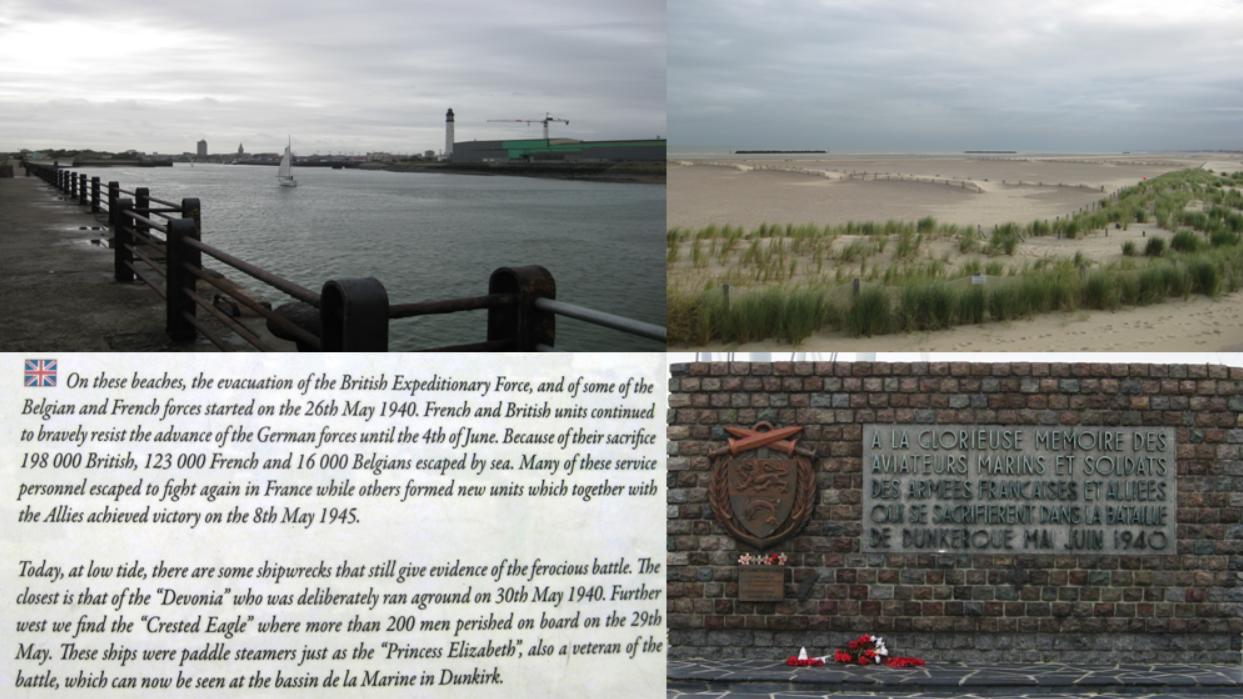 Bottom left: Notice at Bray Sands, one of the main evacuation beaches. Top right: Modern view of the beach at Bray, summer 1940 wrecks clearly visible at low water. Top left: View of Dunkirk harbour from the Eastern Mole. Bottom right: Commemorative wall near the Eastern Mole. 239,446 men were lifted off the Mole, 98,780 from nearby beaches.
Photos: David Nunn
Bottom left: Notice at Bray Sands, one of the main evacuation beaches. Top right: Modern view of the beach at Bray, summer 1940 wrecks clearly visible at low water. Top left: View of Dunkirk harbour from the Eastern Mole. Bottom right: Commemorative wall near the Eastern Mole. 239,446 men were lifted off the Mole, 98,780 from nearby beaches.
Photos: David Nunn
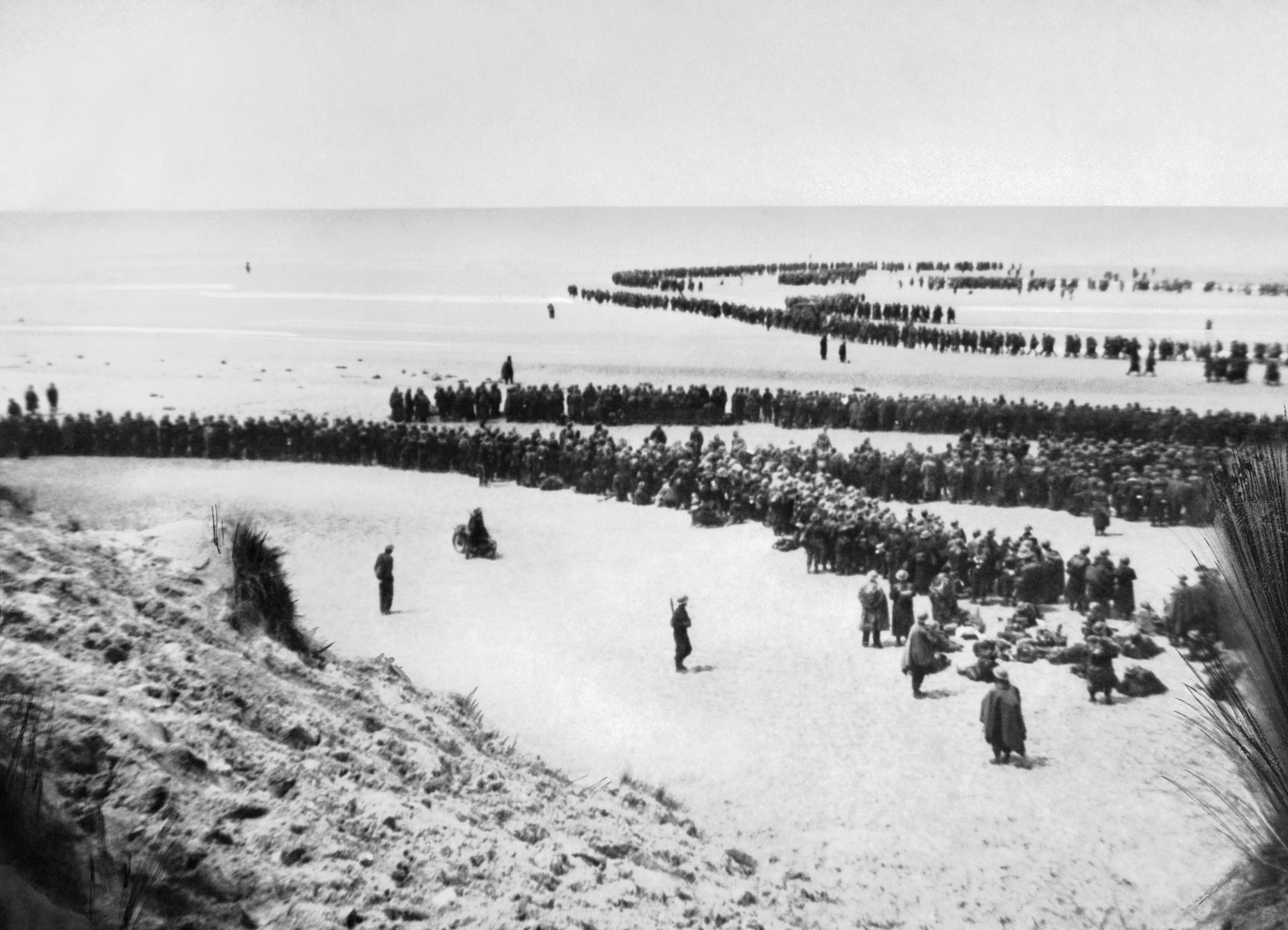 Lines of men waiting to be lifted off a beach near Dunkirk
Photo: Courtesy of Facebook
Lines of men waiting to be lifted off a beach near Dunkirk
Photo: Courtesy of Facebook
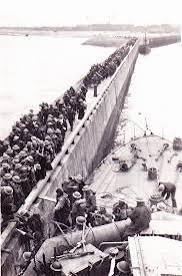 Eastern Mole Dunkirk during the evacuation, men queuing and boarding rescue ship
Photo: Courtesy of Facebook
Eastern Mole Dunkirk during the evacuation, men queuing and boarding rescue ship
Photo: Courtesy of Facebook
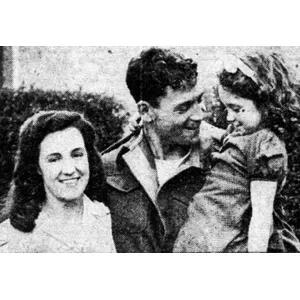 Harry and Constance Nicholls with their daughter Pamela outside Nottingham's Council House before a reception to welcome him home from captivity in 1945. To find out more about Nottinghamshire VC recipients, see The Victoria Cross | Nottinghamshire County Council
Photo: Courtesy of the Nottingham Evening Post 22/6/1945
Harry and Constance Nicholls with their daughter Pamela outside Nottingham's Council House before a reception to welcome him home from captivity in 1945. To find out more about Nottinghamshire VC recipients, see The Victoria Cross | Nottinghamshire County Council
Photo: Courtesy of the Nottingham Evening Post 22/6/1945