


William Arthur Dutton
Educated at Barnby Road School and Magnus Grammar School.
May have assisted his father as a painter and decorator before working as a mechanic.
28 December 1937: joined the Grenadier Guards, civilian trade mechanic.
- Family History
- Military history
- Extra information
- Photographs
CWGC: 'W A Dutton', no personal details recorded.
William Arthur was the elder son of Arthur and Beatrice Marion Dutton (née Butler).
Both his parents were born in Walsall, Staffordshire, his father in 1886 and his mother in 1887. They were married in 1908 (OND reg. Walsall) and had seven children, one of whom died in infancy: Beatrice Mona b. 1909 (JAS), Gladys b. 1911 and Dorothy Ethel b. 1912 who were born in Walsall, and Mary b. 1914 (AMJ) d. 1914 (AMJ), Nellie b. 1916, William Arthur b. 1917 (OND) and Harry b. 1924, who were born in Newark.
Arthur, a house painter (building trade), his wife and their first child, Beatrice, were living on Sandwell Street, Walsall, in 1911. Gladys was born later that year and Dorothy in 1912.
The family later moved to Newark where their fourth daughter Mary was born in 1914. They were recorded on the 1921 census at 69 William Street, Newark. Arthur was employed by a local company, Riley & Sons, as a 'house and sign decorator during season, any trades at other times'. Also in the home were their five surviving children: Beatrice, Gladys, Dorothy and Nellie, who were school age, and William Arthur (3y8m). The youngest child, Harry, was born three years later.
Arthur and Beatrice later moved to Coddington but were living apart in 1939 when the England & Wales Register was compiled.
Arthur, who was still working as a painter and decorator, was recorded at 'Worsall', Coddington Road, Newark, with two of his children; Beatrice, a shop assistant and also serving with the British Red Cross Society (Mobile?), and Harry, an engineer's junior clerk.
His wife was living at 48 Lombard Street, Newark, with her daughter Gladys whose occupation, like her mother's, was given as 'unpaid domestic duties'. Also in the household were two others (male, single, in work) who were probably lodgers. Nellie, a cashier book-keeper, was in rented rooms on Hobard Street, Leicester, but married George W Wingad later that year (reg. OND Newark). Dorothy Ethel has not yet been traced on the 1939 Register.
William had joined the Grenadier Guards on 28 December 1937, trade listed as mechanic. He had named his parents, who were then living in Coddington, as his next of kin but on 6 January the following year he had his father's name removed but retained that of his mother who was living at 48 Lombard Street.
Arthur's wife, Beatrice Marion, was granted a divorce on the grounds of desertion in 1944. She married Frank Dexter in 1957 and died in 1961.
Of William's five siblings: Beatrice Mona married Alfred G Clements in 1954 (reg. Newark); she died in 2004 (reg. Hereford Monmouthshire). Gladys married Harold T Wiseman in 1971 (reg. Nottm); her death in 2004 was registered in Lincolnshire (d. Grantham) but she may have lived in Bournemouth. Dorothy Ethel has not yet been traced after 1921. Nellie, who had married George Wingad in 1939, died in 1980 (reg. Rushcliffe Notts). Harry probably died in 2003 (reg. JFM Lincolnshire).
William joined the Grenadier Guards on 28 December 1937, trade listed as mechanic.
He was serving with the 3rd Battalion when he was killed in action on 21 May 1940. He is buried in Esquelmes War Cemetery, Belgium (grave ref. III.A.2). 'Casualties buried in various places in the neighbourhood were brought to Esquelmes by the Belgian authorities in September 1940' (cwgc.org)
'The British Expeditionary Force was involved in the later stages of the defence of Belgium following the German invasion in May 1940, and suffered many casualties in covering the withdrawal to Dunkirk.Those buried in Esquelmes War Cemetery died in defending the line of the River Scheldt; the Germans attempted to cross the river near Esquelmes during the morning of 21 May, but were repulsed after heavy fighting. They eventually crossed on 23 May, when the British Expeditionary Force withdrew to the Gort Line.' (cwgc.org)
Grenadier Guards 3rd Bn War Diary entry:
1940 May 20
A quiet day.
Battalion H.Q. to BAILLEUL.
The Battalion dug in during the night,
No. 1 Company Right
No. 2 Company Centre
No. 4 Company Left, and
No. 3 Company reserve, immediately East of BAILLEUL.
1940 May 21
All quiet at Stand Down. At 0730 hours a violent Artillery, Mortar and Machine Gun barrage fell on the whole of the 1st GUARDS BRIGADE front. A determined attack was launched at the point of junction of the Battalion and the 2nd Battalion COLDSTREAM GUARDS. A crossing was forced and Machine Guns, Mortars and Snipers got across the river, infiltrating on the left, and forced our men back as far as the PONT A CHIN road. The open country held by our forward Companies was completely under enemy observation, and every movement made by our troops was dogged by accurate Machine Gun and Mortar Fire.
No's 1 and 2 Companies stood firm, and Captain P.T CLIFTON with the reserve Platoon of No. 1 Company and some men of No. 2 Company under Captain P.J.C. RADFORD-NOROP organised an immediate counter attack and regained the line of the river bank. Meanwhile Major W.R.J. ALSTON-ROBERTS-WEST Commanding No. 4 Company gathered the remainder of his Company and made a great but unsuccessful effort to regain the lost trenches. In these attacks Machine Guns and Mortars accounted for Major A.R. WEST and 2/Lieutenant A.N. BOYD (killed), Captain P.T. CLIFTON, Captain P.J.C. RADFORD-NORCOP and Lieutenant the MASTER of FORBES (wounded) and many men.
Seeing that the situation was serious the Commanding Officer went forward in a Carrier and made a recce on the spot as there was no post from which he could see what was happening. As a result one Section of Carriers was sent to cover the Right, and No. 3 Company was ordered to counter attack and regain No. 4 Company’s position. Supported by one Section of Carriers under Lieutenant H. REYNELL- PACK and the Mortar Platoon this attack went in with great dash at 1130 hours, but the men were mown down by hidden Machine Guns mentioned above, although it got within a few yards of the river bank and the old positions it was impossible to hold them. Lieutenant H. REYNELL-PACK in his own Carrier went right across the open country having spotted where the Machine Gun fire was coming from, and silenced the guns on the left, but still the fire was too heavy, so Captain L.S. STARKEY with the remainder of No's 3 and 4 Companies took up a line covering the main road.
In this counter attack Captain R.E. ABEL-SMITH, Lieutenant H. REYNELL-PACK and Lieutenant the DUKE of NORTHUMBERLAND were killed. Owing to the danger of the break through, two companies 2nd Battalion HAMPSHIRES were put under Command Major A.H.S. ADAIR, M.C, one taking up a position in support on the line of the road and one in reserve East of BAILLEUL. Towards dark enemy Artillery and Machine Gun fire died down, and patrols sent forward found our banks clear of enemy, and the line was re-established. The remainder of the Battalion being organised into one Company under Captain R.N. BRINCKMAN who came up from ‘B’ Echelon during the night, and more and more men were collected from weapon pits of the forward area, therefore at Stand Down in the morning the Battalion was organised into two Companies, one under Captain L.S. STARKEY and the other under Captain R.N. BRINCKMAN.
Dutton’s name appears on the following casualty list: ‘Secret. Casualty List 235 (Other Ranks) (This list contains all casualties reported to the War Office Casualty Section for the 24 hours ended 9 a.m. 19th June, 1940).’ Extract: Expeditionary Force – France. Grenadier Guards.’ Dutton was one of eight men of the Grenadier Guards listed as killed on 21 May 1940 although two names were later annotated as Prisoner of War. However, as a local newspaper report of 12 June confirmed Dutton's death, it is likely that his name also appeared in an earlier casualty report.
Newark Advertiser, Wednesday 12 June 1940: ‘Killed in Action. Guardsman WA Dutton. Mr and Mrs A Dutton, of 48, Lombard Street, Newark, received official intimation from the War Office, on Monday [10 June], that their elder son, Grenadier Guardsman WA Dutton, was killed in action on May 21st. Guardsman Dutton, who was 22 years of age, was educated at Barnby Road School and Magnus Grammar School, and for a short time he assisted in his father’s business as a painter and decorator. Later he was employed in an office in Nottingham. Two years ago last January, he joined the Grenadier Guards, and, since he had been overseas, was batman to an intelligence officer. A month ago he wrote his parents to say that he was in the thick of it,’ and for that reason would not be able to communicate with them very regularly.' (wwww.britishnewspaperarchive.co.uk)
Newark Herald, 15 June 1940. Above report published under the heading. ‘War Casualties. Newark Guardsman Killed in Action. More Local Men Safe.’
Newark Advertiser, 25 December 1940: A report about the presentation of certificates to pupils at Magnus Grammar School the previous week concluded with a list (almost the length of a column) of ‘Old Magnussans in His Majesty’s Forces’. The names included ‘WA Dutton GG’, annotated as killed in action.
Newark Advertiser, 12 July 1944. (Extract)At Notts Assizes yesterday week, a marriage that took place in November 1908 was dissolved on the wife’s petition. Petitioner was Mrs Beatrice M Dutton, 48 Lombard Street, Newark. She alleged that her husband had deserted her and after hearing the evidence the Judge said that he was satisfied and granted a decree. Petitioner said there were five children of the marriage, all over 19 years of age.’ (www.britishnewspaperarchive.co.uk) Also Nottingham Evening Post, 4 July 1944.
Register of the Royal Red Cross. Beatrice Mona Dutton. 611060 Corporal. London Gazette 14 June 1945. RRC Class of Award: 2nd Class by registered post with the King’s letter, 8 July 1948. ‘The Royal Red Cross (RRC) was first awarded in 1883 'for special exertions in providing for the nursing, or for attending to, sick and wounded soldiers and sailors.' (RRC website)
Additional research/record updated, RF (Jan. 2026)
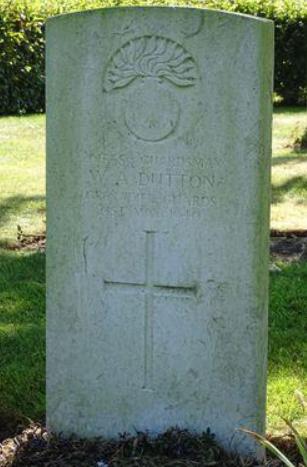 Photo of William Arthur Dutton
Buried Esquelmes War Cemetery, Belgium.
Photo of William Arthur Dutton
Buried Esquelmes War Cemetery, Belgium.