

HMS Hood
Commissioned in 1920, HMS Hood was the last battle cruiser built for the Royal Navy. Although known as ‘The Mighty Hood’, she had design limitations. The most significant weakness was Hood’s deck armour, which was designed for Jutland-era engagements involving flatter trajectories. The armour was spread over three decks, a scheme intended to detonate shells on the top deck. However, this proved inadequate against the "plunging fire" of modern, long-range naval artillery, such as that used by Bismarck.
Bismarck’s hit on Hood’s aft magazine may have been a lucky strike (from a German perspective) but Hood’s design was lining up a disaster waiting to happen.The aft magazine area was particularly vulnerable, potentially due to the storage of 4-inch ammunition handling rooms close to the 15-inch magazines, a layout that resulted from earlier modifications.
Following inter-war service in the Mediterranean, Hood returned to Britain for an overhaul in 1939. By this time, advances in naval gunnery had reduced Hood's usefulness. She was scheduled to undergo a major rebuild in 1941 to correct these issues, but the outbreak of war forced the ship into service without the upgrades.
When war was declared, Hood was operating in the area around Iceland, and she spent the next several months hunting for German commerce raiders and blockade runners between Iceland and the Norwegian Sea. After a brief overhaul of her propulsion system, she sailed as the flagship of Force H, and participated in the destruction of the French fleet at Mers-el-Kebir.
Relieved as flagship of Force H, Hood was dispatched to Scapa Flow, and operated in the area as a convoy escort and later as a defence against a potential German invasion fleet. In May 1941, Hood and the battleship Prince of Wales were ordered to intercept the German battleship Bismarck and the heavy cruiser Prinz Eugen, which were en route to the Atlantic where they were to attack convoys. Hood was commanded by Captain Ralph Kerr and was flying the flag of Vice-Admiral Lancelot Holland. The German ships were spotted by two British heavy cruisers (Norfolk & Suffolk)
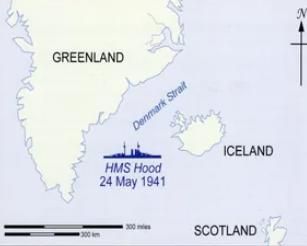
23 May, and Holland's ships intercepted Bismarck and her consort, the heavy cruiser Prinz Eugen, in the Denmark Strait between Greenland and Iceland on 24 May. The British squadron spotted the Germans at 05:37 (ship's clocks were set four hours ahead of local time – the engagement commenced shortly after dawn), but the Germans were already aware of their presence, Prinz Eugen's hydrophones having previously detected the sounds of high-speed propellers to their south-east.
The British opened fire at 05:52 with Hood engaging Prinz Eugen, the lead ship in the German formation, and the Germans returned fire at 05:55, both ships concentrating on Hood. Prinz Eugen was probably the first ship to score when a shell hit Hood's boat deck, between her funnels, and started a large fire among the ready-use ammunition for the anti-aircraft guns and rockets of the UP mounts.
Just before 06:00, while Hood was turning 20° to port to unmask her rear turrets, she was hit again on the boat deck by one or more shells from Bismarck's fifth salvo, fired from arange of approximately 16,650 meters (18,210 yd). A shell from this salvo appears to have hit the spotting top, as the boat deck was showered with body parts and debris.
A huge jet of flame burst out of Hood from the vicinity of the mainmast, followed by a devastating magazine explosion that destroyed the aft part of the ship. This explosion broke the back of Hood, and the last sight of the ship, which sank in only three minutes, was her bow, nearly vertical in the water. A note on a survivor's sketch in the British RN Historical Branch Archives gives 63°20′N 31°50′W as the position of the sinking. Hood sank with 1,418 men aboard.
She sank in three minutes with the loss of 1,415 men - 93 officers, 1,150 ratings, 161 Royal Marines, 4 Royal Australian Navy ratings and 7 NAAFI employees. 90 boys were listed amongst the dead. Only three men survived the disaster - Midshipman William John Dundas, Ordinary Signalman Ted Briggs and Seaman Robert Tilburn. The three were rescued about two hours after the sinking by the destroyer Electra, which spotted substantial debris but no bodies.
Various theories for Hood ‘s rapid demise have been advanced including the explosion of her own torpedoes, a detonation within her own guns, a shell striking below the water line or a spreading fire from the boat deck.
However, the discovery of the ship’s wreck in 2001 seemed to confirm a Naval Board’s initial conclusion that Hood's aft 102 mm magazine exploded after one of Bismarck's 380 mm shells penetrated her armour. It seems that rapidly expanding combustion gases from exploding cordite swept through the ship causing catastrophic structural failure.
Thirty men with strong connections to Nottinghamshire were amongst the 1,415 lost aboard HMS Hood on May 24th 1941. They were:
William Brierley, William Callon, George Carlin, Jack Clark, Stanley Clayton, Thomas Clements, George Cole, John Cruttenden, Ronald Dennis, Kenneth Duckworth, John Gregory, Geoffrey Hartman, Maurice Herod, Kenneth Javan, John Machin, Frederick Mendham, Ronald Neal, Kenneth Radley, Peter Reddall, John Rhodes, Jack Scott, George Smith, John Sulley, Harold Thompson, Herbert Wells, Harry White, Harry Wilcockson, Frederick Wilkinson, James Wilkinson, Frederick Williams.
Due to Hood’s publicly perceived invincibility, the loss affected British morale.
NB. Unless otherwise stated, the photos and service records in this section are courtesy of the HMS Hood Association: https//www.hmshood.org.uk
Thanks also to Michael Szarelis, Elizabeth Szarelis and Shaun Noble for their contributions.
- Names on this memorial
- Photographs
- William Brierley
- William Callon
- George Carlin
- Jack Clark
- Stanley Clayton
- Thomas Clements
- George David Cole
- John Cruttenden
- Ronald Dennis
- Kenneth Duckworth
- John Gregory
- Geoffrey Hartman
- Maurice Edward Hector Herod
- Kenneth Walter Javan
- John Lee Machin
- Frederick George Mendham
- Ronald Neal
- Kenneth Radley
- Peter Ernest Alfred Reddall
- John Rhodes
- Jack Scott
- George Smith
- John Charles Sulley
- Harold Thompson
- Herbert William Wells
- Harry White
- Harry Robert Wilcockson
- James Wilkinson
- Frederick Wilkinson
- Frederick Percy Williams
 The loss of HMS Hood
Photo: Courtesy of Tim and Gail Chamberlin, Aslockton Remembers, p.26
The loss of HMS Hood
Photo: Courtesy of Tim and Gail Chamberlin, Aslockton Remembers, p.26