

Two Lancaster bombers were lost near Hoveringham within 17 days during January 1945. Both aircraft were on training operations from 5 LFS at RAF in Syerston, which is located on the ridge over on the opposite bank of the River Trent.
Lancaster III JB125 crashed on 12thJanuary 1945 whilst trying to land back at Syerston in persistent drizzle below a low cloud base. 'The Lancaster,'wrote Helen Nall, 'had come down in the riverside pasture near the Old Elm Tree pub, narrowly missing the Women's Land Army hostel on Lodgefield Lane.' The aircraft caught fire, killing the entire crew, despite rescue attempts by villagers from Hoveringham. There were three New Zealanders and four British airmen aboard.
The Court of Inquiry. 'continued Nall, 'concluded that, although the weather conditions would have presented little difficulty to an experienced pilot, Dunlop, who had only four hours solo night-flying experience, should have been diverted to another airfield by Control at RAF Syerston. In future, when the cloud base was below 1,000 feet or visibility less than 2,000 yards, no aircraft should be landed at Syerston without prior reference to the Station Commander or Chief Instructor.'
Lancaster III LM308 crashed on 29th January 1945 whilst on the crew's final training flight, a night cross country exercise or 'moon training flight' followed by a practice bombing exercise. In the circuit at Syerston, eyewitnesses saw flames from both port engines before the aircraft crashed at high speed and exploded on impact; all on board were killed instantly. The Land Army girls, whose hostel had survived a close shave on January 12th, watched in horror as LM 308 crashed and exploded in flames in almost exactly the same place as had JB 125 seventeen days previously. This time, the plane was being flown by five Canadians and two British airmen. (The Courage of the Small Hours p.p.127-129)
The cause of this accident, wrote Helen Nall,'remains obscure although the Court of Inquiry agreed that the aircraft had got out of control and Rathbone had been unable to regain control before hitting the ground. Because the wreckage was so widely spread... it was impossible to ascertain the cause of the crash.' (Courage p.p.136-137)
The biographies and photos in this section are all included by kind permission of Helen Nall and extracted from her excellent book The Courage of the Small Hours (Great Britain: Linney Group, 2010 p.p. 129-147).
Recently (January 2026), Helen Nall noted
"When my brother and I found the first fragments of Lancaster in 2009, little did we know what was to unfold. I interviewed hundreds of Bomber Command veterans (aircrew and groundcrew), Land Girls, former POWs, farmers, and local residents. What started as an information sheet to be distributed to attendees at the 2010 Service of Dedication to the aircrew memorial in our field, grew into a book. Every single penny from both editions was donated to the RAF Benevolent Fund. We also donated £12,000 of the book's sales monies to the Bomber Command Memorial in Green Park. I found researching and writing the book humbling beyond words. As I have said and will continue to say, the men who served in Bomber Command were, to a man, 'Heroes All'".
- Names on this memorial
- Location
- Photographs
- Guy Rerendui Dunlop 12/1/1945
- Peter John Hill 12/1/1945
- Albert John Evans 12/1/1945
- Richard Ludgvan Staples 12/1/1945
- Patrick Joseph Vincent Browne 12/1/1945
- Richard Henry Sedgley 12/1/1945
- William Fordyce Cairns 12/1/1945
- Richard Barlow Rathbone 29/1/1945
- Hugh Munro MacKenzie 29/1/1945
- John Alexander Emerson 29/1/1945
- John Henry Reid 29/1/1945
- Albert Mercer 29/1/1945
- Jasper Martin 29/1/1945
- Joseph Francis Fitzgibbon 29/1/1945
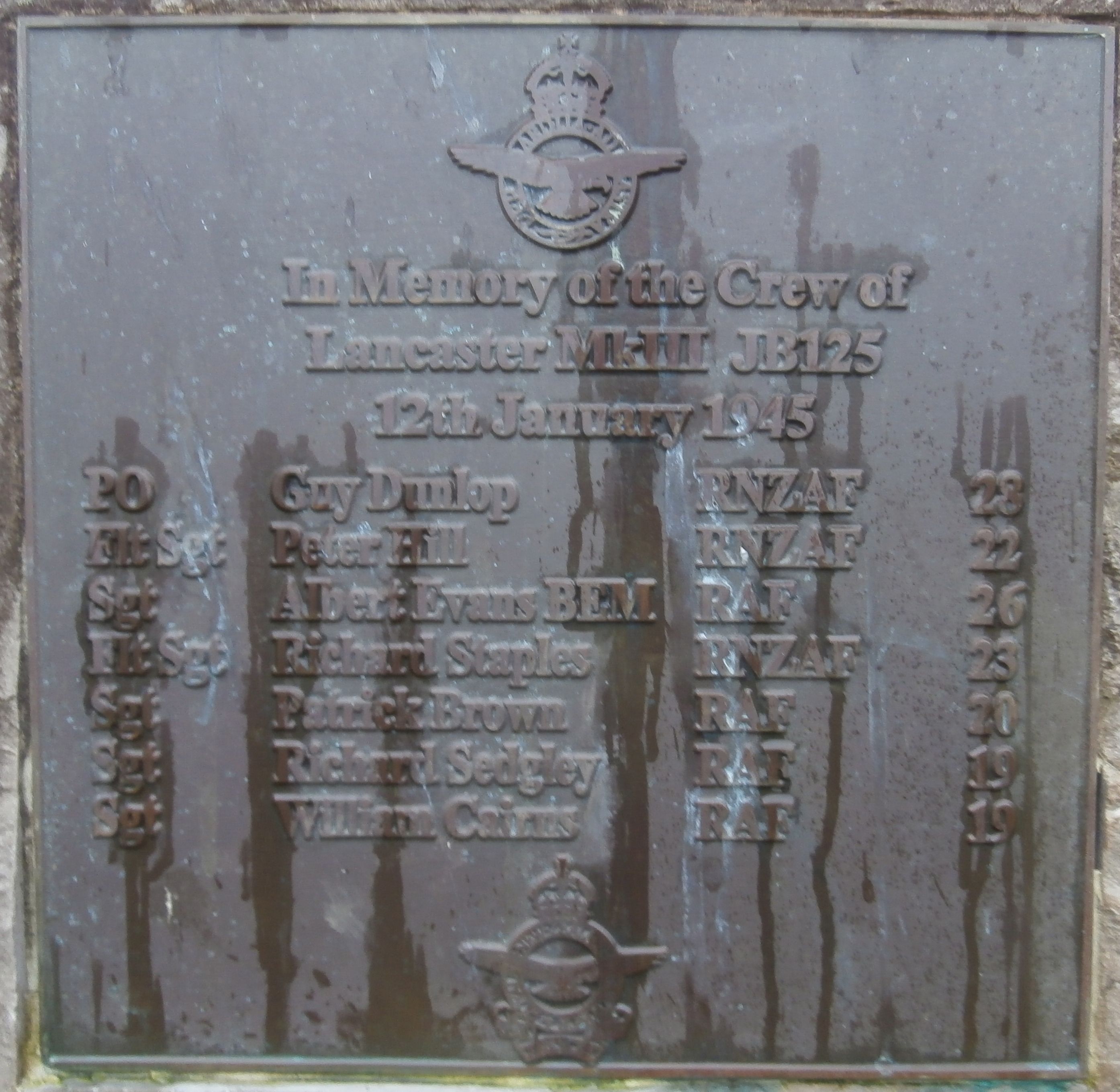 Plaque listing the crew of JB125 lost 12/1/1945
Photo: David Nunn
Plaque listing the crew of JB125 lost 12/1/1945
Photo: David Nunn
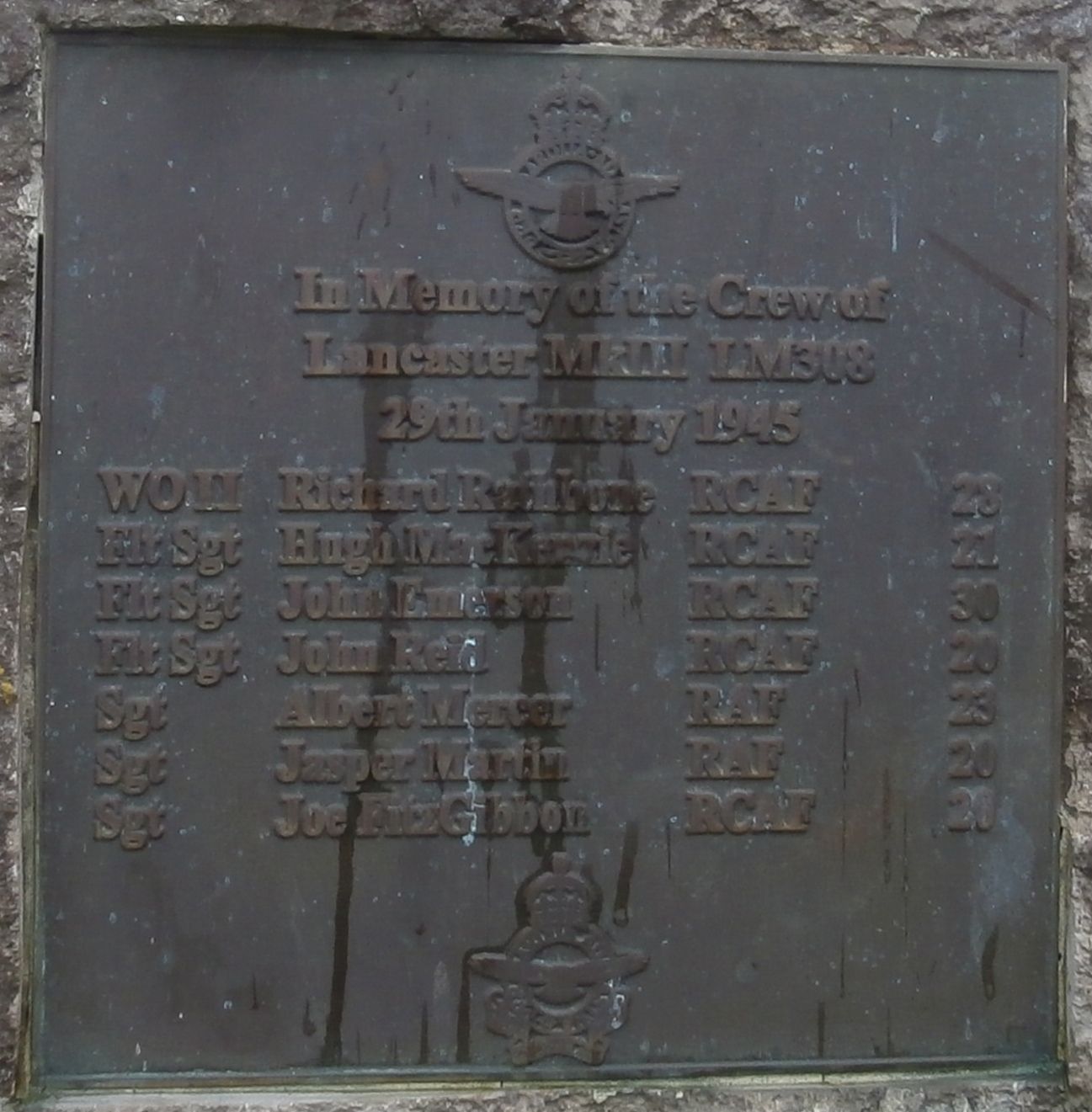 Plaque listing the crew of LM308 lost 29/1/1945
Photo: David Nunn
Plaque listing the crew of LM308 lost 29/1/1945
Photo: David Nunn
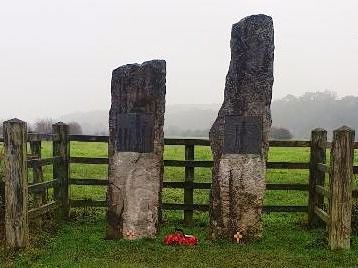 Granite pillars beside the Trent near Hoveringham commemorating fourteen airmen killed near here in two separate accidents during January 1945.
Photo: David Nunn
Granite pillars beside the Trent near Hoveringham commemorating fourteen airmen killed near here in two separate accidents during January 1945.
Photo: David Nunn
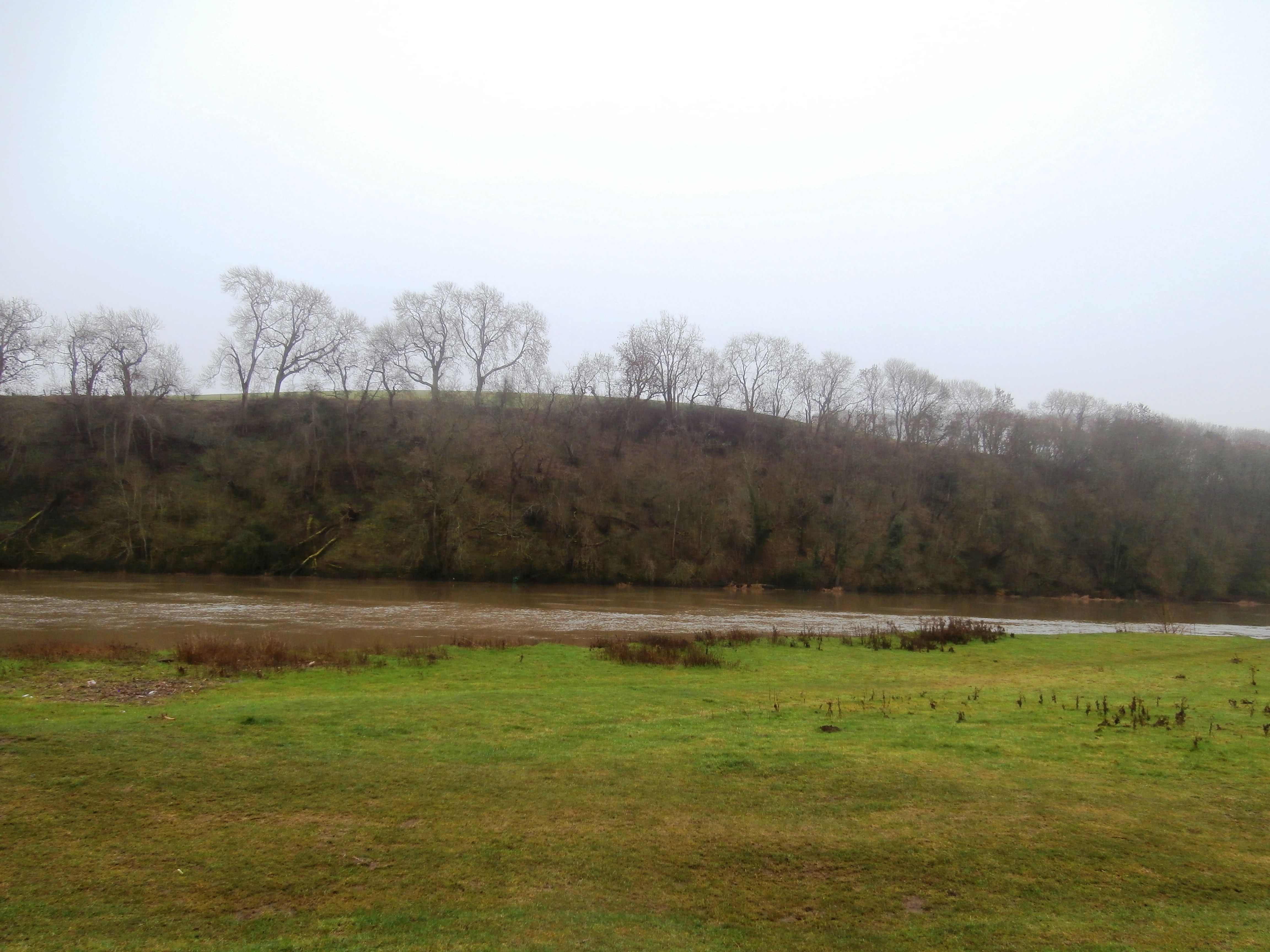 View across the Trent showing the wooded ridge on which is located RAF Syerston.
Photo: David Nunn
View across the Trent showing the wooded ridge on which is located RAF Syerston.
Photo: David Nunn