

On June 3rd 1940, as the Dunkirk exodus was ending, Churchill told the war cabinet that the British Expeditionary Force in France had been withdrawn ‘practically intact except for their losses through casualties in combat.’ [1] As far as the wider British public was concerned, the BEF had come home.
Eight decades later, the Dunkirk miracle of deliverance, with attendant images of small ships and men waiting patiently in line under heavy fire on the beaches of Belgium and northern France, remain firmly embedded in our national consciousness. And so they should. There is no intention here to denigrate the magnificently courageous efforts of all involved in Operation Dynamo.
For Churchill’s government, Dunkirk symbolised the unbreakable spirit of the British people and, hopefully, drew ‘a line under the disastrous opening of the war’. [2] And anyway, as the British historian Julian Jackson put it ‘after Dunkirk there was hardly any further British army presence on the continent except for a Highland division which was still in France after retreating from the Saarland.’ [3]
However, this assertion is inaccurate. 150,000 British troops were still in France, almost half as many as had been saved at Dunkirk, along with 85,000 Poles.
The Nottinghamshire data confirm that men from the Duke of Wellington's Regiment, North and South Staffordshires, several battalions of Sherwood Foresters, Royal Artillery men, Royal Engineers, Signallers, men from the Royal Armoured Corps, Pioneers, RAOC, RASC were all awaiting rescue post- Dunkirk. Other sources allude to Royal Welsh Fusiliers, Royal Hussars and men from the Cheshire Regiment being left behind.
Some had failed to reach Dunkirk, others knew nothing of the evacuation and many had been cut off by the sheer speed of Germany’s panzer-led advance from the Ardennes. Most had not been involved in the battles of May and June 1940.
Many were support troops and RAF ground crews. 800 RAF personnel perished aboard HMT Lancastria (see below) 91 of them from 98 Squadron, 6 from Nottinghamshire, all ordered into the same hold which took a direct hit. Usually poorly armed and untrained for combat, they were sometimes dismissed by British High Command as ‘the grocers’.
As the allied front in France collapsed and the French government, despite Churchill’s best efforts to urge continued resistance, prepared to capitulate, these British troops and airmen were left to make their own way towards ports in western France, notably Nantes and St-Nazaire which were still open.
Often leaderless, exhausted and hungry, many managed to commandeer vehicles, scrounging or stealing food as they progressed in a chaotic mass scramble towards safety.
Known as Operation Aerial, evacuations from Normandy and Brittany were highly successful; 186,700 British, French and Polish soldiers and airmen were rescued by a fleet of boats from Brixham, Dartmouth, Exmouth, Falmouth, Fowey, Teignmouth and Torquay.
There was no recorded loss of life in these evacuations but valuable stores and equipment had to be abandoned.
During the early stages of Operation Aerial, 84,700 men were taken off at Brest, Cherbourg and St Malo with a further 21,000 rescued from smaller ports. 50,000 still remained in the far west around Nantes and at St-Nazaire which became the scene of Britain’s worst ever maritime loss of life.
HMT Lancastria
HMT Lancastria, a converted Cunard liner captained by Rudolph Sharp had departed Liverpool on Friday 14th June arriving in the Loire Estuary off St-Nazaire late on Sunday 16th. Because the port has to be accessed along a tidal channel, Lancastria anchored 5 miles south west of St-Nazaire at 04.00 on Monday 17th in convoy with about 30 other merchant vessels of different sizes. Loading began in daylight.
It will never be known how many servicemen and civilians crammed on board in the few hours before tragedy struck. Those attempting to count were soon overwhelmed by the volume of crowds forcing their way on to the liner. Some survivors reported the total complement to have been between 8,000 and 9,000. Shaun Noble describes the unfolding Lancastria disaster:
‘At 13.50, during an air raid, the nearby Oronsay, a 20,000 ton Orient liner was hit on the bridge by a German bomb. Lancastria was free to depart and the captain of the British destroyer HMS Havelock advised her to do so; but without a destroyer escort as a defence against possible submarine attack, Sharp decided to wait for Oronsay before departing. A fresh attack by air began at 15.30 by Junkers JU88 bombers of Kampfgesschader 30. Lancastria was hit by three or possibly four bombs... and sank in about 20 minutes.
One bomb landed close to the funnel and entered No.4 hold. Two other bombs landed in No2 and 3 holds whilst a fourth landed close to the port side of the ship rupturing fuel oil tanks. As the ship began to list to starboard, men on deck were ordered to move to port to counteract it but his caused a list to port which could not be corrected.
The ship was equipped with 16 lifeboats and 2,500 life jackets but many of the boats could not be launched because they had been damaged in the bombing or because of the angle of the hull. The first boat away was filled with women and children but it capsized on landing in the water and a second had to be lowered for them. A third boat had its bottom staved in by landing too fast. A large number of men who jumped over the side were killed by hitting the side of the hull or had their necks broken by their life jackets on impact with the water.
Many of those in the water drowned because there were insufficient life jackets or died from hypothermia or were choked by fuel oil. German aircraft began strafing survivors in the water and dropping flares into the floating oil. There were 2,477 survivors.’
The Lancastria disaster produced some stories of remarkable heroism; local St Nazaire resident Joan Rodes, a heavily pregnant British nurse whose French husband was away at the front, repeatedly put herself in danger to rescue and care for wounded survivors. She became known as 'the angel of St-Nazaire' whose exertions caused her to mis-carry in the midst of Operation Aerial. Mrs Rodes died in May 2010 aged 89.
Lancastria’s death toll accounted for one third of the BEF losses in France up to that point in the war.’ At the lowest estimate, 2,500 people died that day. An Admiralty report said 2,823 had been lost and Churchill wrote of a toll of ‘upwards of 3,000 men.’
Both figures may well be underestimates; the real number of Lancastria fatalities may have been as high as 5,000 of even 6,000. So far, as research continues, it has been established that 33 Nottinghamshire men were killed aboard HMT Lancastria.
Many families of the dead were initially told only that their loved ones had died in France with the BEF. When Churchill learnt of the disaster, he decided to suppress coverage of the incident; in his memoirs he explained ‘I forbade its publication. The newspapers had got quite enough disaster for today at least. I had intended to release the news a few days later but events crowded in on us so black and so quickly that I forgot to lift the ban.’ The BBC broadcast news of the Lancastria tragedy five weeks later following a story in the New York Sun.
Whereas Dunkirk suvivors were greeted as heroes by the British public, many from Operation Aerial suffered abuse and mockery because of their often bizarre appearance resulting from discarding uniforms to increase chances of survival in the water.
Many were still ingrained with oil and wearing peculiar clothing; Frank Brogden was given a pair of velveteen trousers and a shirt. He looped strips of old carpet round his feet as slippers. Bill Slater of the Pay Corps 'picked up a vest and a pair of trousers which had belonged to a man whose stomach was five inches bigger than his but whose legs were five inches shorter. He also got a blanket but no shoes or socks.' [4]
Others, noted Sean Longden, reported being 'treated with disdain, despte the fact that their fight had continued for weeks after the Dunkirk men had arrived home.
Arriving at depots, they were annoyed to find quartermasters demanding they hand over their divisional insignia, as if erasing the history of who they were and where they had been.' [5]
For 40,000 British troops and airmen there was to be no homecoming in 1940. Captured, many had to endure cuel forced marches across Europe to POW camps in Germany followed by five years of captivity.
‘By any estimate,’ opined Jonathan Fenby, (despite the Lancastria tragedy and numbers becoming POWs) ‘the second evacuation of British troops from France in the early summer of 1940 was an enormous success... 144,171 British soldiers and RAF personnel were taken off, plus 24,352 Poles, 18,246 French, 4,938 Czechs and 168 Belgians – making a total of 191,875, 57,175 of them from Nantes and St-Nazaire. Between 30,000 and 40,000 civilians were also rescued.
Setting aside the dreadful losses aboard the Lancastria, only around 650 British servicemen lost their lives in France between 10th and 25th June 1940 although it is possible that some UK militay deaths during this period were evacuation-related (CWGC Debt of honour Register).
Apart from the Lancastria, only two ships of any size were lost – the Teresias, sunk off St-Nazaire with no loss of life and a troop carrier bombed (between) Le Havre and Cherbourg. Though great quantities of equipment were left behind, 2,292 vehicles, 1,800 tons of stores and 310 guns were shipped back to Britain.
As Captain Roskill put it, in some ways it was ‘an even more convincing demonstration of the effectiveness of sea power’ than Dunkirk. [6]
Notes
- Jonathan Fenby, The Sinking of the Lancastria (London: Simon & Schuster, 2005) p.27
- ibid
- Julian Jackson, The Fall of France (Oxford: OUP, 2003) p.97
- Fenby, Lancastria p.189
- Sean Longden, Dunkirk, The Men they left behind, (Great Britain: Constable, 2005) p.285
- Fenby, Lancastria p.228
*denotes killed aboard HMT Lancastria
** denotes killed in the Rennes train bombing. On June 17, 1940. Luftwaffe bombers targeted the French railway station in Rennes, which was packed with trains carrying fleeing refugees, French soldiers, and British troops. Bombs struck an ammunition train, triggering massive explosions that killed approximately 1,000 people.
David Nunn
- Names on this memorial
- Photographs
- * Frank Beck
- Tom Birkhead
- * Thomas Gervais Booth
- * Francis Ernest Raynor Brown
- * Roy Clark
- **Albert Clay
- * William Arthur Day
- * Donald Phillips Durrant
- * James Easom
- * Kenneth Willoughby Griffin
- * Charles Griffiths
- * Hugh Percy Francis Guymer
- * Hugh Stanley Hancock
- * Wilfred Harpham
- * John Walter Hickling
- Reginald George Hollis
- * Harold Hopewell
- * Fred Hulme
- * Harold Edward Johnson
- * John William Johnson
- Sydney Wallace Johnson
- * Joseph Raymond Jordan
- Edward McKnight
- * Walter Samuel McPhun
- * John Graham Mendham
- **Alfred Miller
- * Raymond Arnold Salloway
- * Joseph Lambley Saxton
- James Simpson
- * Clarence Frederick Slater
- * George Edward Smith
- * Samuel Smith
- * Douglas Smith
- * Henry Radford Spencer
- Roy Spendlove
- Sidney Stain
- George Henry Swinn
- * Albert Edward Thorpe
- * James Edward Turner
- * Thomas Dennis Voce
- * Eric Cecil Wilkin
- * William John Williamson
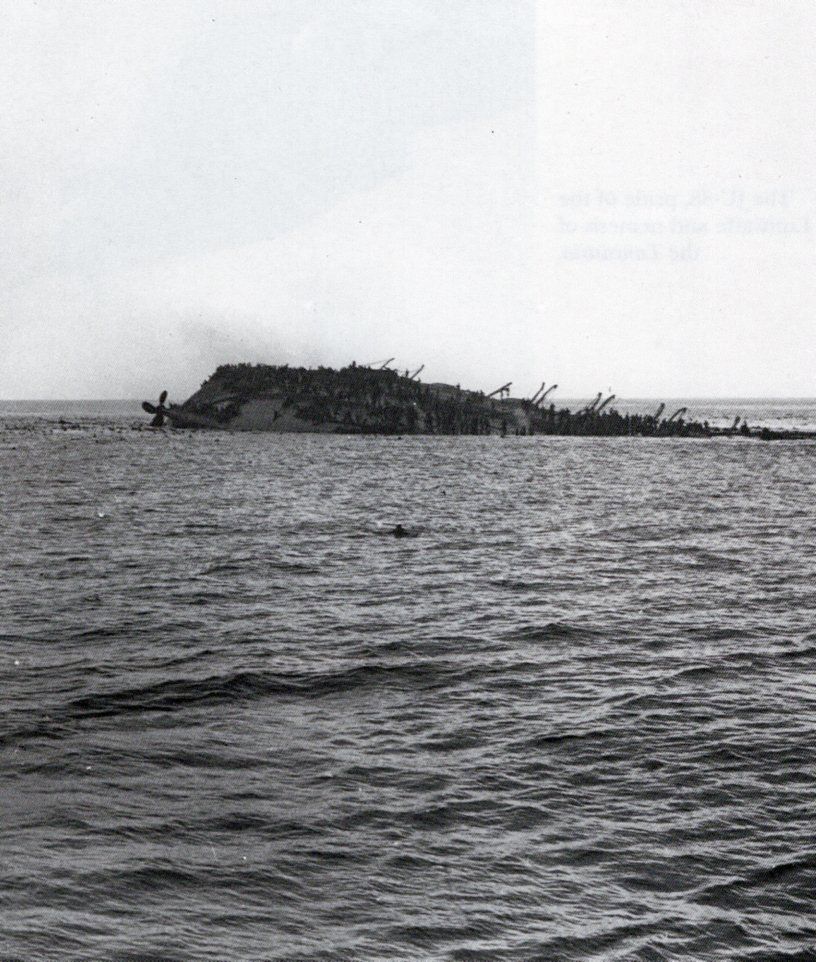 HMT Lancastria's final moments. Men still cling to her upturned hull before plunging into the water, many to their deaths.
Photo: Courtesy of The Sinking of the Lancastria by Jonathan Fenby
HMT Lancastria's final moments. Men still cling to her upturned hull before plunging into the water, many to their deaths.
Photo: Courtesy of The Sinking of the Lancastria by Jonathan Fenby
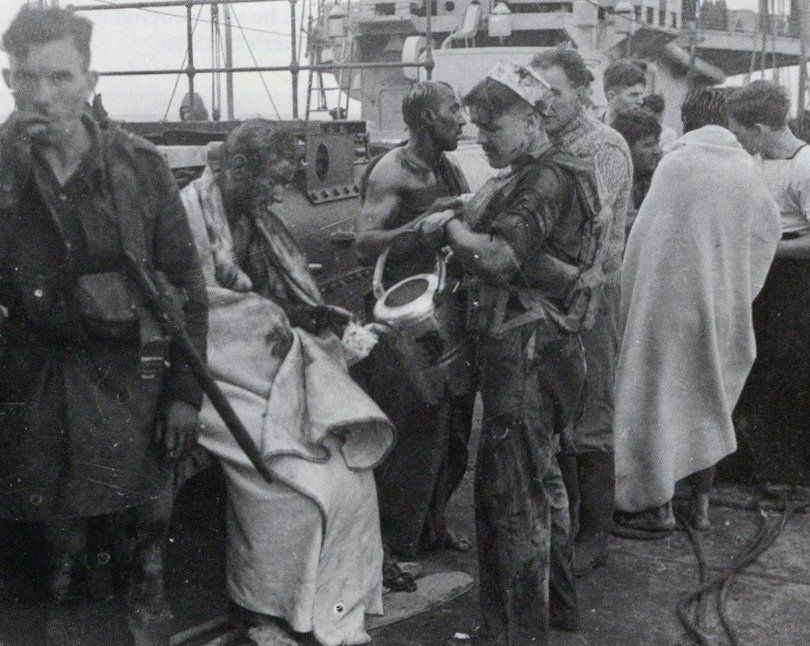 Oil begrimed and half naked survivors from HMT Lancastria prepare for evacuation to the UK
Photo: Courtesy of The Sinking of the Lancastria by Jonathan Fenby
Oil begrimed and half naked survivors from HMT Lancastria prepare for evacuation to the UK
Photo: Courtesy of The Sinking of the Lancastria by Jonathan Fenby
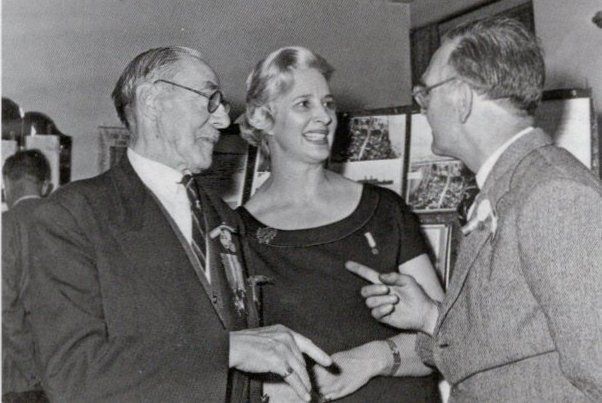 Joan Rodes, the 'Angel of St Nazaire' meeting Percy Fairfax (left) and George Youngs both of whom she helped to save.
Photo: Courtesy of The Sinking of the Lancastria by Jonathan Fenby
Joan Rodes, the 'Angel of St Nazaire' meeting Percy Fairfax (left) and George Youngs both of whom she helped to save.
Photo: Courtesy of The Sinking of the Lancastria by Jonathan Fenby