

Edwin Thomas Banks
Banks attended Nottingham High School between 1931 and 1937. He joined the school OTC winning the camp prize in 1935 and the Mulberry Shooting prize in 1936 and 1937. He was a school prefect and won colours for First XV rugby and First IV rowing.
- Family History
- Military history
- Extra information
- Photographs
He was the son of Albert (died 1928) and Margaret Cameron Banks and the brother of Frederick Walter, Doris Maud and Arthur Robert Banks. In 1921, they lived at 7, Rutland Road, West Bridgford, Nottingham.
On leaving school, Banks joined the RAF and was Gazetted Acting Pilot Officer 6/9/1938, He sailed to Egypt with 112 Squadron aboard HMS Argus and was Gazetted Flying Officer 3/9/1940 before the squadron moved to Greece.
He died aboard Gloster Gladiator II N5913 in Greece. 112 Squadron's ORB for March 1941 (TNA Air 27/873/1) graphically describes the circumstances of how Banks was lost. 'An unusually large enemy force was encountered,'the report begins,'resulting in another field day with a total of 11 confirmed victories. In addition to the above, enemy machines were damaged (by 3 named pilots). An otherwise highly successful day was marred by the passing of Flying Officer ET Banks (Teddy) as the result of a flying accident. While out testing his guns over Yannina Lake, he evidently misjudged his altitude in a steep dive and crashed into the lake sinking immediately with his machine. He was recovered later in the day from 50 feet of water. His passing cast a gloom over the mess as he was held in the highest esteem by all members of the squadron.'
Other reports suggest it was a 300mph crash which somersaulted the aircraft on to its back. Banks made no attempt to leave the plane and it was later confirmed the accident hsd broken his neck. (aircrewremembered)
His record in combat was 2 destroyed, 1 probable, 6 damaged.
The Gloster Gladiator
The Gloster Gladiator is a British biplane fighter. It was used by the Royal Air Force (RAF) and the Fleet Air Arm (FAA) (as the Sea Gladiator variant) and was exported to a number of other air forces during the late 1930s.
Developed privately as the Gloster SS.37, it was the RAF's last biplane fighter aircraft, and was rendered obsolescent by newer monoplane designs even as it was being introduced. Though often pitted against more advanced fighters during the early days of the Second World War, it acquitted itself reasonably well in combat.
The Gladiator saw action in almost all theatres during the Second World War, with a large number of air forces, some of them on the Axis side. The RAF used it in France, Norway, Greece, the defence of Malta, the Middle East, and the brief Anglo-Iraqi War (during which the Royal Iraqi Air Force was similarly equipped).
Other countries deploying the Gladiator included China against Japan, beginning in 1938; Finland (along with Swedish volunteers) against the Soviet Union in the Winter War and the Continuation War; Sweden as a neutral non-combatant (although Swedish volunteers fought for Finland against the USSR); and Norway, Belgium, and Greece resisting Axis invasion of their respective lands.
South African pilot Marmaduke "Pat" Pattle was the top Gladiator ace with 15 victories with the type. (Wikipedia)
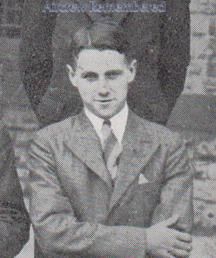 Edwin Thomas Banks
Photo: Courtesy of Nottingham High School archives and aircrewremembered.com
Edwin Thomas Banks
Photo: Courtesy of Nottingham High School archives and aircrewremembered.com