


Cecil Malcolm Baldry
He was an apprentice hairdresser in 1939.
- Family History
- Military history
- Extra information
- Photographs
He was the son of Robert Baldry. In 1939, they lived at 37, Brooke Road, Oakham.
RUNNYMEDE MEMORIAL Panel 224.
Baldry was the Fight Engineer abaord Halifax III LW468 which took off 1950 21 Jan 1944 from Burn to attack Magdeburg on a diversionary operation for the main target - Berlin. According to 578 Sqdn's ORB (TNA Air27/2050) they had attacked the taregt at 2253 from 21,500' with 1/200lb HC, 2x500lb clusters, 32x30lb & 630x 4lb incendiaries.
Crossing the enemy coast homebound, the captain reported an intensification of flak and searchlight actvity but did not mention any hits on his aircraft. This aircraft may have been damaged by enemy flak over the target.
Halifax III LW468 was ditched 50 miles off Flamborough Head when it became apparent that enemy gunfire had caused leaks to the aircraft's fuel system which made it impossible to reach base. According to 578 Sdn's ORB, like Baldry, Albert Thomas Lester (Rear Gunner) was lost to the sea. William Henry George Williams (Air Gunner) died in the dinghy.
It is presumed that Sergeants Melville, Mansfield, Godfrey and Chapps survived the ditching to fight another day.
During World War II, aircraft attacking Germany faced massive anti-aircraft fire from heavy ground batteries and massive Flak towers. Flak - Fliegerabwehrkanone (meaning "aviator-defence gun") probably accounted for around 25% of allied air force fatalities. Direct hits frequently crippled bombers like the Lancaster and the American B-17 Flying Fortress, tearing off wings, igniting fuel tanks, and causing catastrophic losses during both RAF night raids and USAAF daylight missions.
Nazi Germany built flak tower complexes in three key cities. Berlin had three main locations (Zoo, Humboldthain, and Friedrichshain). Hamburg had two major sites (Heiligengeistfeld and Wilhelmsburg). Vienna had three primary locations (Arenbergpark, Augarten, and Gedenkstätte Mauthausen/Arne-Karlsson-Park area).
Additionally, smaller single-purpose or projected installations were used or planned in cities like Stuttgart, Frankfurt, and important outlying military strongpoints outside Germany proper such as Angers (France), Heligoland (Germany), and Trondheim (Norway).
Berlin's Air Defences
Berlin was especially well defended against air raids and its flak defences were particularly effective against RAF raids mounted between January 20th and 22nd 1944. At least six airmen with strong connections to Nottinghamshire were killed by flak during this period.
Flak Towers: Huge concrete fortresses mounted massive 12.8 cm FlaK 40 guns.
Intense Barrages: Ground radar-guided searchlights and anti-aircraft guns put up thick black smoke and shrapnel fields over the city centre.
Youth Deployment: As the war progressed, most able-bodied men and older teenagers having been taken by the German army, many flak batteries were manned by fourteen year olds of the Hitler Youth and League of German Girls. Interview evidence suggests these youngsters were proud to attempt the defence of their city out of patriotic duty.
The lives of many Berliners were undoubtedly saved by flak towers which doubled as public air raid shelters particularly during the war's later months as damage and destruction within Berlin intensified.
The left hand photo shows weary Berliners leaving the Zoological Gardens flak tower in February 1945. Most flak towers have since been demolished but in Volkspark, Humboldthain (a few stops from central Berlin on the U-Bahn) one stands more or less intact. This photo was taken by David Nunn in April 2026.
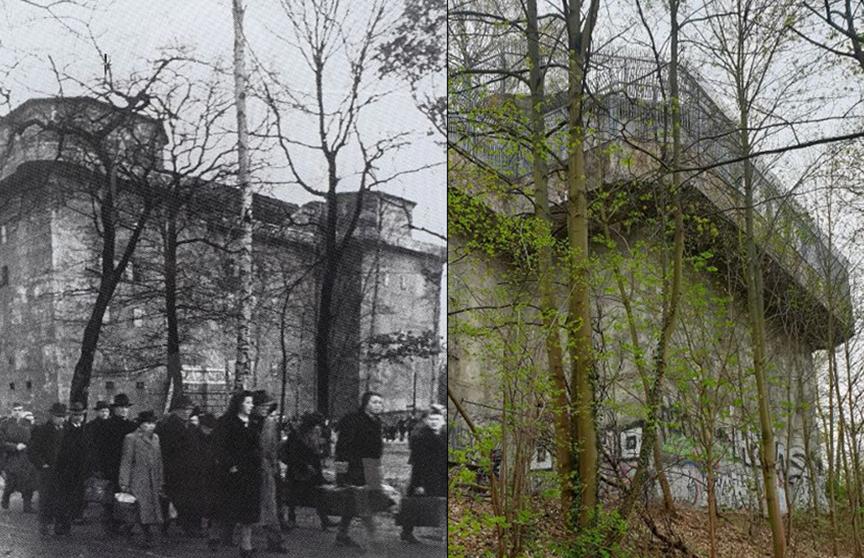 Berlin flak towers 1945 & 2026
Public Domain & Courtesy of David Nunn
Berlin flak towers 1945 & 2026
Public Domain & Courtesy of David Nunn