


John Stanley
He was a tobacco sorter in 1921.
- Family History
- Military history
- Extra information
- Photographs
He was the son of Harry and Elizabeth Stanley and brother of Annie and Hilda Stanley. In 1921, they lived at 14, Upper Eldon Street, Sneinton, Nottingham. John Stanley and Elsie Raynor were married at Nottingham in 1922 and they were to have three sons - John, Dennis and Maurice.
NOTTINGHAM SOUTHERN CEMETERY Sec. H.33. Grave 55.
He died at Newark Hospital from injuries sustained the previous evening when his motorcycle collided with an Army lorry on the Fosse Road near Newark while returning to his unit from leave. A subsequent inquest returned a verdict of accidental death.
In October 1940, 368th Searchlight Battery, 42nd (The Robin Hoods, Sherwood Foresters) Searchlight Regiment, Royal Artillery was actively deployed on Home Defence duties in the East Midlands at the height of The Blitz.
Key details of the unit's structure and role during that month include:
Originally the 7th (Robin Hoods) Battalion, Sherwood Foresters, the unit had been converted to anti-aircraft searchlights in 1936 (with the 368th originally raised as a Territorial company at Bulwell, Nottingham). Just two months prior, in August 1940, the entire regiment was officially transferred from the Royal Engineers into the Royal Artillery.
In October 1940, the 42nd Searchlight Regiment was part of 50th Light Anti-Aircraft Brigade under 2nd Anti-Aircraft Division, headquartered at Derby. Its batteries manned dispersed searchlight sites across Derbyshire and Nottinghamshire to protect vital industrial centers and airfields.
With the Luftwaffe shifting to night bombing raids across Britain in autumn 1940, 368 Battery's crews operated carbon-arc searchlights and sound-locators to detect, illuminate, and track enemy bombers for RAF night fighters and local anti-aircraft guns.
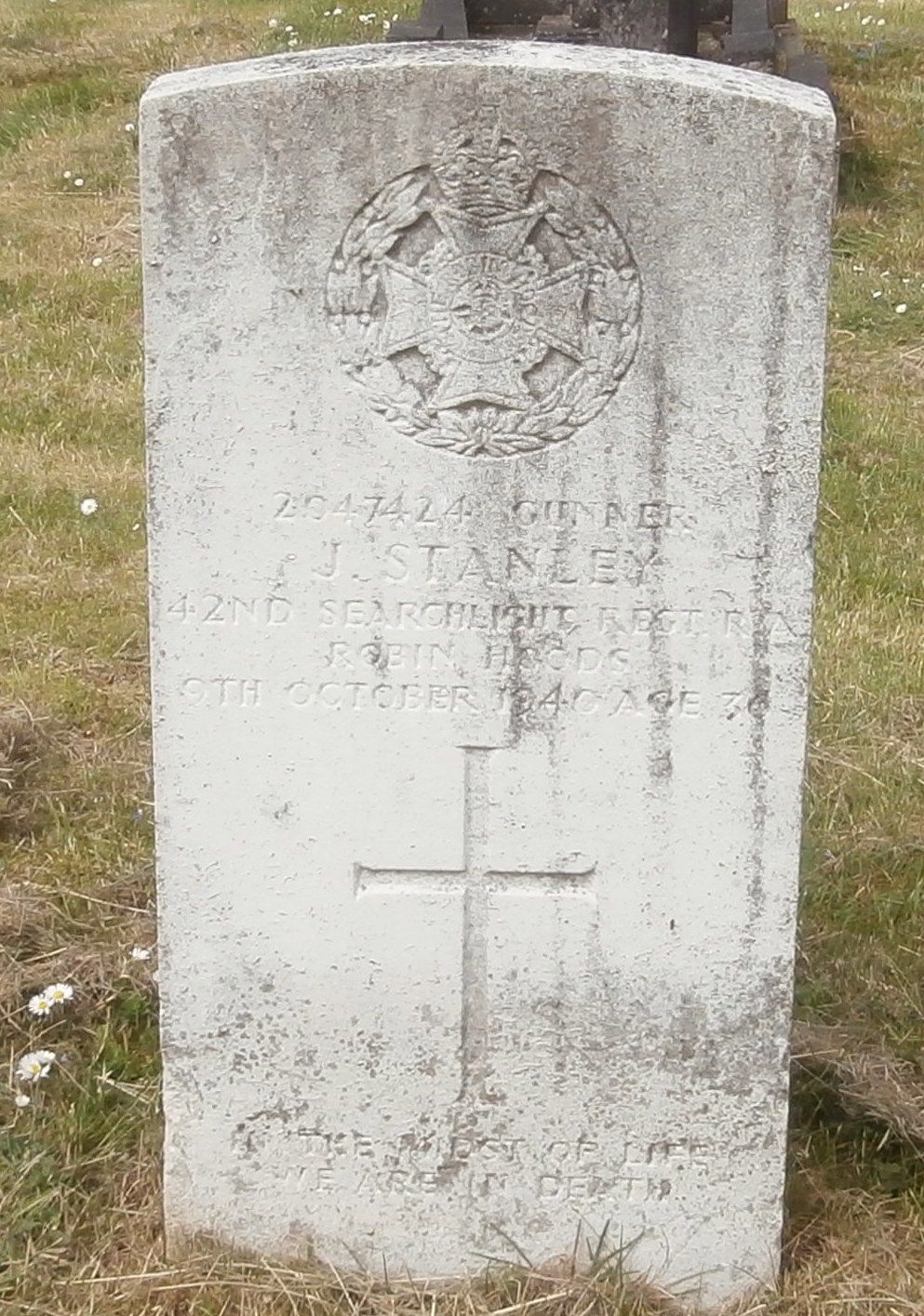 CWGC headstone at Nottingham Southern Cemetery (Wilford Hill)
Photo: David Nunn