

Charles Edward Johnson
After leaving school, he trained as a tailor and was employed by Hector Powe in the Nottingham area. In 1939, he was still a tailor (traveller).
- Family History
- Military history
- Extra information
- Photographs
He was the son of Charles Henry (1868-1930), a ladies tailor and Helen (1883-1966) Johnson and the brother of Helen Alice, Blanche Edith and Louis George Johnson. In 1921, they lived at 46, Greenwood Road, St John at Hackney, London.
Charles Edward Johnson and Doris Ena May Hawes were married on 14th July at Hendon in 1929 and their daughter Joyce was born in 1931. In 1939, they lived at 33, Stamford Road, West Bridgford, Nottingham.
Charles Johnson's brother Louis survived three tours with Bomber Command ending the war a Squadron Leader.
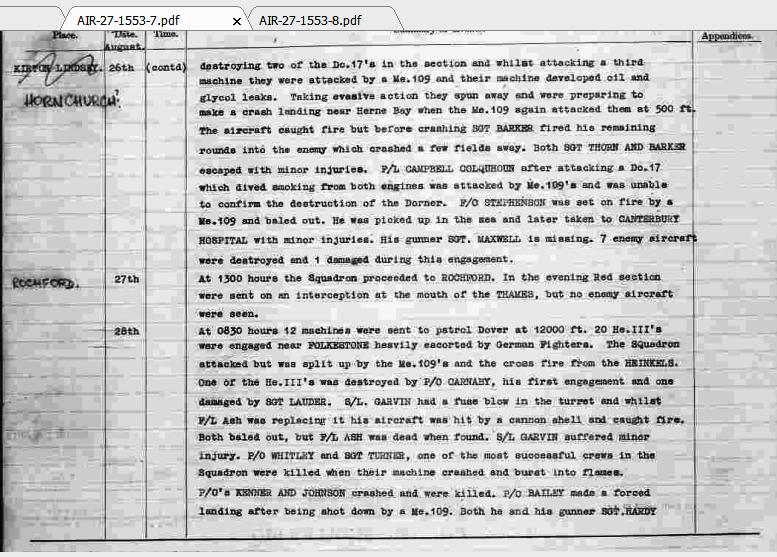
Johnson joined 264 Squadron as a Defiant gunner at Kirton-in-Lindsey in mid-August 1940. Johnson was in Defiant L7026 on his first operational sortie when it was shot down by Me 109s of JG26 over Thanet on 28th August. The aircraft crashed in flames on Sillibourne Farm, Hinxhill, east of Ashford. Both Johnson and the pilot, P/O P L Kenner, who had also attended Brentwood School, were killed.
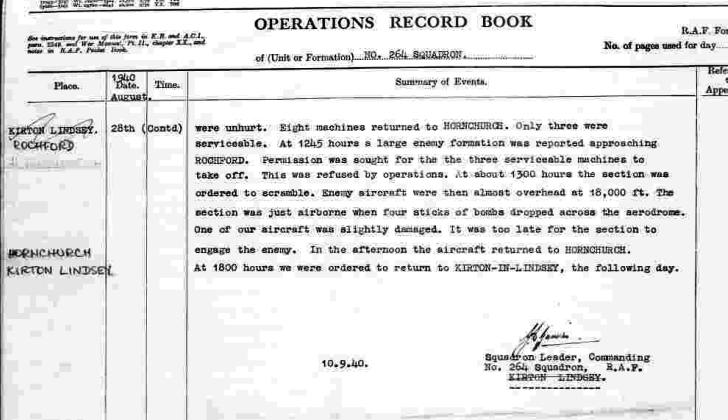
The intensity of airborne combat and the pressures under which Fighter Command was operating during this third stage of the Battle of Britain is evident from 264 Sqdn's ORB covering the final days of August 1940 (TNA Air 27/1553/7 (See photos).
The Luftwaffe was mounting huge daylight attacks against RAF airfields and installations in South East England with the object of exhausting the RAF's abilty to provide defence. 264 Squadron was involved in a series of desperate engagements between 25th and 28th August 1940, often numerically outnumbered, to reist these incursions. Their efforts, it seems, were hampered by the battle-unfitness of machines being delivered to replace losses (See photo 3).
Squadron Leader Garvin's account of combat above Kent during those desperate days (photos 4 & 5) resonate with self sacrifice, courage, skill and loss when confronted sometimes by as many as 50 faster, more manouverable Me 109s.
August 28th 1940
On August 28th 1940, the day C E Johnson and his pilot P L Kenner were killed, Fighter Command lost 16 aircraft - 7 Spitfires, 6 Hurricanes and 3 Defiants - from 8 squadrons - 54, 56, 151, 249, 264, 603, 610 & 615. At least 9 airmen were killed (4 from 2 seater Defiants). At least 6 were wounded and only 3 definitely safe although the identity and fate of Hurricane N2523's pilot from 249 Sqdn remain unknown.
Source: Norman L Franks, Royal Air Force Fighter Command Losses of the Second World War Vol 1 (Midland Publishing Ltd: 1997) p.66
The Defiant
The Defiant was designed and built by Boulton Paul Aircraft as a "turret fighter" to meet the RAF requirement for day and night fighters that could concentrate their firepower on enemy bombers which were not expected to have fighter escorts due to the distance from Germany to the United Kingdom. The Defiant had all its armament in a dorsal turret offering the ability to fire in most directions.
In combat, the Defiant was found to be effective at destroying unescorted bombers, but was vulnerable to the Luftwaffe's more manoeuvrable, single-seat Messerschmitt Bf 109 fighters operating from bases in Northern France, allowing them to escort bombers to London. The Defiant had been designed only to destroy unescorted bombers by means of beam or ventral attacks, and had no forward-firing armament; it proved to be very vulnerable to frontal attacks by fighters in daylight combat. (Wikipedia)
Heinkel 113
264 Sqdn's ORB regularly refers to attacks from He 113s. In fact the Heinkel 113 was a fictitious fighter aircraft, invented as a propaganda and possibly disinformation exercise. In 1940, Nazi Minister of Propaganda Joseph Goebbels publicised the fact that a new fighter was entering service with the Luftwaffe. The plan involved taking pictures of Heinkel He 100 D-1s at different air bases around Germany, each time sporting a new paint job for various fictional fighter groups. The pictures were then published in the press with the He 113 name, sometimes billed as night fighters (despite lacking even a landing light). (Wikipedia)
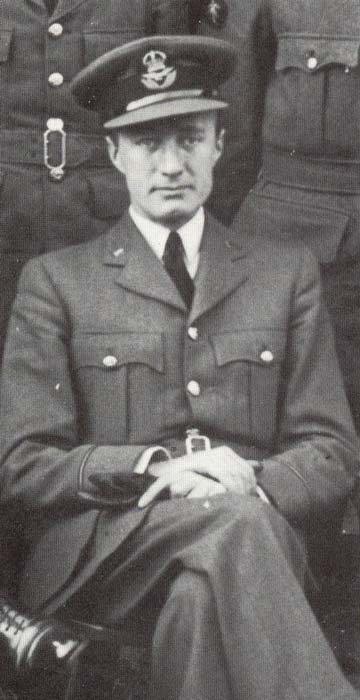 Charles Edward Johnson
Photo: Courtesy of the Battle of Britain Monument (on line)
Charles Edward Johnson
Photo: Courtesy of the Battle of Britain Monument (on line)
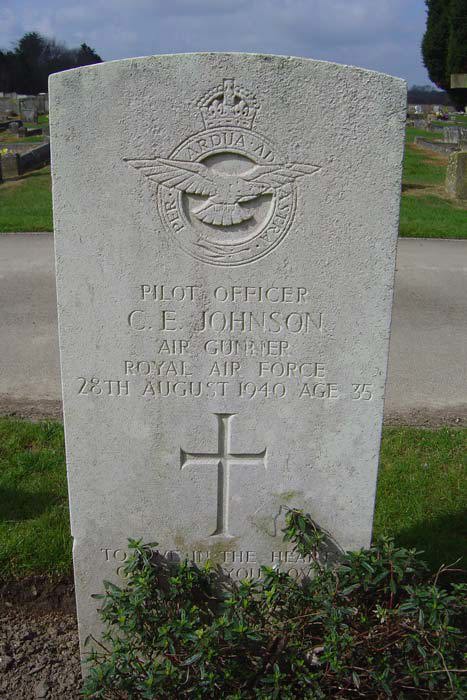 Charles Edward Johnson's CWGC headstone in Hawkinge Cemetery near Folkstone.
Photo: Courtesy of the Battle of Britain Monument (on line)
Charles Edward Johnson's CWGC headstone in Hawkinge Cemetery near Folkstone.
Photo: Courtesy of the Battle of Britain Monument (on line)
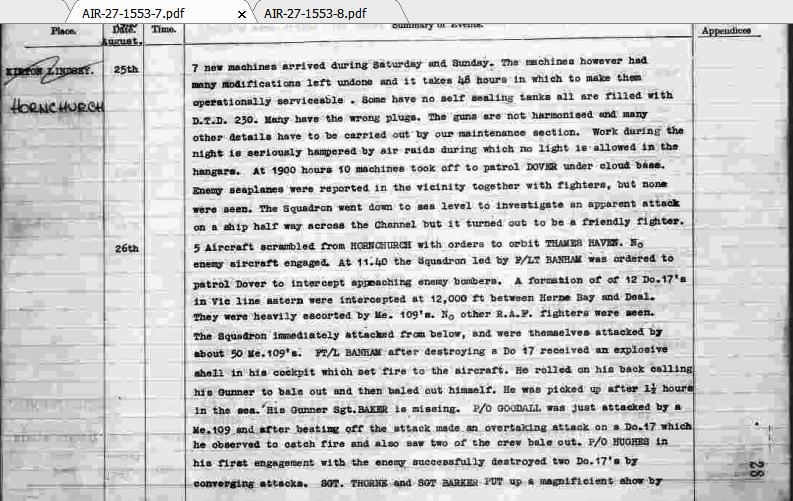 Photos: 264 Sqdn ORB August 1940, Record of Events
TNA Air 27 1553/7
Photos: 264 Sqdn ORB August 1940, Record of Events
TNA Air 27 1553/7
 See previous photo
 See previous photos