

Morton Brown Paton
Educated at the Nottingham High School and Balliol College Oxford.
Joined the firm of Messrs. A. V. Paton and Co., of Liverpool, cotton merchants.
- Family History
- Military history
- Extra information
- Photographs
Morton Brown was the youngest son of the Reverend Dr. John Brown Paton and his wife Jessie (née Paton).
Both his parents were born in Galston, Ayrshire and were married on 14 September 1859 at Anderston, Glasgow, although Dr Paton was living in Sheffield. (Sheffield Daily News & Morning Advertiser, 19 September).
The couple had seven children: Caroline Mary b. 1860, Alfred Vaughan b. 1861 (reg. 1862 JFM) and John Lewes Alexander b. 1863 who were born in Sheffield, and Mary Frances Augusta b. 1865, William Paton b. 1867, Jessie Muriel b. 1869 and Morton Brown b. 1871 who were born in Nottingham
The family had moved from Sheffield to Nottingham by 1865 when the fourth child, Mary, was born and in 1871 were living on Forest Road West at the Congregational Institute. The Patons employed a governess, nursemaid, cook and housemaid. The youngest of the seven children, Morton, was born later that year.
Only four of the seven children were in the home on the night of the 1881 Census: Caroline, Alfred, who was an Oxford University undergraduate, Jessie and Morton. John was probably a pupil at Shrewsbury school (left 1882, then at St John's College, Cambridge). Also in the household were a cook, housemaid and nurse. At the time of the census the following decade only Caroline, Morton, an undergraduate (Oxford University), and their mother together with three domestic servants were in the family home on the night of the census. Alfred, a cotton broker, was living in West Derby, Lancashire, as a boarder.
The eldest daughter, Caroline, married Thomas Phillips Figgis, an architect, in 1891 (reg. JAS Nottingham, and in 1901 they were living in Camden Square, Kensington, with their sons Lenox and Gordon. Lenox was killed in the Great War (see 'Extra information').
The third son, William, died on 1 August 1894, in a boating accident on the Mawddach Estuary, Barmouth, Wales, in which ten people, including William, in two boating parties drowned when their boats capsized when the weather became rough. (Nottingham Evening Post, 2, 3 and 4 August). William's parents donated £1,000 toward the cost of a new wing to the Children's Convalescent Home, West Kirby, Cheshire, in memory of their son. (Nottingham Evening Post, 17 August 1894).
William's parents were recorded at Sea View Villa, Crowborough, Sussex, in 1901; presumably on holiday. Morton, a cotton salesman, was one of two boarders living on Jermyn Street, Toxteth Park, Lancashire, in 1901. His brother Alfred, a cotton, merchant, was living in Hoylake cum West Kirby, Cheshire and was at the same address in 1911; he employed a housekeeper and housemaid.
The youngest daughter, Jessie, died on 28 May 1909, aged 39, and was buried in Nottingham General Cemetery.
Her mother died the following year on Christmas Day and her father on 26 January 1911; both were buried in Nottingham General Cemetery.
John may have spent a period as a teacher in Canada as there is a record of his name on the Teachers’ Registration Council Registers 1914-1948, St John Newfoundland. Reg. 1914 residence St John Newfoundland. A notice of his death in 1946 included the information that from 1925-1933 he had been president of the Memorial University College, St. John’s, Newfoundland.
However, John and his sister Mary were recorded in the same household in Chorley, Lancashire, in 1921. Their brother, Alfred, was also living in Chorley in 1921 and their sister Caroline and her husband were living in Kent.
Caroline Figgis died in Kent on 6 June 1928. Alfred Vaughan, who had been knighted in January 1920 and lived in West Kirby, Cheshire, died on 24 September 1930. (See 'Extra information')
In 1939 when the England & Wales Register was compiled, the two surviving siblings, Mary, of 'private means', and John, a retired teacher, together with domestic servants, including a housekeeper, were living on Chalk Way, Pilgrims Way, Kemsing, Kent. Mary died in Kemsing on 26 October 1944 and John on 28 April 1946 in Beckenham, Kent.
Morton Brown Paton was a member of the University Volunteers while at Balliol College, Oxford.
He enlisted as a special constable on the outbreak of war but then in November 1914 was awarded a commission with South Lancashire Regiment (Prince of Wales's Volunteers), and promoted captain in April 1915. In the May the Regiment joined the BEF Mediterranean and Paton was attached to the 6th Bn. Lancashire Fusiliers (CWGC). He was killed in action on 7 August 1915.
He has no known grave and is commemorated on the Helles Memorial, Turkey inc. Gallipoli, (Panel 140 and 141).
Photograph with caption: 'Captain MB Paton. 10th South Lancs. Regt. (attd, 5th Lancs. Fusiliers). Aged 44. Son of the late Rev.Dr. JB Paton.'
Nottingham General Cemetery, family grave and headstone, inscription: 'John Brown Paton MA DD founder & for 35 years principal of the Congregational Institute in this city Dec (-) 1830-Jan 26, 1911. Jessie Paton his wife Aug. 2. 1831-Christmas Day 1910. William Paton Paton June 15. 1867-Aug. 1. 1909. Morton Brown Paton Captain 10th South Lancs. Reg. Attd. 5th Lancs. Fusiliers killed in action at the Dardanelles 7th Aug. 1915, aged 44. Lenox Paton Figgis MC. Captain 'The Buffs' Fell in action near Maricourt Aug. 27. 1918 aged 25 Grandson of Dr. and Mrs Paton. 'For they shall see God'. [Matthew 5:8, KJV]
LENOX PATON FIGGIS. Cousin of Morton Brown Paton.
CWGC 541794. Lenox Paton Figgis. The Buffs (East Kent Rgt) 6th Bn, 27 August 1918 age 25, Meaulte Military Cemetery, France (grave ref. F. 25)
CWGC Additional information: Son of Thomas Phillips Figgis and Caroline Mary Figgis [née Paton], of Campden Hill, Kensington, London; husband of Ethel Lizzie Winning Cleland Figgis, of School House, Rowallan, Kilmarnoc
CWGC headstone personal inscription: ‘Faithful unto death herein is love made perfect’
(1 John 4:17-19. KJV)
Commemorated on Wye South Eastern Agricultural College War Memorial. From website, 'He was killed in action somewhere near to Bernafay Wood on the Somme.' ref. Buffs Regimental History (p. 366), Moody.
CWGC Morton Brown Paton. Additional information: Son of the Rev. Dr. John Brown Paton and Mrs. Jessie Paton, of Nottingham. Cotton merchant of Liverpool. Formerly of Balliol College, Oxford.
Nottingham Evening Post, 27 December 1910: ‘The sympathy of a very wide circle of friends will be extended to the Rev. Dr. Paton in the loss of his wife, who died on Christmas Day at their residence, Forest-road West.’ (www.britishnewspaperarchive.co.uk} Nottingham Evening Post, 28 December 1910: report of the funeral of Mrs Paton with a family devotional service at her residence, commital prayer at the graveside in Nottingham General Cemetery, and the names of the principal mourners at the cemetery. (www.britishnewspaperarchive.co.uk)
Nottingam Evening Post, 31 March 1911: ‘Dr Paton’s Will. Bequests to Servants. Dr John Brown Eaton DD, of 22, Forest-road, Nottingham, from 1863-1898 principal of the Congregational College a Nottingham, founder of the National Home Reading Unon, the Recreative Evening Schools’ Association, the Social Institutes’ Union, and the England Land Colonisation Society (now the Co-operative Small Holders’ Association), and one of the founders of the University Extension movement, chairman of the Christian Union for Social Service, and a vice president of the British and Foreign Bible Society, from 1882-8 associate editor of the ‘Contemporary Review’, and the author of numerous pamphlets, who died on the 26th January last, aged 80 years, son of Mr Alexander Paton, and grandson of Mr Andrew Brown, of Newmilns, Ayrshire, left estate …’ The report named his surviving children who all received legacies: Alfred Vaughton Paton, cotton merchant, of West Kirby, Cheshire; John Lewis Alexander, high master of the Manchester Grammar school, of Arncliffe, Broughton Park, Manchester; Morton Brown, cotton merchant, of Old Hall, Bidston, Notts.; John Lewis Alexander; Caroline Mary (Figgis) and Mary Frances Augusta (Paton), and also his servants, including Anna Kupfer (b. Switzerland) who had been recorded as an employee (nurse) on the census of 1881 and 1891, who received modest legacies. (www.britishnewspaperarchive.co.uk)
Nottingham Evening Post, 14 August 1915:
'Death of Captain Paton. Old Nottingham High School Boy.
'Captain Morton B. Paton, 10th Battalion South Lancashire Regiment (attached to the 5th Battalion Lancashire Fusiliers), was killed in action in Gallipoli on August 7th. He was the youngest son of the late Rev. Dr. J. B. Paton, of Nottingham, and brother of Mr. J. L. Paton, High Master of the Manchester Grammar School. He was a member of the firm of Messrs. A. V. Paton and Co., cotton merchants, of Liverpool, and lived at Bidston.
'His leisure and energy were freely given to work among boys and young men, among whom he had a strong influence. These activities included the National Home Reading Union, which his father was one of the founders. Educated at the Nottingham High School and Balliol College, Captain Paton while at Oxford was a member of the University Volunteers. 'Last November he received a commission in the 10th (Service) Battalion South Lancashire Regiment, and trained with them at Crosby and Heswall. He was promoted captain in April.
'He was sent out to the Mediterranean in the spring, and was at first attached to the 6th Lancashire Fusiliers after their heavy loss in officers, but later he was transferred to the 5th Battalion, with which it is believed he was serving when he met his death. He was 44 years of age.'
Above courtesy Jim Grundy facebook pages Small Town Great War Hucknall 1914-1918.
Nottingham Guardian, 16 August 1915: reference to the death of Morton Brown Paton who was the brother of J L Paton, High Master of Manchester Grammar School.
Nottingham Daily Express, 16 August 1915: reference was made to Paton’s death by the Reverend Mann preaching at Park Hill Congregational Church. 'He was a fine scholar, a successful businessman, a brave soldier of Christ as well as England’s King and a thorough Christian gentleman. Nothing but a keen sense of duty could have induced such a man as Captain Paton to take up arms on behalf of his country. By falling at his post in far distant Gallipoli, he has enriched the moral forces of the nation.'
Nottingham Daily Express, 18 August 1915: additional report describing Paton as particularly fond of children, 'A man who diffused sunshine wherever he went ... It may be said of him that he not only died for his country, but greatly helped to make it worth dying for.' (www.britishnewspaperarchive.co.uk)
Nottingham Daily Express 23 August 1915: further information,
'M B Paton was the youngest son of the family. Educated at Nottingham High School and Balliol College, Oxford, he was in business in Liverpool, partner in the firm of A V Paton and Co, Cotton Merchants. Sir Alfred Vaughan Paton was his uncle and, I believe, an Old Nottinghamian. A memorial service had been held at Birkenhead.
'He was Nottingham born and bred, educated under Dr Gow and won a Carey Scholarship to Balliol. He entered the cotton business with his uncle, visited the USA on business several times and resided at Bidston, near Birkenhead.
'He did a lot of good work for the village, especially children. He formed a boys’ cricket club and organised Empire Day celebrations. He was the President of the junior YMCA in Birkenhead, Vice President of the Albert Memorial Industrial School, taking great interest in camps held on the Wirral sea coast each year. He was a respected member of the Cotton Association, Secretary of National Home Reading Union which had been founded by his father. He was a committee member of the WEA. A keen sportsman, he played tennis, badminton, golf and rowing.
'He originally enlisted as a special constable on the outbreak of war, but joined the South Lancashire Regiment in November 1914, being promoted to captain in April 1915. He was sent to Gallipoli where he was attached to the Lancashire Fusiliers in May, commanding 'A' Company of the 6th Battalion.
'A memorial service was held at St James’ with the address given by J C Neil, Paton’s Congregationalist pastor. The 'Dead March' from 'Saul' was played, as well as the National Anthem and the Last Post. His brother, J L Paton, gave a moving tribute.' (www.britishnewspaperarchive.co.uk)
Knights of the Realm & Commonwealth. Alfred Vaughan Paton KBE (Civil) awarded 1 January 1920. President Liverpool Cotton Association 1917-1918. For a biography of Alfred see: www.lakewirral.co.uk/wp-content/uploads/2022/02/Lake-NovDec. He donated significant tracts of land at Turstaston Hill to the National Trust and also to the local council and there is a memorial to him on Caldy Hill on land he donated for public use.
Nottingham Evening Post, 24 September 1930: ‘Noted Liverpool Man Dead. Sir Alfred Vaughan Paton KBE of West Kirby died to-day aged 69. He had rendered notable service to Liverpool, and was president of the Liverpool Cotton Association during the critical war years, 1917 and 1918.’ (www.britishnewspaperarchive.co.uk)
There is a portrait of Sir Alfred in the National Portrait Gallery (Walter Stoneman, artist)
Nottingham Evening Post, 29 April 1946: ‘A Great Headmaster. The death has occurred at Beckenham of Mr JL Paton, High Master of Manchester Grammar School from 1903 to 1924 and president of the Memorial University College, St. John’s, Newfoundland, 1925-33. He was one of the great headmasters of his time. Born on August 13th, 1863, John Lewis Alexander Paton was the son of the late Dr JB Paton of Nottingham, a Congregationalist minister.’ (www.britishnewspaperarchive.co.uk)
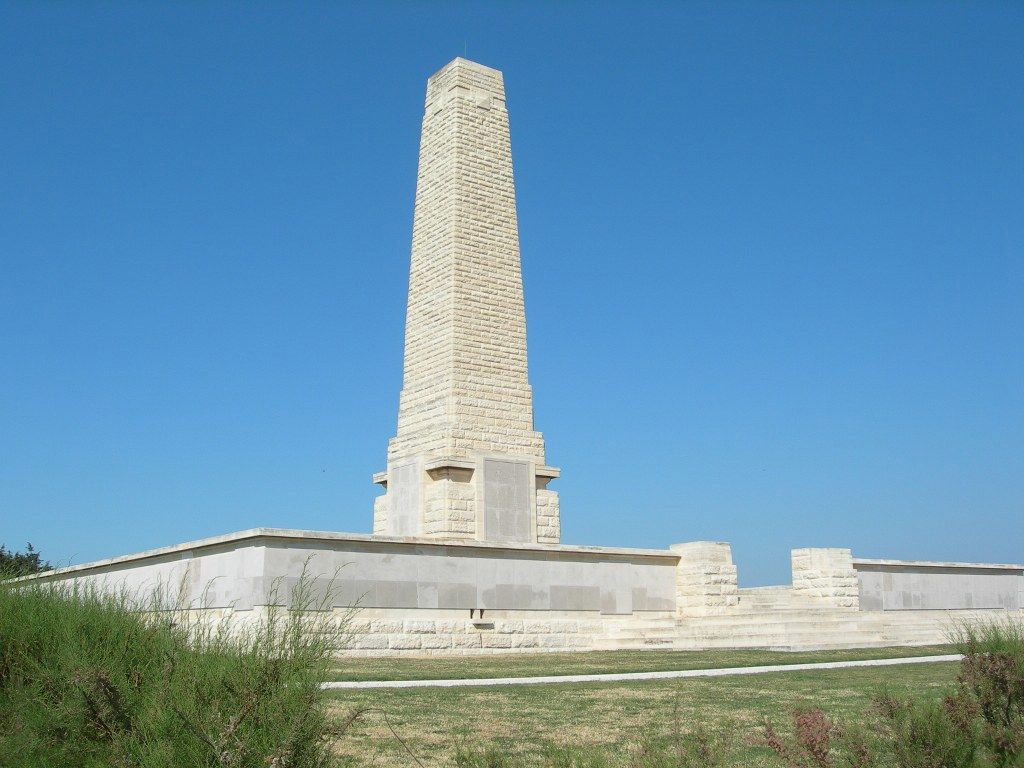 Photo of Morton Brown Paton
Commemorated on the Helles Memorial (www.cwgc.org)
Photo of Morton Brown Paton
Commemorated on the Helles Memorial (www.cwgc.org)
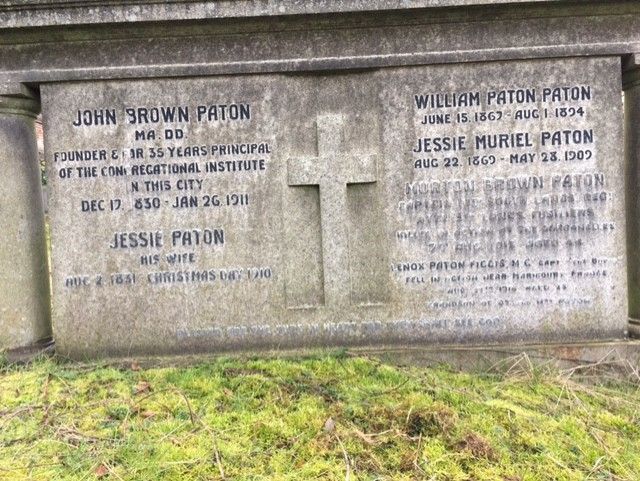 Photo of Morton Brown Paton
Nottingham General Cemetery, Paton family grave and headstone. Photograph Rachel Farrand (Feb. 2026)
Photo of Morton Brown Paton
Nottingham General Cemetery, Paton family grave and headstone. Photograph Rachel Farrand (Feb. 2026)
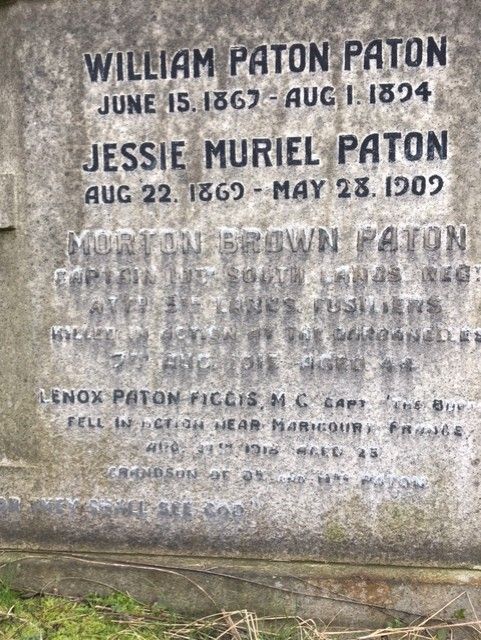 Photo of Morton Brown Paton
Nottingham General Cemetery, Paton family grave and headstone. Photograph Rachel Farrand (Feb. 2026)
Photo of Morton Brown Paton
Nottingham General Cemetery, Paton family grave and headstone. Photograph Rachel Farrand (Feb. 2026)
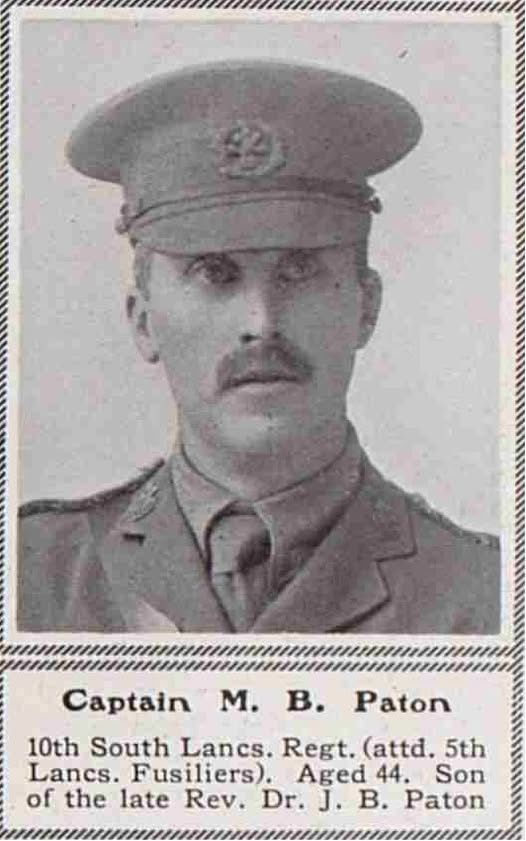 Photo of Morton Brown Paton
Photograph courtesy of the Gallipoli 1915 Facebook group
Photo of Morton Brown Paton
Photograph courtesy of the Gallipoli 1915 Facebook group