

During World War II, Allied prisoners of war (POWs) and forced labourers coined the term 'hell ships' for the Japanese merchant vessels used to transport them to labour camps. Approximately 126,000 Allied POWs endured these floating dungeons, which were infamous for extreme overcrowding, rampant disease, deliberate starvation, and brutal violence.
Before embarkation, one group, many of whom had already endured the horrors of the Railway of Death, was told 'all men should be honoured to know they are going to a land of peace and tranquility, where even the birds can nestle on the hunter's hand and will not be harmed... A land of milk and honey. In Japan it is a sin to to eat and not to work so to prevent all men from becoming sinners, we shall put you to work.' (Return from the River Kwai, p.p. 20-21)
Many, however, were destined never to reach this promised paradise. Freighters designed for 100 to 150 passengers were packed with thousands of men. POWs were jammed into stifling, unventitilated holds with no room to sit or lie down. Captives were routinely denied adequate water, sanitation, and fresh air. Many men died of dehydration, heat exhaustion, and rampant dysentery.
Because the Japanese military refused to mark these vessels as POW carriers, Allied submarines and aircraft frequently attacked them. An estimated 21,000 Allied prisoners died aboard 26 'hell ships', with the majority perishing from these 'friendly fire' sinkings or being abandoned or murdered in the water by Japanese forces afterwards.
So far, it has been possible to identify 43 Nottinghamshire men who perished on 5 of these vessels.
Lisbon Maru was transporting POWs between Hong Kong and Japan when it was torpedoed by the submarine USS Grouper on October 1st 1942. Over 800 British prisoners died in the sinking either by drowning or being shot by Japanese soldiers as they attempted to escape [5].
384 POWs were rescued by nearby Chinese fishermen. Their relief, however, was short lived. According to Gregory F Mincho, 'they were fed and cared for by the Chinese until Japanese destroyers came during the next few days to collect them all... (Guards were ordered) to beat those who could no longer stand to attention. Even so, three were hidden by a villager who arranged their escape to Chungking.' (Hellships p.47)
Suez Maru, sunk by the submarine USS Bonefish on November 29th 1943, was carrying 548 allied POWs. Many drowned but many others were shot by the Japanese [7]. Bonefish stalked Suez Maru overnight before firing a number of torpedoes which caused instant flooding, chaos and orders to abandon ship. Their captors were merciless towards struggling men in the sea.
Japanese Minesweeper 12 concluded its report of the sinking with "the prisoners had attempted to escape (ryuushutsu) and had been disposed of (shobun)". Back to the east of them in the Java Sea, there was nothing left but scattered debris and an oil slick. Not one of the 548 captives survived.' (Hellships p.p. 135-139)
On September 4th 1944, the Rakuyo Maru carrying 1,317 POWs and the Kachidoki Maru with 900 prisoners on board sailed from Singapore. Apparently unaware these vessels carried POWs, American submarines attacked the convoy on September 12th. Rakuyo Maru was torpedoed by the USS Sealion. 1,005 prisoners were lost [14] and only 259 survived.
There were soon 'about twelve haundred British and Australian POWs in the water. Hundreds of men were abandoned to die as Rakuyo Maru rapidly sank in a mile deep sea... they were warned from a nearby ship rescuing guards 'that they must not come near the ship or they would be shot...'
Then in one last act of vitriolic meanness the frigates tore back through the centre of the floating survivors, chopping up some in their propellers and drowning others.' (Hellships p.p.205-207). 73 prisoners from Rakuyo Maru were picked up several days later by USS Pampanito. (Hellships p.p.211-219)
A few British and Australian prisoners from the Rakuyo Maru sought revenge, as the ship went down, showing no mercy to their former captors: survivor accounts frankly document Japanese guards being bludgeoned to death or held under water and drowned. The following example of savage retribution is particularly gruesome. A lifeboat crowded with prisoners and one guard, was approached by a rescue frigate.
Realising only Japanese were being saved, prisoners ‘held his mouth shut so he couldn’t call out and sat on him (to make him invisible)’... As the frigate sailed off, POWs murdered the guard with their fists. ‘He was bleeding heavily. Some of the men were already dying of thirst. They drank his blood. It was horrible.’ (Recalled by former British coal miner Wilfred (Barney) Barnett in Return from the River Kwai, p. 165)
Kachidoki Maur was sunk by the USS Pampanito. 244 POWs died [10], whilst 656 survived. 'The POWs who survived the sinking now had to face the sea,' observed Michno. 'The few lifeboats the POWs had been able to secure were dangerously overcrowded. One contained 60 people with another seventy five hanging on the sides. Men that swam up had to be kicked and punched away, left to drown...
As the sun grew hotter, the suffering increased. Heads and faces were burned. Lips cracked and swelled. They became ravenous and exhausted from hanging on to their pitiful bits of flotsam... Some were eventually rescued by fishing craft and Japanese naval vessels on board which more beatings were handed out to the allied prisoners.'
Having been atacked by Liberator bombers and submarines, Hofuko (Toyofuko) Maru was confined for a month to Manila Bay by Japanese officials terrified of the infectious diseases many of the POWs on board undoubtedly carried.
There were instances of cholera and a virulent form of dysentery. Other men suffered from beriberi, edema, scurvy, optic nerve degeneration, pulmonary congestion, enlarged hearts and vocal chord paralysis. Many were removed to the care of Dr Paul Ashton's Communicable Diseases section of a local prison.
Eventually allowed to proceed, as part of convoy MATA-27 on September 21st 1944, Hofuko Maru was hit 'at 10.35 (when) forty planes singled out the ten-knot twenty six year old (ship) and blasted it to pieces.' The rest of the convoy shared a similar fate. On Hofku Maru, 1,000 prisoners died [7] and 200 survived.
'Hell Month (September 1944) was over', noted Gregory F Michno. 'More than 9,300 prisoners and labourers had been killed at sea - all but 400 by "friendly fire"'. (Hellships p.p. 242-244)
[N] - Nottinghamshire totals per sinking
This section makes extensive use of two texts: Gregory F Minchno, Death in the Hellships, Prisoners at sea in the Pacific War (Annapolis, Maryland, UK Pen & Sword:2001). This is an emplary piece of scholarship, comprehensively researched and fluently written. Rooted in primary sources, his narrative remains restrained despite the grim events under review.
NB: Gregory F Michno's father was serving aboard USS Pampanito during the events covered by his book and this section of the Roll of Honour.
Joan and Clay Blair, Return from the River Kwai, From Hell on Earth to Hell at Sea - The greatest untold story of World War Two (Great Britain, Raven Books in association with Macdonald and Jane's publishers: 1979, this ed. London, Futura Pubslications Ltd: 1980). The Blairs' narrative is rooted in extensive taped interviews with survivors and their families carried out during 1977 and 1978.
- Names on this memorial
- Location
- Photographs
- WS Arter
- W Barker
- H Burke
- GH Burton
- JJ Bush
- RD Butler
- AH Casellette
- W Clarke
- L Cook
- W Daft
- CV Dooley
- H Goodall
- RJ Green
- IV Grice
- W Hancock
- H Hayes
- SE Healey
- TE Holmes
- FTE Howell
- ER Hunt
- JH Lane
- H Love
- A MacAskill
- H Milner
- TP Mulroy
- JK Newstead
- W Parsons
- J Peel
- VD Perry
- FC Pollington
- PF Pope
- H Pressley
- KD Samuels
- JE Sanderson
- L Scudder
- H Smith
- LR Stanley
- P Thompson
- PR Thompson
- F Thorley
- JB Tomlinson
- FE Tyler
- A Woolwright
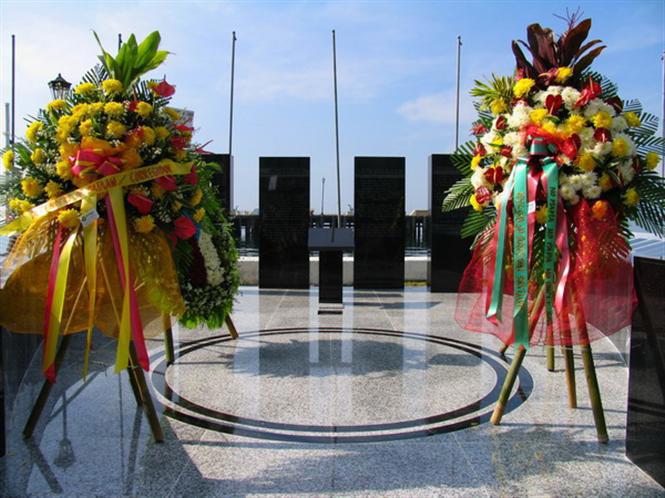 This memorial is principally the work of two retired American naval officers Gerald Anderson and Robert Chester. It is located on the Subic Bay Freeport (SBF), which forms part of Luzon Sea on the west coast of the island of Luzon in Zambales, Philippines.
Courtesy of the Australian Government Department of Veterans' Affairs.
This memorial is principally the work of two retired American naval officers Gerald Anderson and Robert Chester. It is located on the Subic Bay Freeport (SBF), which forms part of Luzon Sea on the west coast of the island of Luzon in Zambales, Philippines.
Courtesy of the Australian Government Department of Veterans' Affairs.
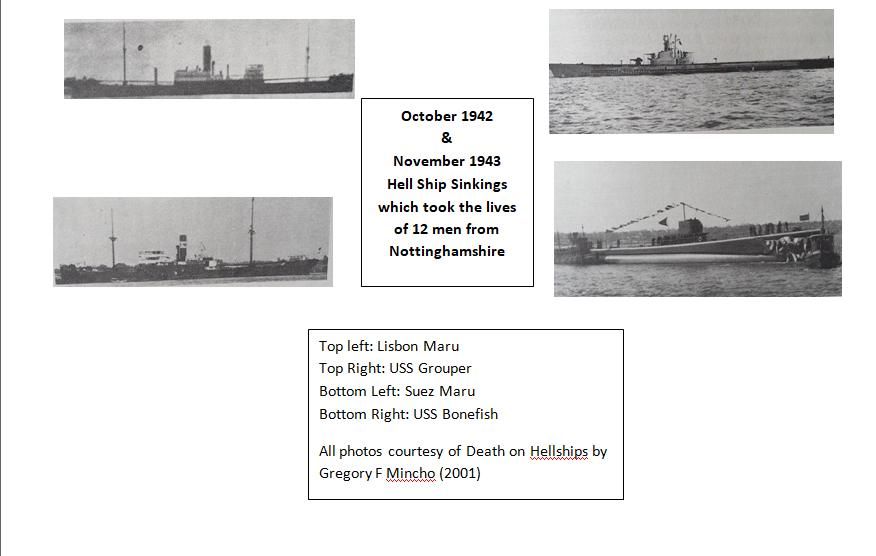 Photo of Nottinghamshire Deaths on Hell Ships - Virtual Memorial - World War Two
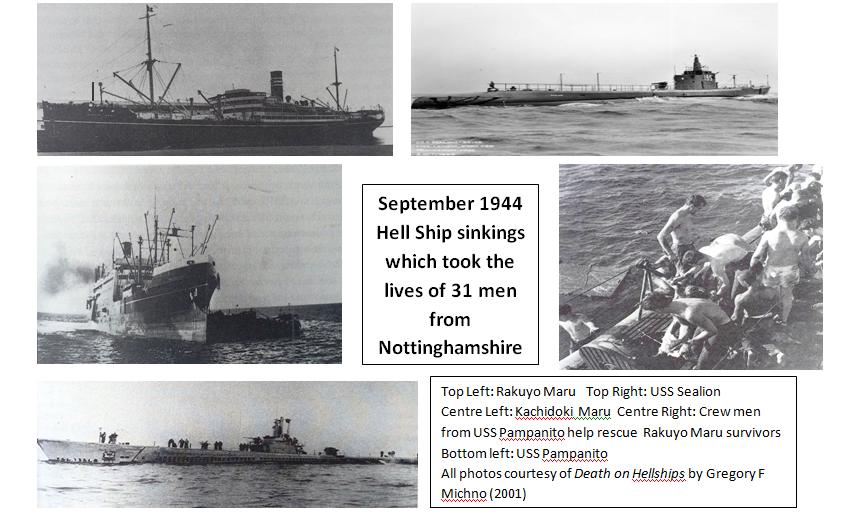 Photo of Nottinghamshire Deaths on Hell Ships - Virtual Memorial - World War Two
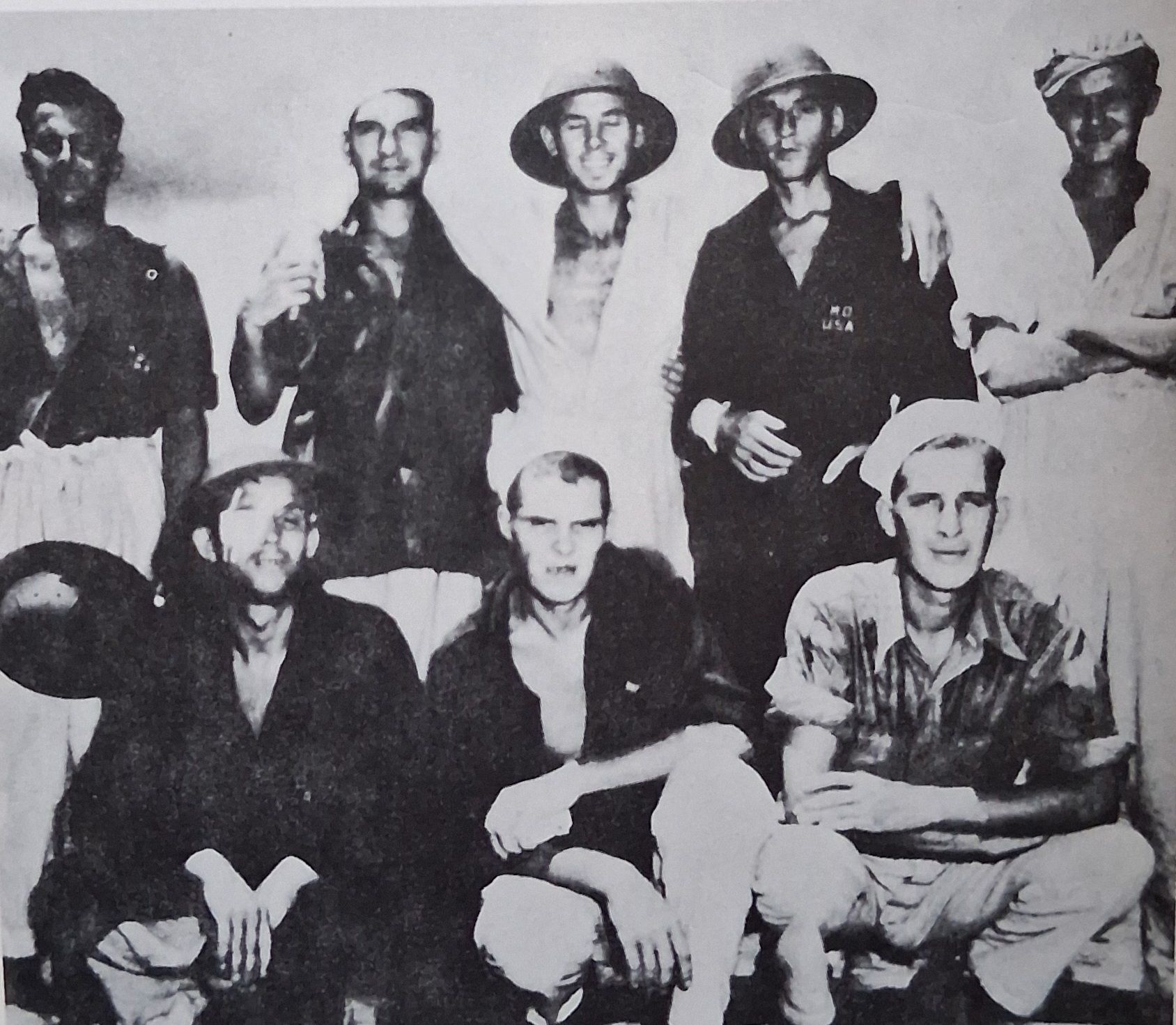 British survivors of Rakuyo Maru on Saipan Island after rescue.
Photo: Courtesy of Joan and Clay Blair, Return from the River Kwai
British survivors of Rakuyo Maru on Saipan Island after rescue.
Photo: Courtesy of Joan and Clay Blair, Return from the River Kwai