


Arthur Swaap
Arthur was an engineer (hydraulic press machinist at Humber Yard Beeston) following a six year apprenticeship.
- Family History
- Military history
- Extra information
- Photographs
Arthur Swaap born 1892 at Beeston was one of seven children born to Solomon Arthur Swaap a cycle dealer known as Arthur and Mary Ann (née Wilson) Swaap. Florrie, George, Harold, Evelyn and James were his surviving siblings
His father Solomon Arthur was born in 1864 at Leeds, his mother Mary Ann Wilson was born in 1867 at Loughborough, they were married on 25th May 1885 at St Matthias Church Sneinton, they went on to have 7 children, sadly 1 was to die in infancy or early childhood.
in 1911 when the family lived at 22 Alpine Close William Street Beeston Mary Ann Swaap 43 yrs married a lace hand, clipping and scalloping, she is living with her children, Arthur 15 yrs an engineer, Florrie 14 yrs a lace mender, George 12 yrs Harold 8 yrs Evelyn 6 yrs and James 2yrs of age.
He was the husband of Ethel Goodwin whom he married on 20th May 1916 at Beeston parish church and the father of Arthur Charles Swaap (b.19/7/1916) and William Robert born 26th September 1918,
Ethel married William H Poulton at Leicester in 1920 and they lived at 72 Regent Street Beeston.
He had previous service with the South Notts Hussars and when war broke out was one of the first to enlist. On 19th August 1914 he enlisted at Grantham aged 24 years and 58 days living at 2 Granville Street, Grantham. He was posted to the 6th Battalion Lincolnshire Regiment 6/9/1914 transferring to 11th Cyclist Corps 1/3/1915. He saw service on the home front from 19/8/1914 until 30/6/1915 when he joined the Mediterranean Expeditionary Force serving from 1st July until 27/8/1915 and then served on the Western Front between 11/12/1915 and 14/2/1916 when he was discharged suffering from tuberculosis. He was given a pension of 25 shillings a week initially for six months and then to be reviewed.
He died on 5th July 1918 and was buried on 9th July 1918 he is buried in Beeston Cemetery.
This page was researched by Peter Gillings.
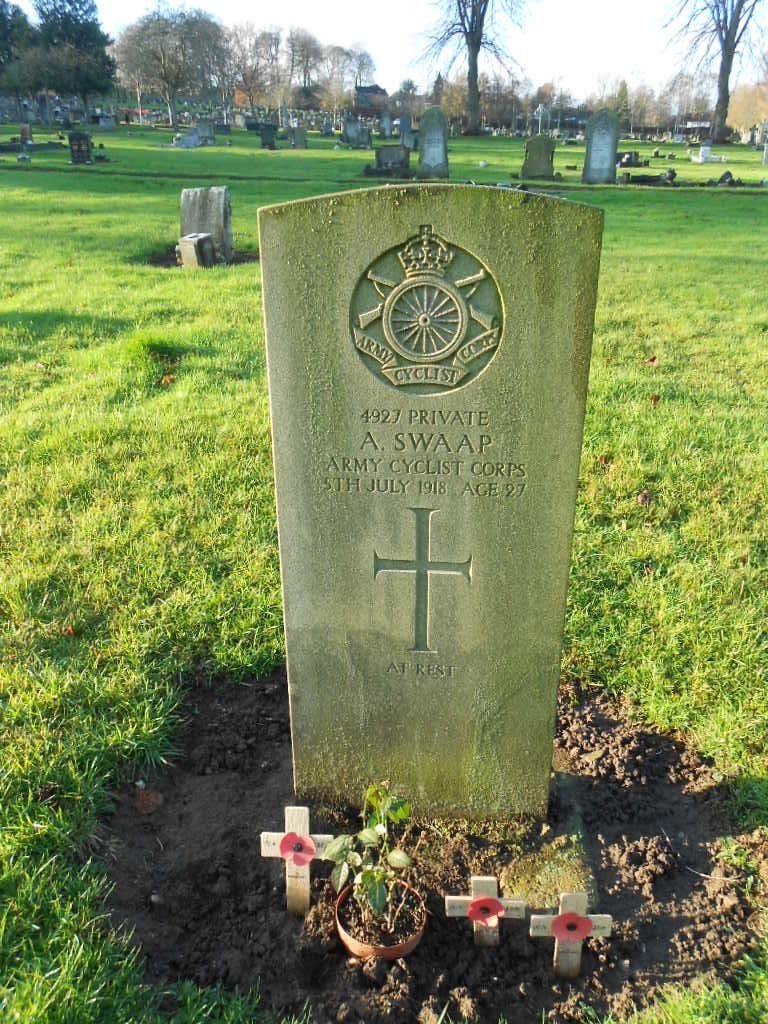 Photo Peter Gillings
Arthur Swaap's headstone in Beeston Cemetery
Photo Peter Gillings
Arthur Swaap's headstone in Beeston Cemetery