


James Brown
He was a general labourer.
- Family History
- Military history
- Extra information
- Photographs
James Brown was born on 22nd November 1891 at St Ann's, Nottingham, he was baptised on 16th December 1896 at StAnn'sparish church,along with two of his siblings Susannah and Thomas, he was the son of the late James a shoe rivetter and of Susannah Brown néé Kingston and the brother of Harry, Susannah, Thomas, Lily and Walter Brown their address on the baptism register was71 Edwin Street, St Ann's
His father James was born in 1857 at Basford, he diedin 1908 he was aged 51 yrs , his mother Susannah Kingston was born in 1857 at Walthamstowe, Essex they were married on 27th June 1886 at St Mathias Church, Sneinton, Nottingham, they went on to have 6 children,
In 1901 they lived at 61 Brassey Street Old Radford Nottingham.
In the 1911 census the family are living at 57 Park Street, New Lenton, Nottingham, Susannah Brown 50 yrs a widow and charwoman is living with her children Harry 24 yrs a nusery gardener, Susannah 21 yrs a cigarette packer, Thomas 16 yrs a telephone worker, Lily 13 yrs a scholar and Walter 10 yrs a scholar.
In the same 1911 census we find that James Brown has left the family home, he has joined th Army iand is in barracks at Tregantle Fort, Torpoint, Cornwall he is 21 yrs and serving with the 2nd battalion Sherwood Foresters Regiment.
Private James Brown attested on 13th August 1908 at Derby claiming to be 18 years and 4 months old. (Census and CWGC data suggests he was about two years younger than this). Standing 5' 5" tall and weighing 106 lbs, he was a general labourer he was placed in the Sherwood Foresters Special Reserve. He was mobilised on the outbreak of hostilities and went to France on 8th September 1914 and was killed in action on 20th October 1914, aged 22, when the battalion held position south-east of Bois Grenier, Ennetieres/Escobecques, France against a German attack.
Commemorated : Ploegsteert Memorial, Belgium. Panel 7.
Special Reserve
This was a form of part-time soldiering, in some ways similar to the Territorial Force. Men would enlist into the Special Reserve for 6 years and had to accept the possibility of being called up in the event of a general mobilisation and otherwise undertake all the same conditions as men of the Army Reserve. Their period as a Special Reservist started with six months full-time training (paid the same as a regular) and they had 3-4 weeks training per year thereafter. A man who had not served as a regular could extend his SR service by up to four years but could not serve beyond the age of 40. A former regular soldier who had completed his Army Reserve term could also re-enlist as a Special Reservist and serve up to the age of 42. David Nunn
additional research Peter Gillings
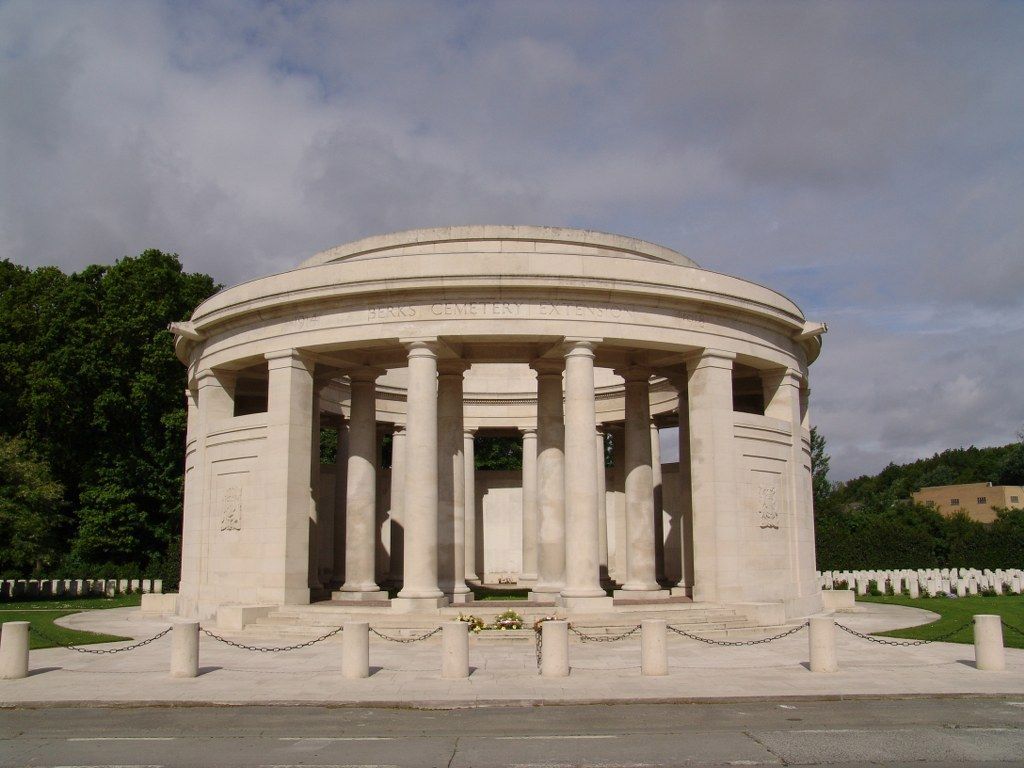 Photo of James Brown
Ploegsteert Memorial, Belgium
Photo of James Brown
Ploegsteert Memorial, Belgium