

Reginald Glyndur Wiltshire
- Family History
- Military history
- Extra information
- Photographs
He was the son of Aaron C. and Beatrice Wiltshire of 57, Beverley Street, St Ann's Well Road, Nottingham.
PORTSMOUTH NAVAL MEMORIAL Panel 40, Column 1.
HMS Gloworm
HMS Glowworm was a G-class destroyer built for the Royal Navy in the mid-1930s. During the Spanish Civil War the ship spent part of 1936 and 1937 in Spanish waters, enforcing the arms blockade imposed by Britain and France on both sides of the conflict. Glowworm was transferred from the Mediterranean Fleet shortly after the beginning of World War II to the British Isles, to escort shipping in local waters. In March 1940, she was transferred to the Home Fleet in time to participate in the opening stages of the Norwegian Campaign.
On 8 April 1940 Glowworm encountered German destroyers transporting troops to invade Norway in Operation Weserübung. The destroyers attempted to disengage while calling for help from the heavy cruiser Admiral Hipper. At 10:10, Glowworm fired five torpedoes from one mounting at a range of 800 metres (870 yd), but all missed because Captain Hellmuth Heye had kept Hipper's bow pointed at Glowworm throughout the battle to minimize his risk from torpedoes. The destroyer fell back through her smoke screen to buy time to get her second torpedo mount working, but Heye followed Glowworm through the smoke to finish her off before she could fire the rest of her torpedoes.
The two ships were very close when Hipper emerged from the smoke and Roope ordered a hard turn to starboard to ram the cruiser. Hipper was slow to answer her helm and Glowworm struck the cruiser just abaft the anchor. The collision broke off Glowworm's bow and the rest of the ship scraped along Hipper's side, gouging open several holes in the latter's hull and destroying her forward starboard torpedo mounting. One German sailor was knocked overboard by the collision. Hipper took on some 500 tonnes of water before the leaks could be isolated, but was not seriously damaged. Glowworm was on fire when she drifted clear and her boilers exploded at 10:24, killing 109 men including Ordinary Seaman Francis Allen from Mansfield.
Admiral Hipper hove to in order to rescue her man overboard and Gloworm's survivors. The German sailor was not found, but 40 British survivors were recovered, although at least six later died of their wounds. Glowworm’s captain Commander Gerard Broadmead Roope, who drowned when he could no longer hang on to a rope whilst being pulled up the side of the cruiser, was posthumously awarded the Victoria Cross. The award was justified, in part, by the recommendation of Heye, who wrote to the British authorities via the Red Cross, giving a statement of the valiant courage Roope had shown when engaging a much superior ship in close battle. (Wikipedia)
Unknown
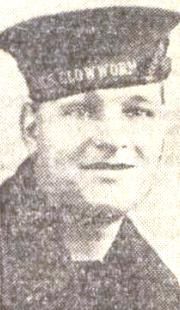 Reginald Glyndur Wiltshire
Photo: Courtesy of the Nottingham Evening Post 21/6/1940
Reginald Glyndur Wiltshire
Photo: Courtesy of the Nottingham Evening Post 21/6/1940