


Arthur Leonard Eastgate
Lorry Driver Road Haulage Contractor
- Family History
- Military history
- Extra information
- Photographs
Son of Arthur George and Mary Eastgate; husband of Nellie Eastgate, of 62 Bancroft Road Newark, Nottinghamshire.
L/Bdr Eastgate's wife, Nellie Eastgate had spent the entire War working as a volunteer with the W.V.S., packing parcels for prisoners. She was the town’s special beacon of hope during Thanksgiving Week 1945, when she stood on the Town Hall steps and opened Women’s Day. She knew her husband had been taken prisoner in Singapore. Four-and-a-half months after his " official death date of death ", she had got a card from him, assuring her he was fit and well; and she recognised his hand-writing. But from then on there was no news for almost three years – until the War Ministry wrote in June 1946 to inform her that Arthur “must be presumed to have died.
POW of the Japanese arrived in Singapore 13th January 1942 a month before it fell. Arthur was captured and was one of 600 men taken by "hell ship" Kenkon Maru to Rabaul on the 6/11/42. The Kenkon Maru was torpedoed by the American submarine USS Gato and damaged and then scuttled by her escort ships on 21/1/1943. The Japanese informed the British; all the POW's had been onboard and killed on the 5/03/1943. The families were mistakenly informed their relatives died on or about 5/03/1943.
Although it would take till July 1946 for the families to be told the truth. Arthur was one of 517 of the 600 men who then went a week later from Rabaul to Ballalae Island, where they were made to construct a runway. None of the 517 men survived.
At first a British Officer was shot, 81 of the prisoners died from beatings, exhaustion and tropical diseases.
A USAAF B24 raid on the night of 12/13 March 1943 killed many of the prisoners when three bombs landed on their encampment. In late June 1943 another heavy air raid followed by shelling from US navy ships convinced the Japanese that the island was about to be invaded and they were ordered by HQ to execute all the surviving prisoners. On 30 June 1943 the survivors, perhaps numbering several hundred men, were all bayoneted or beheaded.
In November 1945 a large pit containing the remains of all the POW's was found, in December the bodies were recovered by the 3rd Division AIF War Graves Unit of the Australian Army and interred at Port Moresby Cemetery Papua New Guinea. As the Japanese had stripped and removed all identification they are buried as "A Soldier of the 1939 - 1945 - War Known Only to God".
Report on War Crimes on Ballale Island November 1942 to September 1943 By Major E.C. Millikin B Sqn 2/4 Aust. Armd. Regt.
Acting on instructions from HQ 11 Div I carried out in the Rabaul area an investigation into the alleged war Crimes on Ballale Island during the period November 1942 to September 1943.
Ballale Island is pear shaped with an area of approx. one square mile and approx 2000 yds East & West and 1900 yds North & South. An area approx 600yds square, where the white POWs and Chinese were quartered, was "Out of Bounds" to the majority of the Japanese and to all Koreans unless they were there on duty.
Osaki Unit (18 Naval Construction Unit) during the period under review was approx. 800 strong and while on this island suffered fairly heavily from Allied bombing. In Sep '43 the Unit was moved to Kavieso (New Ireland) and built up to 1200 strong. At this period the commander Lt. Comd. Osaki returned to Japan. His further movements are unknown.
In all 324 Japanese Naval personnel and 2 Koreans of Osaki Unit who had been on Ballale Island during the period under review were located in the Rabaul area. Of these 108 Japanese, including all the Officers and Petty Officers also the 2 Koreans were interrogated. The Japanese all claimed to know very little about the white POWs and in my opinion must know a lot more than they are prepared to admit. Not one man interrogated would admit having come into actual contact with the POWs. In view of the wall of silence raised by these Japanese it would appear they have either been ordered not to say or admit to knowing anything or else they have decided upon this course by themselves.
On the other hand the 2 Koreans were prepared to tell all that they knew. Their evidence was mostly hearsay, being mainly overheard from groups of Japanese discussing these matters. I
consider that the story told by these two men is, as far as it is possible to obtain, the true story of what happened.
A Japanese interpreter Higaki of No. 5 Compound RABAUL gave evidence about a party of 600 British Artillerymen from Singapore who left there by ship during Oct '42 arriving Rabaul 6 Nov '42.
One man died on the voyage. The party staged at Kokopo (Rabaul) for about one week. 82 men were left here as too weak to continue their journey. This party was later put under the care of Higaki as he could speak English. These men, apart from 3 reasonably fit men left as cook and medical orderlies, were suffering from beriberi, malaria and other sicknesses. On 18 March '43 the numbers were down to 48 - Higaki took over at this stage. On Japanese surrender 18 men survived. Higaki states that the men told him that after a stay of one week at Kokopo the 517 fit men were put on a ship and departed for an unknown destination. He was unable, despite repeated inquiries, to find out anything about their fate. This party of 517 appears to be the same one referred to in HQ First Aust. Army letter A27974 of 25 Jan '46 addressed to 23Bde, the differences being that the letter refers to a party of 512 leaving New Britain in Mar '43 by boat. Higaki is quite definite about the number 517 and the date approx. one week after 6th November 1942.There is no doubt that a large number of the POWs were killed by Allied bombing, mainly as a result of the Japanese refusing to let them take shelter in slit trenches or air raid shelters. From evidence given by the Koreans, also that taken in other areas, it seems certain that the remaining POWs round about June 1943 were killed and buried. The reason for this is not clear, the evidence pointing to:-
(a) The POWs were of no further use due to being too weak for further work or else their task was finished.
(b) The Japanese feared an invasion by the Allies and did not wish the POWs to be discovered.
The method of killing is not clear, although evidence gathered in other areas is all to the point that at a certain time the POWs remaining were killed. In the absence of an eyewitness the best evidence will be a complete report on the exhumation of the bodies.
In view of the evidence gathered by me I am of the opinion that the only person who can be held responsible is the commander of the unit Lt Comd Ozaki.
Major E C Milliken NX.70429
10th March 1946
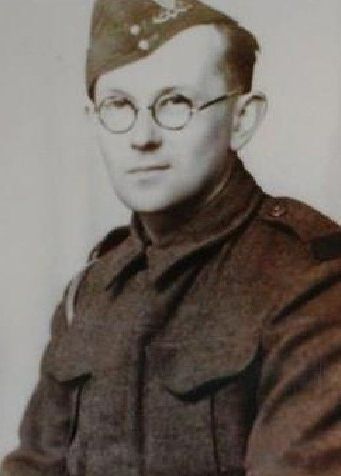 Photo of Arthur Leonard Eastgate