


Arthur William Coote
- Family History
- Military history
- Extra information
- Photographs
Adopted son of Mr & Mrs J Ford of South Godstone, Surrey; Husband of Olive Mary Coote of 5 Smith Street, Old Balderton, Nottinghamshire. Married October 1943 in Newark, he never got to see his son, also called Arthur. Olive remarried in 1947.
Lancaster ED974 OL-Y RAF Wyton mission to Berlin. Take off 16.03, hit by Flak and crashed in the target area.
F/Sgt Alfred Millard, DFM
P/O Glen Ranson RCAF
F/Sgt Cyril Plumb
Sgt Paul Vernon de Villiers Vickers
F/Lt Frederick West also killed.
F/Sgt George MacKinnon - POW No 926 Stalag Luft VI - Stalag 357
The squadron was part of No 8 Group Pathfinder Force at RAF Wyton, operating as a marker unit for the main force of Bomber Command.
During World War II, aircraft attacking Germany faced barrges of anti-aircraft fire from heavy ground batteries and massive Flak towers. Flak - Fliegerabwehrkanone (meaning "aviator-defence gun") probably accounted for around 25% of allied air force fatalities. Direct hits frequently crippled bombers like the Lancaster and the American B-17 Flying Fortress, tearing off wings, igniting fuel tanks, and causing catastrophic losses during both RAF night raids and USAAF daylight missions.
Nazi Germany built flak tower complexes in three key cities. Berlin had three main locations (Zoo, Humboldthain, and Friedrichshain). Hamburg had two major sites (Heiligengeistfeld and Wilhelmsburg). Vienna had three primary locations (Arenbergpark, Augarten, and Gedenkstätte Mauthausen/Arne-Karlsson-Park area).
Additionally, smaller single-purpose or projected installations were used or planned in cities like Stuttgart, Frankfurt, and important outlying military strongpoints outside Germany proper such as Angers (France), Heligoland (Germany), and Trondheim (Norway).
Berlin's Air Defences
Berlin was especially well defended against air raids and its flak defences were particularly effective against RAF raids mounted between January 20th and 22nd 1944. At least six airmen with strong connections to Nottinghamshire were killed by flak during this period.
Flak Towers: Huge concrete fortresses mounted massive 12.8 cm FlaK 40 guns.
Intense Barrages: Ground radar-guided searchlights and anti-aircraft guns put up thick black smoke and shrapnel fields over the city centre.
Youth Deployment: As the war progressed, most able-bodied men and older teenagers having been taken by the German army, many flak batteries were manned by fourteen year olds of the Hitler Youth and League of German Girls. Interview evidence suggests these youngsters were proud to attempt the defence of their city out of patriotic duty.
The lives of many Berliners were undoubtedly saved by flak towers which doubled as public air raid shelters particularly during the war's later months as damage and destruction within Berlin intensified.
The left hand photo shows weary Berliners leaving the Zoological Gardens flak tower in February 1945. Most flak towers have since been demolished but in Volkspark, Humboldthain (a few stops from central Berlin on the U-Bahn) one stands more or less intact. This photo was taken by David Nunn in April 2026.
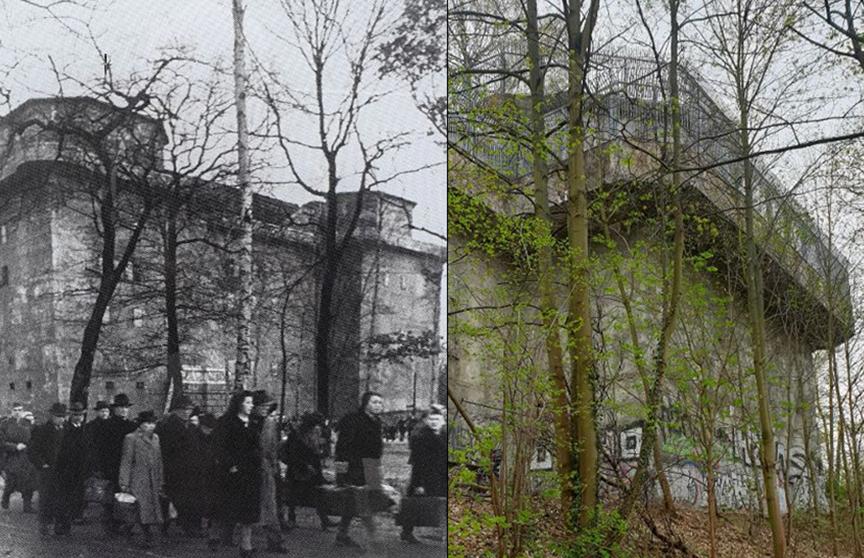 Berlin flak towers 1945 & 2026
Public Domain & Courtesy of David Nunn
Berlin flak towers 1945 & 2026
Public Domain & Courtesy of David Nunn