


William Barber
1911 - London Midland Scottish Railway (LMS) stoker
- Family History
- Military history
- Extra information
- Photographs
William was the son of Arthur and Daisy Barber (née Bagshaw).
William's father, Arthur, was born in Chard, Somerset, in 1892, the son of Sarah Ann Barber (née Silvester). Sarah had married Jess Barber in 1879; he died in 1889 and she married secondly Joseph Walker in 1893.
His mother Daisy was born in 1888, the daughter of Samuel and Elizabeth Bagshaw, and baptised at Sneinton St Stephen on 14 October the same year. Her parents were then living on Windmill Lane, Sneinton. In 1911, Daisy, a net mender, was living on Seymour Street with her parents, Samuel a labourer (timber trade) and Elizabeth a shop keeper grocer/provision dealer (on her own account), and three of her four siblings, Ruth and Ethel, both hosiery menders) and Bertie, a packer (furniture). Their parents had had seven children of whom only five survived infancy/childhood.
Arthur and Daisy were married in 1912 (JAS Nottingham) and had at least four children whose births were registered in Nottingham (surname Barber, mother's maiden name Bagshaw): Arthur Bertram (Bert) b. December 1912 (reg. 1913 JFM), Lewis b. August 1914 (reg. OND), Maisie Elizabeth b. 1916 (JAS) and William (registered 'Willie') b. 15 December 1918 (reg. 1919 JFM).
Arthur and his wife had been recorded on the 1918 Electoral Register at 59 Oldham Street, Nottingham, but only Daisy was registered at that address in the three subsequent years.
Arthur served in the Great War (42627 Private 1/6th Bn South Staffordshire Regiment) and was killed in action on 29 September 1918. (See record on this Roll of Honour).
His widow Daisy married Alfred J Holmes in 1921 (JFM Nottingham) and their daughter, Dorothy M. was born in 1922 (reg. JFM). There was probably a second daughter, Hilda b. 1926 (reg. OND Nottm mother's maiden name Bagshaw).
In 1921 Alfred Holmes, a general labourer, his wife Daisy and her children Arthur, Lewis, Maisie and Willie were living at 59 Oldham Street. The children's surnames were given on the census as 'Holmes' and their names annotated (parents) 'both alive.'
Daisy Holmes, died aged 45 in 1934 (reg. JFM Nottm).
Alfred Holmes was still living at 59 Oldham Street when the 1939 England & Wales Register was compiled. Also in the household were Dorothy Holmes annotated 'Coates' (m. Frank P Coates, 1945), and William, an LMS stoker. The record of one other member of the household remains closed but appears to have been a child of school age and was probably Alfred's second daughter, Hilda. William's surname was given as 'Holmes' but this was deleted and replaced with 'Barber'. The Probate record gives William's address as 59 Oldham Street.
Alfred Holmes died in 1944 (OND Nottingham).
Of William's siblings:
Arthur married Annie Patricia Singleton in 1934 and in 1939 they were living at 71 Sneinton Road, Nottingham; Arthur was a general labourer (brickwork). They probably had a daughter Kathleen in 1945. Arthur died in 1968 and his widow in 1987.
Lewis married Lucy Bartels in 1938 and they were living on Leighton Street, Nottingham, in 1939; Lewis was a silk winder. Lewis died in 1983.
Maisie married Leslie Bartles in 1936. She died in 2009 aged 93.
William was employed as an LMS stoker before enlisting on 15 November 1939 'for the duration of war'.
He was posted to the Royal Engineers 1st Railway TC Royal Engineers (Longmoor, Sheffield), then 7th Railway BH, 3 January 1940. No. 9 SH8 (39/199 – Coy), 20 December 1940. Transportation Company Rail Mounted (-) Heavy Batteries, (1/Trans Coy RMSHB), 21 August 1941. His last address was Elham Valley Railway, Barham, Kent.
William Barber was killed on 31 October 1942 during an air attack on Canterbury known as a Baedeker Raid. It is probable that he was not killed in the city but at his place of duty as suggested by several official records of his death.
Army Form W3040. Casualty Card. Date 6 November 1942. 1898515 Sapper William (sic) Barber. Regt 195, Transportation Company RE. Date: 31 October 1942. Reported by: OC Unit by wire D. 1.11.42. Casualty: Killed by enemy action near Canterbury, Kent.
WW2 Civilian Casualties: Elham Valley Railway. William Barber. D. 31 October 1942 age 23, Type of casualty: AR (air raid). Address Elham Valley Railway, Barham, Kent. Military RE Sapper.
His next of kin was his brother, Arthur Bertram Barber, 70 Sneinton Road, Nottingham, who was notified of William's death on 4 November.
William was buried in Nottingham General Cemetery on Friday 6 November (grave ref 958A).
'Baedeker' Raid on Canterbury:
Canterbury was hit by a major "tip and run" air raid on October 31, 1942, where 62 Focke-Wulf FW 190 fighter-bombers caused widespread damage, killing 33 people and injuring 55, as part of Germany's retaliatory "Baedeker" tactics. This daytime attack was one of the war's largest fast-fighter raids, exploiting low altitude to evade radar.
Key details of the October 31, 1942, Canterbury raid
• Date: October 31, 1942 (a Saturday).
• Aircraft: ~62 FW 190 fighter-bombers (some sources say 60-68), using low-level, high-speed tactics.
• Bombs: At least 30 HE (High Explosive) bombs dropped.
• Casualties: 33 people killed, 55 seriously injured.
• Context: Part of Germany's retaliatory "Baedeker" raids against historic English cities (Bath, Norwich, Exeter, York also hit) following RAF bombing of Cologne. The October raid was specifically a "tip and run" attack. (David R Lewis and Wikipedia)
Nottingham General Cemetery. Headstone inscription: In remembrance of Sapper William Barber, killed in enemy action. Oct 31st 1943 aged 25 years. Also parents of the above. Pte Arthur Barber killed in (-) Sept. 29th, 1918 aged (-) years. And Daisy (Barber) Holmes, (-) aged 45 years’ (See record for Arthur Barber on the Roll of Honour)
The main attack on Canterbury took place on 1 June 1942, shortly after the Cologne bombing. In the early hours of this day, German planes dropped 130 high explosives and 3,600 fire bombs on the city, killing 43 and seriously injuring 40 others. The cathedral escaped with minor damage, but much of the St George's area was reduced to rubble. A further substantial raid, this time in daylight on 31 October 1942, claimed 33 lives and left 54 seriously injured.
Casualty estimates from different sources rarely agree, but the following from Rootes (1980) provide some guide to the magnitude of the death and destruction suffered by the city during the war years:
• Canterbury received some 10,000 incendiary bombs, 445 HE (high explosive) bombs, and just one flying bomb.
• Around 115 deaths were recorded, 140 seriously injured civilians and 240 slightly injured civilians.
• 808 properties were wrecked beyond use, 1,047 were seriously damaged and a further 5,691 slightly damaged.
• In addition to raids on 1 June and 31 October 1942 mentioned above, there was loss of life from enemy bombing on the city on 7 other days of the war: 21 August 1940 (5 killed), 9 September 1940 (9), 11 October 1940 (9), 14 October 1940 (2), 20 April 1941 (1), 3 June 1942 (5), and 7 June 1942 (1).
Courtesy of David R Lewis [Baedeker Raids (1942) on line]
Kent Herald, 4 November 1942: ‘Canterbury Raided By Focke-Wulfs. Low-Level Daylight Attacks. City Bombed & Machine Gunned (extract): ‘Canterbury was on Saturday afternoon [31 October] the chief target in the Luftwaffe’s biggest daylight raid since the Battle of Britain. It is estimated that 50 Focke-Wulf 190s crossed the coast and raided various districts. The raid came with such surprising suddenness to Canterbury that it was difficult to tell how many planes came over the city, estimates ranging from 12 to 20. Hedge-hopping over the country-side, the raiders swept low over the roof tops, loosing their bombs and spraying the streets with machine gun fire. The streets were, at the time, crowded with shoppers, who dived for shelter or threw themselves flat. Quite a fair proportion of the casualties were caused by flying debris and glass. Some 20 bombs were dropped and these caused considerable damage … Buses Attacked. Six people, including the conductress, were killed when a bus was bombed and machined gunned … In another bus, machined gunned in the open country, the driver was shot through the heart …’ Other sources mention that the city’s protective barrage balloons were down for maintenance.
Nottingham Evening Post, ‘Deaths’, 5 November 1942: ‘Barber. Sapper William, late LMS Loco Dept., age 23, killed by enemy action October. Funeral Friday, 2.30, General Cemetery. Loved by all. Broken-hearted family.’ (www.britishnewspaperarchive.co.uk)
Nottingham Evening Post, ‘Deaths’, 5 November 1942: ‘Barber. Sapper William, killed by enemy action, October. Shattered hopes. Irene, Mr. and Mrs. Pickance, and family.’ (www.britishnewspaperarchive.co.uk) Note: Irene I Pickance (b. 1922) daughter of Vernon and Lavinia Pickance, m. William Taylor 1944.
Nottingham Evening Post, ‘In Memoriam’, 30 October 1943: ‘Barber. Sapper William (Bill) RE, age 23, killed enemy action, Canterbury. One year has passed since that sad day when one we loved was called away. Loving family.’ (www.britishnewspaperarchive.co.uk)
Probate: Barber William of 59 Oldham-street Nottingham died 31 October 1942 on war service. Administration Nottingham 8 January to Maisie Elizabeth Bartles (wife of Leslie Bartles). Effects £163 11s.
Additional research (family history, war record), RF (Dec. 2025)
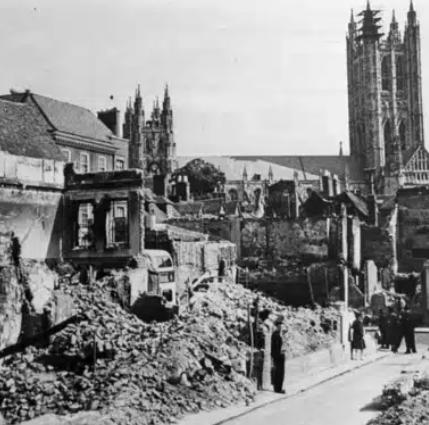 Extensive damage to Canterbury's cathedral district after the air raid which killed William Barber
Photo Courtesy :https://www.1stlinedefence.co.uk/resources/uxo-city-guides/canterbury/
Extensive damage to Canterbury's cathedral district after the air raid which killed William Barber
Photo Courtesy :https://www.1stlinedefence.co.uk/resources/uxo-city-guides/canterbury/
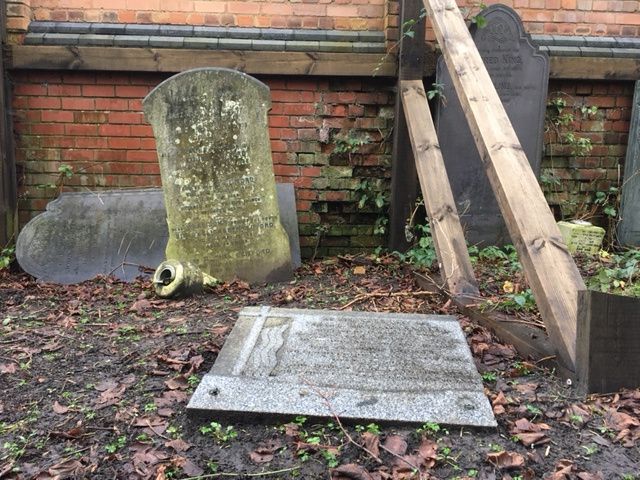 Photo of William Barber
Buried in Nottingham General Cemetery. Photograph Rachel Farrand (15 Dec. 2025)
Photo of William Barber
Buried in Nottingham General Cemetery. Photograph Rachel Farrand (15 Dec. 2025)
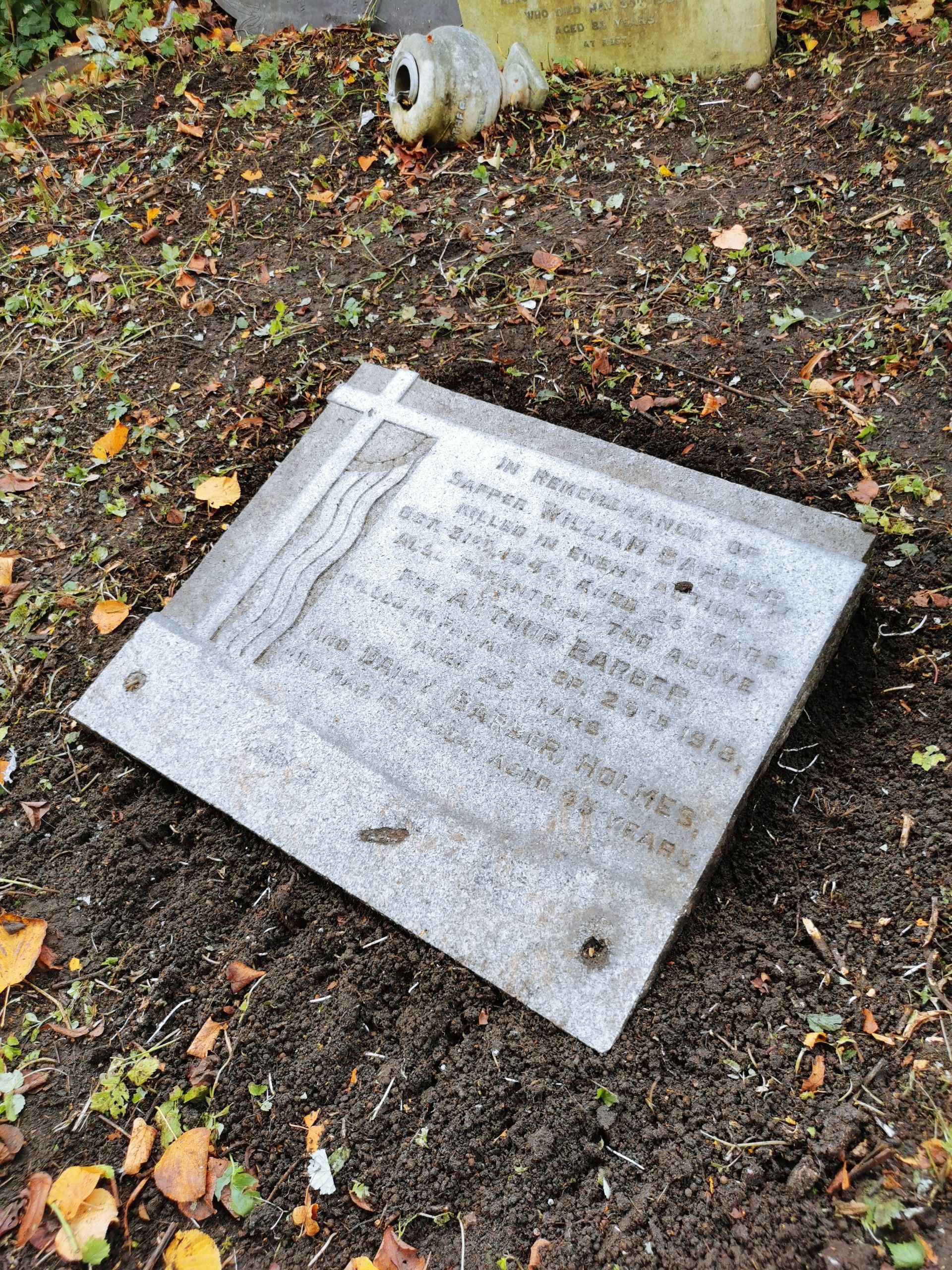 Photo of William Barber
Buried in Nottingham General Cemetery. Photograph Simon Roots (Nov. 2025)
Photo of William Barber
Buried in Nottingham General Cemetery. Photograph Simon Roots (Nov. 2025)