


Ronald Etheridge Chesser
He was a police constable in 1939.
- Family History
- Military history
- Extra information
- Photographs
He was the son of William Etheridge Chesser and Ethel May Chesser and brother of Hazel Chesser. In 1939, they lived at 13, Highfield Drive, Carlton, Nottingham. Ronald Chesser and Margery Knowles were married at Nottingham in 1940 and their daughter Diana was born in 1942.
He was the navigator aboard Lancaster II DS665 which took off 2205 11 Aug 1943 from Little Snoring. Broke up in the air whilst returning to base and crashed 0430 11 Aug 1943 at East Hall Farm Broughton 5 miles NNE of Huntingdon. No survivors. Fatalities:
Pilot Officer J F H Erwin, Pilot Officer R E Chesser, Pilot Officer N P Gardner, Sergeant G E Oliver, Sergeant F H Merritt, Sergeant L P Fannan, Sergeant O A Bettridge (RCAF): killed; Lancaster DS665, 115 Squadron, aircraft failed to return from an operational flight, near Maidstone, Kent.
Buried at Carlton Cemetery SecA Row M6 grave 163. His parents are also mentioned on the War Grave headstone. "Also his Father William 27th October 1949 age 56 and Mother Ethel May 10th January 1978 age 82"
Lancaster Mark II
The Mk II was the only version of the Lancaster not to be powered by Rolls Royce Merlin engines. Instead, it used Bristol Hercules radial air cooled engines. The aim was to provide an alternative source of Lancasters in case the supply of Merlin engines failed. British production was seen as vulnerable to German bombing, while there were worries that American production (by Packard) would be diverted or stopped if American entered the war.
While the Mk I operated at 22,000 feet, the best the Mk II could achieve was an altitude of 18,400 feet. The Mk II was issued to 115 Squadron, in 5 Group. Despite the altitude problems, the Lancaster Mk II was a welcome improvement on their Wellingtons.
In service the Mk II was slightly more robust than the Mk I, lacking the extensive liquid cooling systems needed by the Merlins, although at the lower altitude this would be put to the test. An additional aid to survival was the installation of a FN64 ventral turret below the aircraft, although this was sometimes removed to save weight.
A second problem with the Mk II was that it could only carry 14,000 lbs of bombs, compared to the 18,000 of the Mk I. By the end of 1943 the Lancaster Mk II was being phased out. Armstrong Whitworth had converted to production of the Mk I, Merlin engine production was keeping up with demand, and American production had increased after the U.S. entered the war.
By D-Day only two squadrons (514 and 408) were still using the Lancaster II. All other squadrons had moved to either Lancaster I/ IIIs or Halifax IIIs. A small number of Mk IIs remained in use as test beds, with the last surviving to 1950. (courtesy of historyofwar.org)
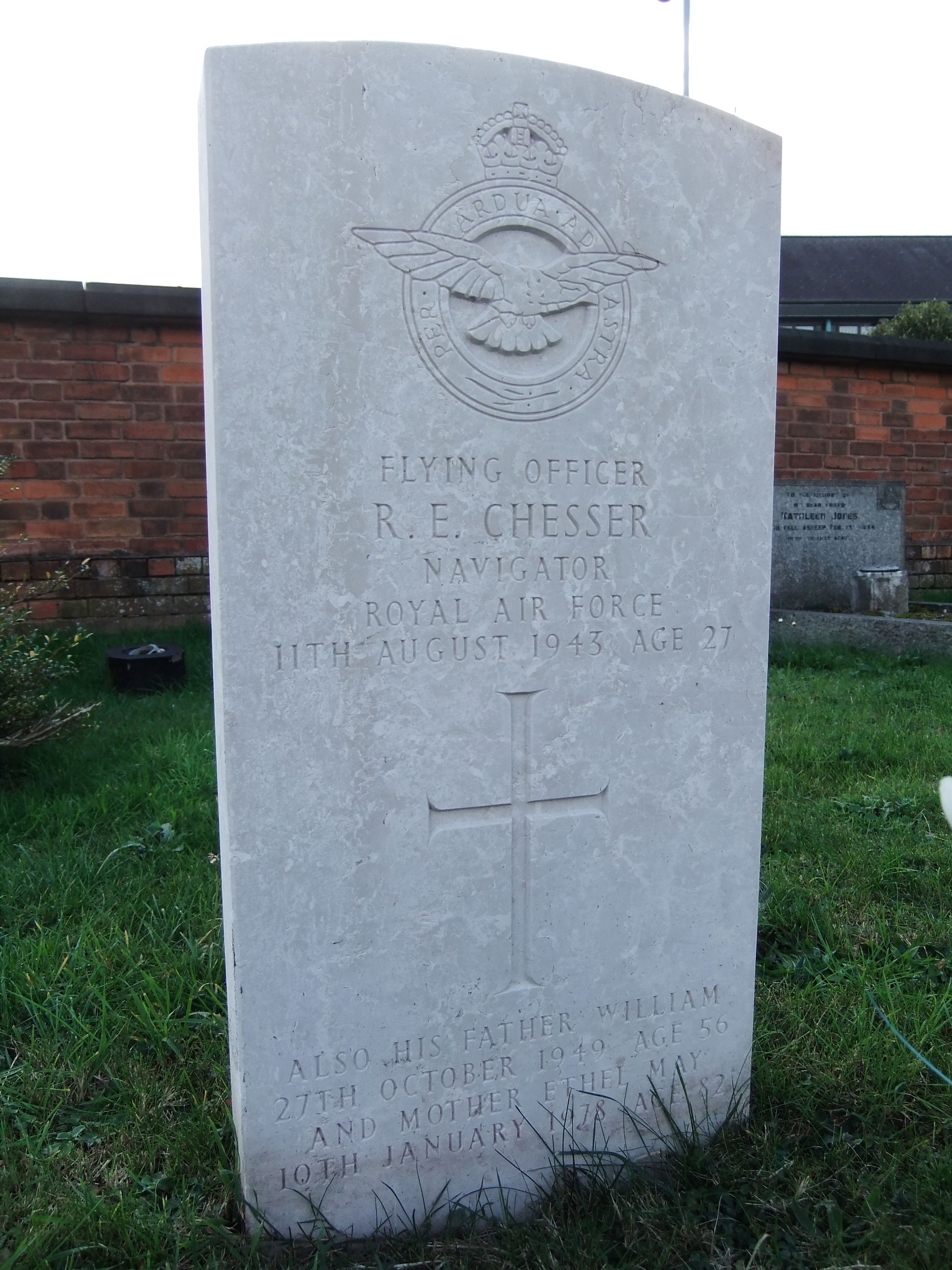 Photo of R Chesser grave
Headstone photo by Tracy Dodds
Photo of R Chesser grave
Headstone photo by Tracy Dodds