


Alexander Smith
Stonecutter.
- Family History
- Military history
- Extra information
- Photographs
Alexander married Annie Craig at St Nicholas, Aberdeen, on 14 February 1902 she died on 17th October 1908 aged 54 yrs they had three children: Alexander Robert b. 25 March 1903, Eveline Annie b. 29th January 1905 and John Craig born 18th September 1908.
Alexander's service record includes correspondence between the RE records office and the children's guardian, and also her solicitors, asking for confirmation of the date of the death of Alexander's wife, given as 7 October 1907, when the date of birth of the youngest child had been stated to be 18 September 1908.
The children's guardian, their maternal aunt, Jane Craig, of 71 John Street, Aberdeen, completed Army Form W5080 listing her late brother-in-law's surviving blood relatives. The entries on the form are largely illegible, but it is probable that Alexander had three sisters, one of whom, Barbara Smith (who may have been a married woman but, according to custom, had retained her maiden name), may have had the care of the youngest girl. Alexander and Eveline appear to have been living with their guardian at 71 John Street.
Commencing 8th May 1916 Jane Craig was awarded a pension of 15 shillings a week
Alexander Smith, aged 38y 270d, a stone mason, attested in Aberdeen on 7 September 1914 on an Army Reserve (Special Reservists) engagement. He had previously served for 14 years in the Royal Engineers (time expired) and was posted to the Royal Engineers and promoted Corporal on 8 September 1914.
He served in Ireland and then with 157th Field Company at Newark, Nottinghamshire.
Alexander committed suicide on 8 September 1915. He was buried in Newark General Cemetery with full military honours (grave ref. R. C. "U." 281).
Nottingham Evening Post, 7 September: Brief report of ‘supposed suicide of a soldier at Newark.’
Nottingham Evening Post, 8 September 1915: ‘Soldier's Suicide. Newark Engineer who wanted to go to the Front. Disappointment through being rejected for active service, and being compelled to remain at home while his company went to the front, was given to the Newark Coroner to-day as the explanation of the suicide of a Royal Engineer, Corporal Alexander Smith, belonging to the 157th Field Company Royal Engineers in training in Newark, who was found on Monday morning with his throat cut. Capt. McHGeorge said that when deceased reported himself at Newark on August 11th, he said he was useless. His comrades described Smith as having been very depressed for some months. A subaltern, writing from Ireland, said deceased was not very strong mentally when in Ireland.’
(www.britishnewspaperarchive.co.uk)
Nottingham Journal, 9 September 1915: report as Nottingham Evening Post, but with headline: ‘Suicide through disappointment. Royal Engineer who wanted to go to the Front’ and an additional final paragraph, ‘A verdict of Suicide whilst of Unsound Mind was returned.’ ((www.britishnewspaperarchive.co.uk)
Mansfield Reporter, 10 September 1915: short report including the verdict of suicide.
Newark Herald, 11 September 1915. Detailed report on the inquest into the death of Cpl Alexander who was 39 years old: ‘Following the inquest on the victim of the railway accident the Borough Coroner (Mr FB Foottit) proceeded to hold an inquest on the bodyof Alexander Smith, a Corpl. in the Royal Engineers stationed at Newark, who cut his throat with a razor at the huts on Tuesday, the alleged cause being that he was disappointed at not being able to go to France. The same jury as in the previous inquest were sworn in.’ Statements were made in person by Sergt. G Pringle, 157th Company RE, stationed Newark, who was in the same company as Smith and confirmed Smith’s disappointment at being rejected for active service. Driver Wm Docherty 157th Field Company said he did not know deceased personally but ‘was sitting in the stables at the Barracks about three yards from deceased when he heard a noise and went to see what it was. Deceased was lying down and blood was coming from his throat. Witness ran for the doctor, that would be about 8.25am. The doctor found the razor. He was there when the doctor came, deceased died without speaking. There was no one there who could have done it.’ Driver Docherty later told the court after evidence had been given by the Medical Officer that ‘deceased was between the hedge and the tent. He was not in the stables.’ Statement from Lieut. J Lindsey, Medical Officer at the Barracks, who was called to the deceased on Tuesday morning. Statement from Capt. Harold McGeorge, OC 157th Field Company who had referred Smith to the medical officer for treatment as Smith ‘appeared to be run down.’ The Coroner advised the jury on the evidence they had heard and the jury returned a verdict ‘that deceased committed suicide by cutting his throat when in a state of temporary insanity.’ (www.britishnewspaperarchive.co.uk)
Aberdeen Press and Journal, 14 September 1915: ‘Aberdeen Casualties. Engineer Corporal’s Death in England. ‘News has been received of the death of Corporal Alexander Smith, 157th Company, Royal Engineers, at Newark, England, Deceased was the son of the late Mr Alexander Smith, granite merchant, Gilcomston Park, and enlisted in September last. He was a stonecutter to trade, 39 years of age,and was formerly a member of the Royal Engineers, Hardgate. He was a widower, and has left three of a family, two boys and a girl, the eldest of whom is 12 years of age. In a letter to the corporal’s eldest boy, who resides at 71 John Street, the commanding officer speaks of Corporal Smith as a good and valuable soldier, who was greatly respected by all with whom he came in contact. Corporal Smith was buried at Newark on Friday last with full military honours. A number of beautiful wreaths were placed on his grave by officers and men of his company, as also a fine floral tribute from his chldren. Much sympathy is felt for his family and relatives.’
(www.britishnewspaperarchive.co.uk)
Aberdeen Evening Express, ‘Deaths’, 14 September 1915: ‘Smith. At Newark, England, on 7th inst., Corporal Alexander Smith, Royal Engineers, aged 39 years. Deeply regretted.’ (www.britishnewspaperarchive.co.uk)
RE Records, Brompton Barracks, Chatham, requested OC 157th Field Company to provide information about Smith’s death and the inquest. The reply included, ‘Identification of his death was immediately wired to his son, Alexander Smith, residing at 71 John Street, Aberdeen; a letter was also sent the same day.’ The service records include documents relating to Smith’s suicide include a copy of a report of the inquest published in the Newark Advertiser, 15 September 1915.
A pension for the children was awarded on 18 May 1916.
Research RF (May 2026)
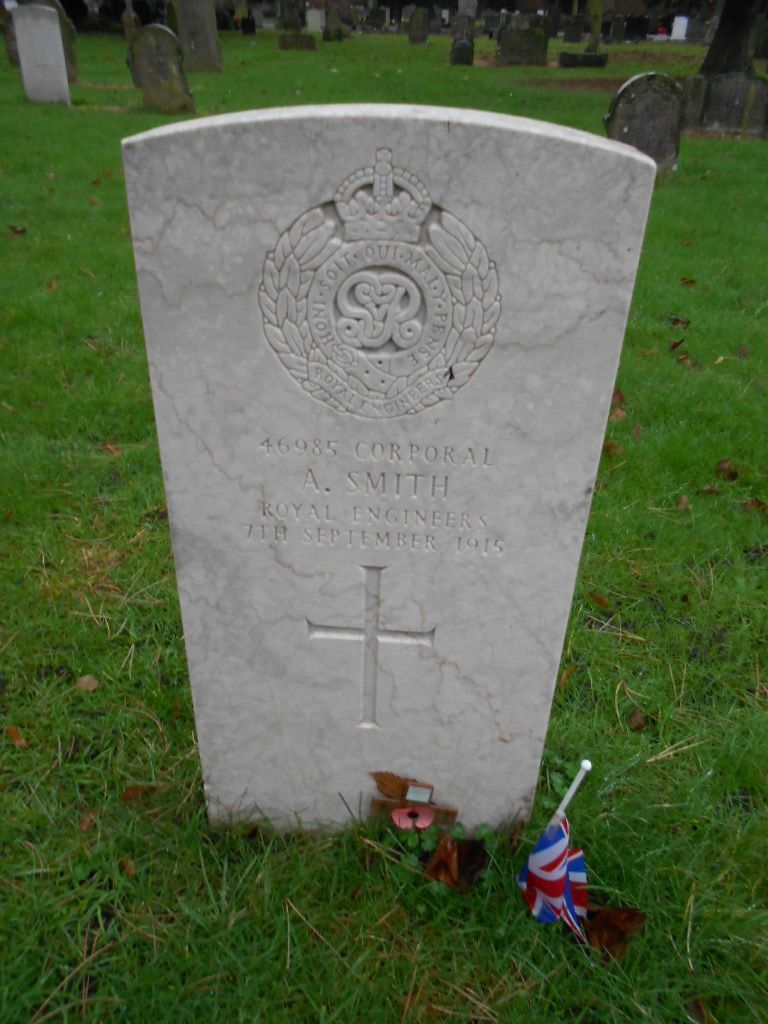 Photo of Alexander Smith
Newark General Cemetery, Newark
Photo of Alexander Smith
Newark General Cemetery, Newark