


Klemens Prusak
- Family History
- Military history
- Extra information
- Photographs
This record was originally created by Shaun Noble and, to commemorate the 81st annversary of KP's passing, has been augmented by a lengthy contribution from Klemens Prusak's niece Olga who lives in Texas. Olga wrote:
'One of Klemens's brothers, Józef, was a gunsmith. During the war, the Germans arrested Józef — officially for “supporting bandits,” but in reality for arming soldiers of the Polish Underground. He was sent to Buchenwald concentration camp.
Another of Klemens’s older brothers, Stanisław, infected him with a passion for aviation. Unfortunately, before the war even began, Stanisław suffered a serious accident, crashing a Hanriot H-19 aircraft.
(As an aside: despite the fact that Stanisław was no longer able to fly, the Soviets later declared him an “enemy of the people” and deported him to Siberia, where he spent almost 11 years. According to communist documents, he worked all those years as a locomotive engineer — a strange engineer indeed, who knew absolutely nothing about trains.)'
'Klemens idolized Stanisław and spent his entire life trying to prove that he was a far better pilot and aviator than his older brother. From an early age, Klemens was fascinated by aviation. He completed his first pilot training course on the Hanriot H-28 shortly after his brother’s accident. In the training squadron of Captain Pilot Wołkowinski, Klemens flew 895 daytime flights (98 hours) and 6 night flights (4 hours).
On 1 November 1937, as a fully trained pilot, he reported to the 11th Line Squadron under Captain Pilot Franciszek Dudzik. In this unit he completed 231 daytime flights (122 hours) and 19 night flights (3.5 hours).
Unfortunately, little is known about Klemens’s fate in September 1939. What is known is that in October 1939, together with a group of “tourists” organized by General Sikorski, Klemens first reached Greece and later France. There he was assigned to a bomber pilot group at Cazaux.
After the fall of France, Klemens made his way to Great Britain. On 5 August 1940, he was entered onto the personnel list of the Polish Air Forces. On 1 March 1941, he received the British rank of Sergeant, and on 1 August 1942 he was promoted to Flight Sergeant.
Klemens, however, had hot blood and a hot head. Although his training was rated as very good by 2nd Lt. Pilot Jerzy Godlewski, repeated breaches of military discipline — especially violations of low-flying regulations — resulted in his demotion from Flight Sergeant to Sergeant.
As punishment for his low-level flying antics, he was reassigned to the dull task of towing target sleeves for trainee aerial gunners. Klemens did not give up. He continued flying and training relentlessly. Eventually, he was assigned to the Polish Fighter School, and on 28 April 1944 his rank of Flight Sergeant was restored.
On 6 June 1944, Klemens Prusak reported to Squadron Leader Tadeusz Koc of No. 303 Polish Fighter Squadron. His first flight as a 303 pilot took place on 7 June 1944, and on 8 June he flew his first operational mission over the Normandy beaches. From then on, there was only “routine” combat flying. Initially he flew the Spitfire Mk V, and in mid-June he transitioned to the Spitfire Mk IX.
On 15 August 1944, Klemens received his Field Pilot Badge. On 30 December 1944, he was awarded the Cross of Valour. On 26 February 1945, Klemens flew a Spitfire Mk IX RF-Q MA814 to the American airfield at Harrington, where he was to participate in joint exercises with American forces. A tire burst on landing, and he did not take part in the exercises.
The following day he was scheduled to return to Coltishall. Klemens was deeply disappointed that he had missed the training. After takeoff, he decided to “show those damn Yanks how flying is really done.” He performed several barrel rolls at an altitude of about 100 metres and then attempted to fly even lower.
It did not succeed. Reportedly, he struck a tree with his wing and crashed to the ground. Klemens Prusak was killed in his burning aircraft on 27 February 1945.
Although the military commission ruled pilot error as the cause of the accident, not all witnesses agreed. There were voices suggesting an engine failure. Doubts remained. Unfortunately, we will never know the truth. Klemens took that knowledge with him to the grave.
By the time of his death, he had completed 80 combat flights totalling 168 hours, and 8 operational sorties totalling 10 hours and 40 minutes.
His commanding officers — DM Squadron Leader Drobinski and Flight Lieutenant Stanisław Socha — highly valued Klemens’s training, sense of duty, and discipline (apart from his low-flying incidents, for which he paid a heavy price).
Klemens was laid to rest at Newark in the United Kingdom (grave no. 328). He was awarded the Cross of Valour twice (the second posthumously), as well as the Aviator’s Medal, 1st, 2nd, and 3rd Class (all posthumously).
Klemens’s brother Stanisław and his wife Anna never forgot him. On their gravestone, the names of Klemens and Józef Prusak also appear 'pro memoria.'
Unknown
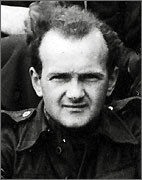 Photo of Klemens Prusak
Photo: Niebieska Eskadra.
Photo of Klemens Prusak
Photo: Niebieska Eskadra.