

Kenneth Hird
Kenneth Hird was employed at the Northern Rubber Works before enlistment. He was a member of The Retford ATC and belonged to the ARP.
- Family History
- Military history
- Extra information
- Photographs
He was the son of Mrs G Hird of 4, Strawberry Terrace, Newtown, Retford. Kenneth Hird and Amy E Tranter were married at Retford in 1944.
Thanks to Michael and Elizabeth Szarelis for the newspaper cutting. Thanks also to Adrian Lambourne for restoring Kenneth Hird's photograph.
Kenneth Hird joined the RAF in September 1942.
According to the Retford, Gainsborough and Worksop Times (June 1945), Hird 'lost his life while engaged in bringing troops back to England and it seems this aircraft had been involved in ferrying batches (24 at a time) of pows back to the UK.' WR Chorley in his Bomber Command Losses (1945 p.176) was broadly supportive of this account; he stated that that Avro Lancaster Mk I PP673 coded OJ-B had taken off at 16:52 hrs from Juvincourt (Aisne) bound for U.K. with ex prisoners of war. He also mentioned unconfirmed reports about an unidentified airmen who survived.
It has been suggested suggested that perhaps the passengers were not ex-PoWs, but civilians doing some 'sight-seeing', as it was common at that time. H0wever, on this occasion it seems the fateful flight was part of either Operation Exodus or Operation Dodge - the repatriation of troops and prisoners of war. Although hostilities in Europe had ceased, the skies were still crowded so gunners were probably included in crews as extra pairs of eyes.
Jon Pollard shared a report found on AI Google that 'the a/c burst a tyre on a taxiway of steel planking and crashed on take off as a result, killing all the crew (the names fit) and 3 passengers (the names fit).' This explanation seems unlikely.
Colin Cummings, author of The Price of Peace asserted ' At 2,000ft the aircraft suddenly went into a steep dive but pilot was able to flatten this out before the starboard outer wing and engine fractured and broke away from the aircraft which then crashed into the ground, burst into flames and was destroyed. The accident is thought to have been caused by a failure of the auto pilot. There was one survivor from the 11 on board`.
Jocelyn Le Cercq's contribution is definitive:
'The crew was returning from Juvincourt, bringing back 4 groundcrews who had been stationed there temporarily. During the flight, one of the ground crew exchanged places with the rear gunner. A technical problem occurred, probably an autopilot malfunction, and PP673 crashed near Arras. The rear turret became separated from the fuselage. LAC John E. Farley trapped inside survived, bruised but alive. He came back to the crash site in the 90s. I contributed these informations on rafcommands forum, shown in another post, and to other families. I used the ORB and the accident report in AVIA files at Kew.'
Unknown
 Kenneth Hird's grave
Courtesy of Michael and Elizabeth Szarelis
Kenneth Hird's grave
Courtesy of Michael and Elizabeth Szarelis
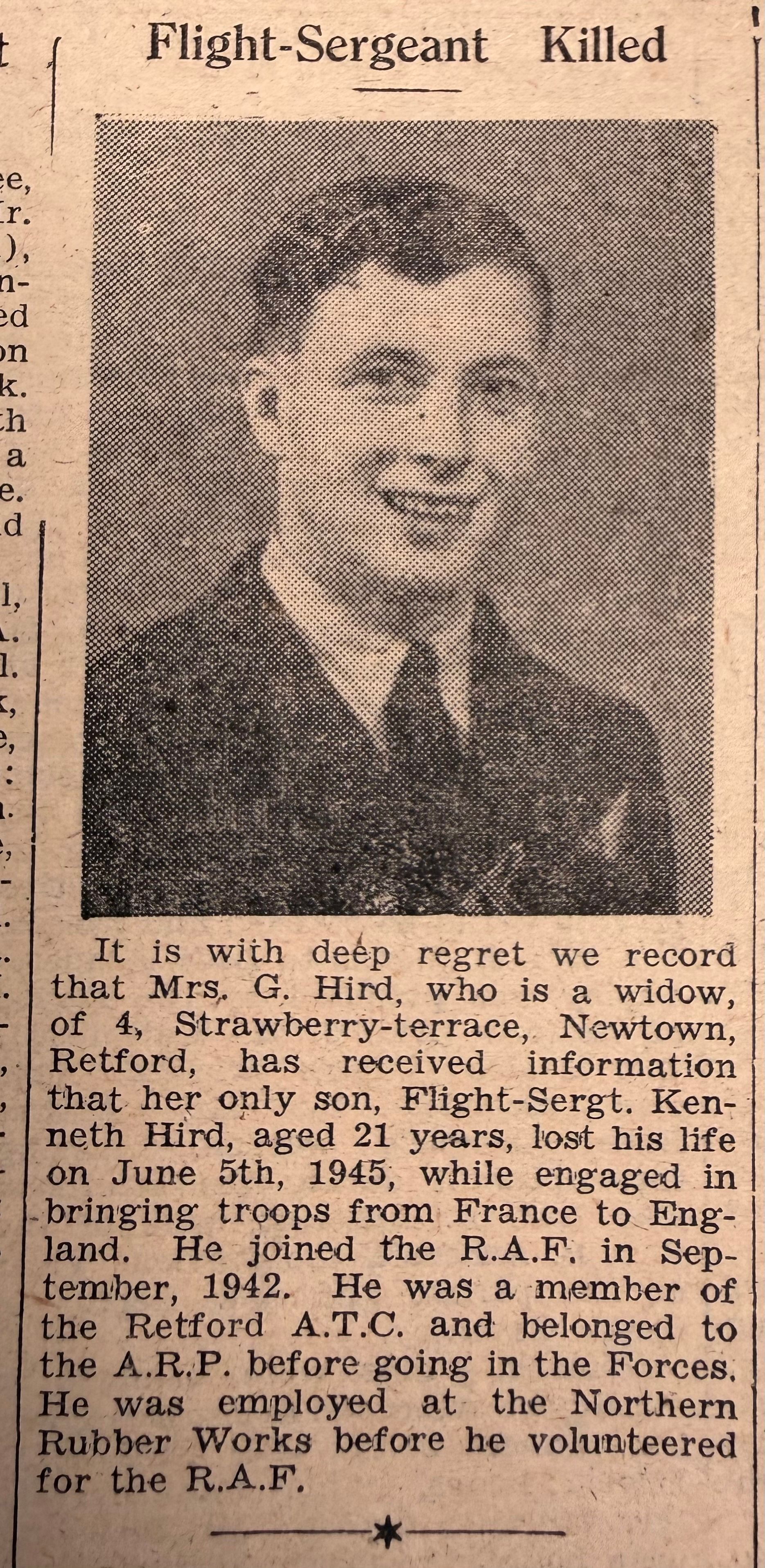 Kenneth Hird
Photo: Courtesy of the Retford, Gainsborough and Worksop Times, June 1945 via Michael and Elizabeth Szarelis
Kenneth Hird
Photo: Courtesy of the Retford, Gainsborough and Worksop Times, June 1945 via Michael and Elizabeth Szarelis
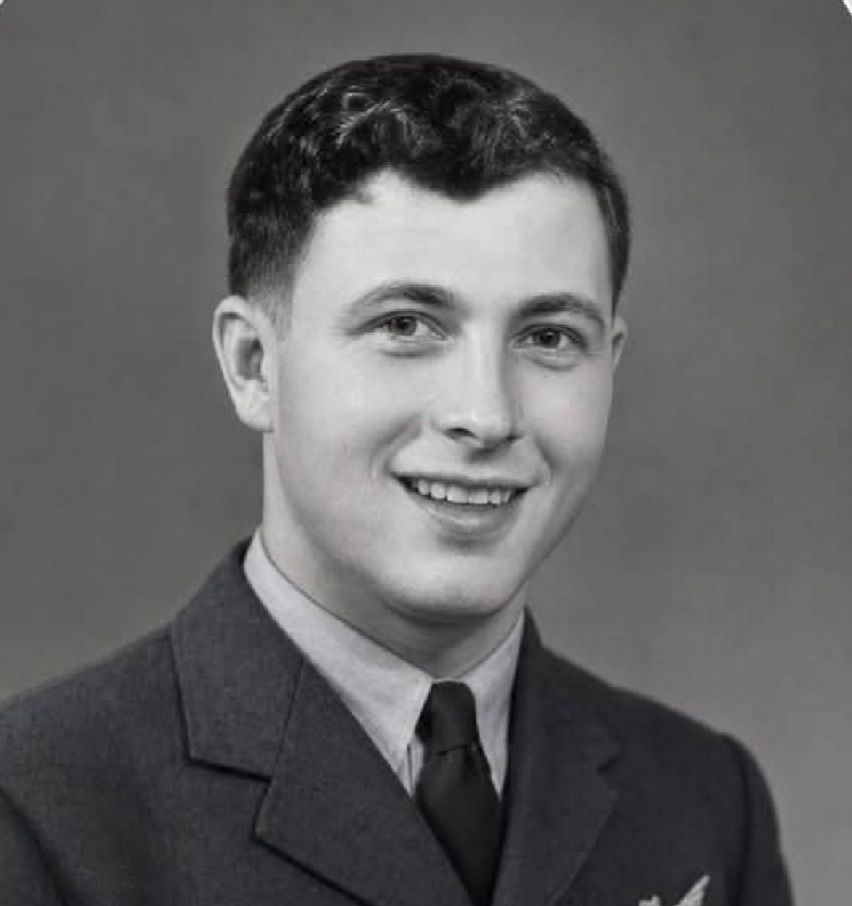 Kenneth Hird
Photo restored by Adrian Lambourne
Kenneth Hird
Photo restored by Adrian Lambourne