

Thomas Wilfred Henry Usher
1939: packer/office (silk factory)
- Family History
- Military history
- Extra information
- Photographs
Thomas Wilfred Henry was the son of James Wilfred and Hannah Elizabeth Usher (née Hall). His date of birth was given on the 1939 England & Wales Register as 15 February 1924.
His father James, the son of Joseph Usher, was born in March 1903 and his mother Hannah, the daughter of Harry Hall, in October 1899. James and Hannah were married at the parish church of St John the Evangelist, Ilkeston, in January 1924; James was living on Hallam Lane (?Stanton Gate), and Hannah in Trowell.
James and Hannah probably had eight children. Five children were named on the 1939 England & Wales Register: Thomas Wilfred Henry birth reg. 1924 (JFM), Allan Everard b. 1925 (AMJ), Esme H. b. 1928 (JAS), Betty birth reg. 1930 (JFM) and Clarence Albert b. 1932 (JAS) whose births were registered in Basford registration district. The entry for the family included three closed records, one of which may have been that of Joseph who was born in 1926 (OND reg. Basford) and the other two those of Eunice birth reg. 1937 (JFM reg. Shardlow) and Edwin b. 1938 (JAS reg. Ilkeston).
James was a warp knitter (silk) at the time of his marriage, later unemployed, and then in 1937 he purchased a grocery business on Nottingham Road, Ilkeston, Derbyshire. The family was living at 387 Nottingham Road in 1939 when the England & Wales Register was compiled: James, occupation grocer (own account), his wife Hannah and children Thomas, a 'packer & office' (silk factory), Alan an errand boy, and Esme, Betty and Clarence who were school age, together with three others whose records remain closed (see above).
It is likely that the family moved from the property on Nottingham Road, Ilkeston, when the business failed, apparently impacted by the introduction of rationing (Derby Evening Telegraph, 25 September 1940). The later CWGC record gives James & Hannah's address as Stanton Gate, Nottinghamshire.
Hannah died in 1969 (reg. Ilkeston) and James in December 1987 (reg. Ilkeston)
The following information is from the record of Sgt. William Taylor Banner who is also commemorated on this Roll of Honour:
According to one WW2 record, Thomas was a pilot, but another record gives his role as flight engineer. 214 Squadron was based at RAF Oulton, Norfolk.
Fortress III HB 796, an American B-17 transferred to the RAF (see 'Extra Information' below). The aircraft usually carried twelve 400-pound S.C.I. bombs or sixteen 250-pound depth charges, had the cheek-mounted machine guns removed and radar was fitted in place of the ball turret.
214 Squadron's ORB, February 1945, Record of Events (TNA AIR-27-1324-4): 'This aircraft (HB 796) was detailed to carry out a Window patrol but nothing has been seen or heard of it and it failed to return.' Subsequently, it has emerged that HB 796 took off from RAF Oulton in Norfolk at 03:29 hrs tasked with dispensing 'Window' west of the Ruhr in support of an operation to Kefled. It probably became involved in an air battle and at 04:30 hrs was seen to be flying very low over New Romney and Lydd. Witnesses stated that they head the aircraft diving towards the sea and then heard a muffled thud. A Coastguard watcher at Denge Marsh was of the opinion that the aircraft attempted to land on the foreshore, bounced up and crashed into the sea. Debris was found on the shore above the high water mark which seemed to confirm that. The body of the pilot, James Peter Robertson, was washed ashore at Dungeness. (findagrave.com)
There were no survivors of the crash. Thomas Usher is commemorated on the Runnymede Memorial (Panel 277).
The other members of the crew were:
2221107 Sgt. William Taylor Banner RAFVR. Sutton-in-Ashfield Cemetery, Notts.
42287 W.O. Lionel John Bennett RNZAF. Runnymede Memorial (Panel 285)
1337316 Flt. Sgt. Peter George Buckland RAFVR. Runnymede Memorial (Panel 270)
1118147 Sgt. William Bunyan RAFVR. Bolton (Astley Bridge) Cemetery
1816917 Sgt. Robert James Carrott RAFVR. Runnymede Memorial (Panel 274)
1590215 Sgt. Ernest Dobson RAFVR. Bradford Crematorium (Panel 1)
442340 Flt. Sgt. George Swan Murray Fowler RAAF. Runnymede Memorial (Panel 284)
427313 Flt. Sgt. Frederick Rossini Olds RNZAF. Runnymede Memorial (Panel 285)
422318 P.O. James Peter Robertson RNZAF. Brookwood Military Cemetery (2.AA.6)
CWGC Additional information: Son of James Wilfred and Hannah Elizabeth Usher, of Stanton Gate, Nottinghamshire.
Nottinghamshire Roll of Honour: See record for 2221107 Sgt. William Taylor Banner
The following information is from Sgt. Banner's record on this Roll of Honour:
Eighty-five USAAF B-17Gs were transferred to the Royal Air Force as the Fortress III. The first 30 of these planes were built by Boeing, and the remainder, including HB 796 in which William Taylor Banner was killed, were built by Lockheed-Vega.
In January 1944, the squadron was taken off routine bombing operations and converted to special operations, joining No. 100 Group RAF for electronic countermeasures in support of the main bombing operations. The squadron used the Boeing Fortress Mk II and Mk III and Stirlings.
They used the jamming system codenamed 'Airborne Cigar' (ABC) to block German night fighter communications. German speaking radio operators would identify and jam the ground controllers broadcasts and also pose as ground controllers themselves with the intention of steering the night fighters away from the bomber streams.
At least some of 214 Squadron's B-17s were equipped with 'Piperack' which countered the Germans' Lichtenstein SN-2 aerial intercept radar. Fortress IIIs also took part in mass night attacks, being employed as decoys to confuse enemy night fighters and to drop 'window'. 'Window' was first deployed by the RAF in 1943 and involved dropping thousands of aluminium strips to confuse and jam enemy radar.
Additional research, record updated (RF, Oct. 2026)
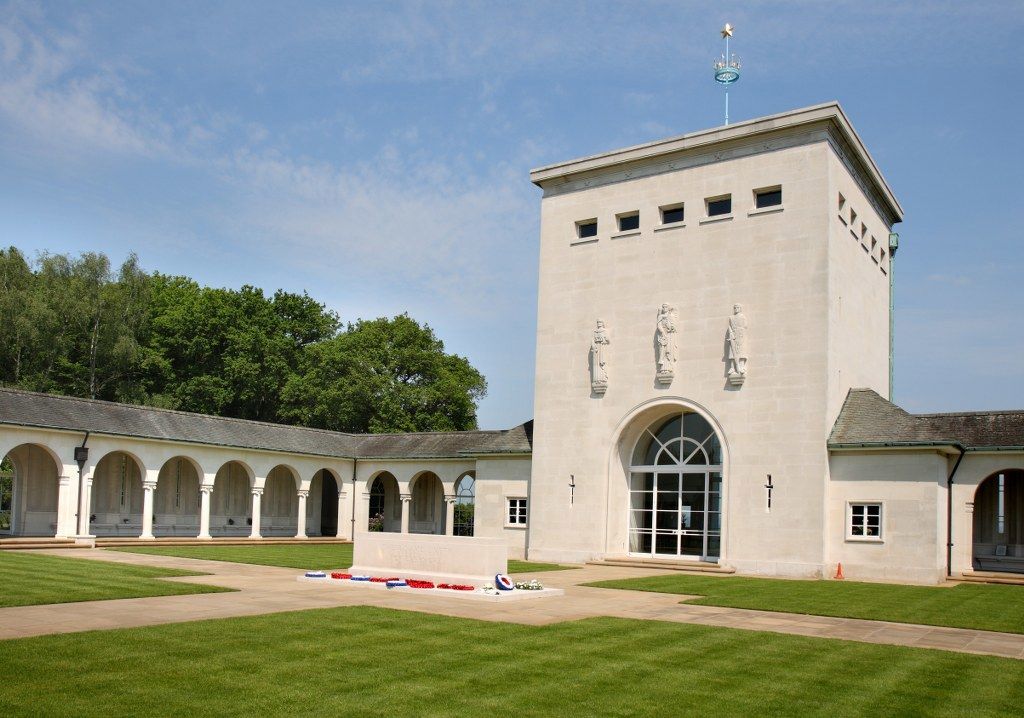 Photo of Thomas Wilfred Henry Usher
Commemorated on the Runnymede Memorial (www.cwgc.org)