

Cyril Pullen
He was a joiner.
- Family History
- Military history
- Extra information
- Photographs
He was the son of Cyril and Florence Pullen of 36, Garden Road, Radford, Nottingham.
Trooper Pullen died during the Siege of Dunkirk operations in October 1944. As part of the 7th RTR's heavy Churchill tank crews operating in the muddy, waterlogged western perimeter near Mardick and Grande-Synthe, he faced a treacherous stalemated battlefield.
While the Allied objective focused on containing and starving out the fanatical German garrison rather than mounting a full-scale bloody assault, the perimeter was heavily seeded with dense German minefields. The tank crews were also subjected to constant, harassing artillery and mortar fire. Pullen was lost during these late-autumn containment skirmishes.
In October 1944, the 7th Battalion, Royal Tank Regiment (7th RTR), operating heavy Churchill tanks under the Royal Armoured Corps, was detached from its parent brigade to play a critical role in the siege and containment of Dunkirk.
Having spearheaded brutal breakthroughs from the Normandy beaches to the capture of Le Havre in September, the reconstituted battalion spent October pinning down a heavily fortified, fanatical German garrison that Adolf Hitler had ordered to hold the French port at all costs.
The Siege Layout
• Dunkirk Containment: The battalion was operating around the perimeter of Dunkirk, specifically stationed in the muddy, waterlogged sectors near Mardick and Grande-Synthe to the west of the city.
• The Stand-off: Rather than mounting a costly direct assault on the heavily mined port, the Allied strategy focused on starving out the garrison while defending against aggressive German counter-raids.
Mid to Late October: Active Skirmishing
• Diversionary Feints: According to the 7th RTR October 1944 War Diary, the Churchill tanks frequently conducted diversionary sorties alongside French resistance forces (Forces Françaises de l'Intérieur, or FFI).
• Drawing Fire: These feints were designed to draw heavy German artillery fire away from adjacent sectors where Allied infantry—including the Czechoslovak Armoured Brigade—were successfully launching assaults to capture prisoners and shrink the pocket.
• The Hazards: The landscape was highly dangerous. During operations in late October, the battalion lost tanks to dense German minefields laid along the canal banks and roads. At the same time, crews endured regular, harassing German shelling.
Unit Strength & Footprint
• By the end of October 1944, the 7th RTR maintained an active field strength of 45 officers and 617 other ranks, supported by their Light Aid Detachment (LAD) engineers and a chaplain.
• They successfully held their ground, transitioning into November before eventually being pulled back to prepare for a major tactical shift: refitting with specialized Churchill Crocodile flamethrower tanks for the final invasion of Germany.
 Cyril Pullen
Nottingham Evening Post 31/10/1944
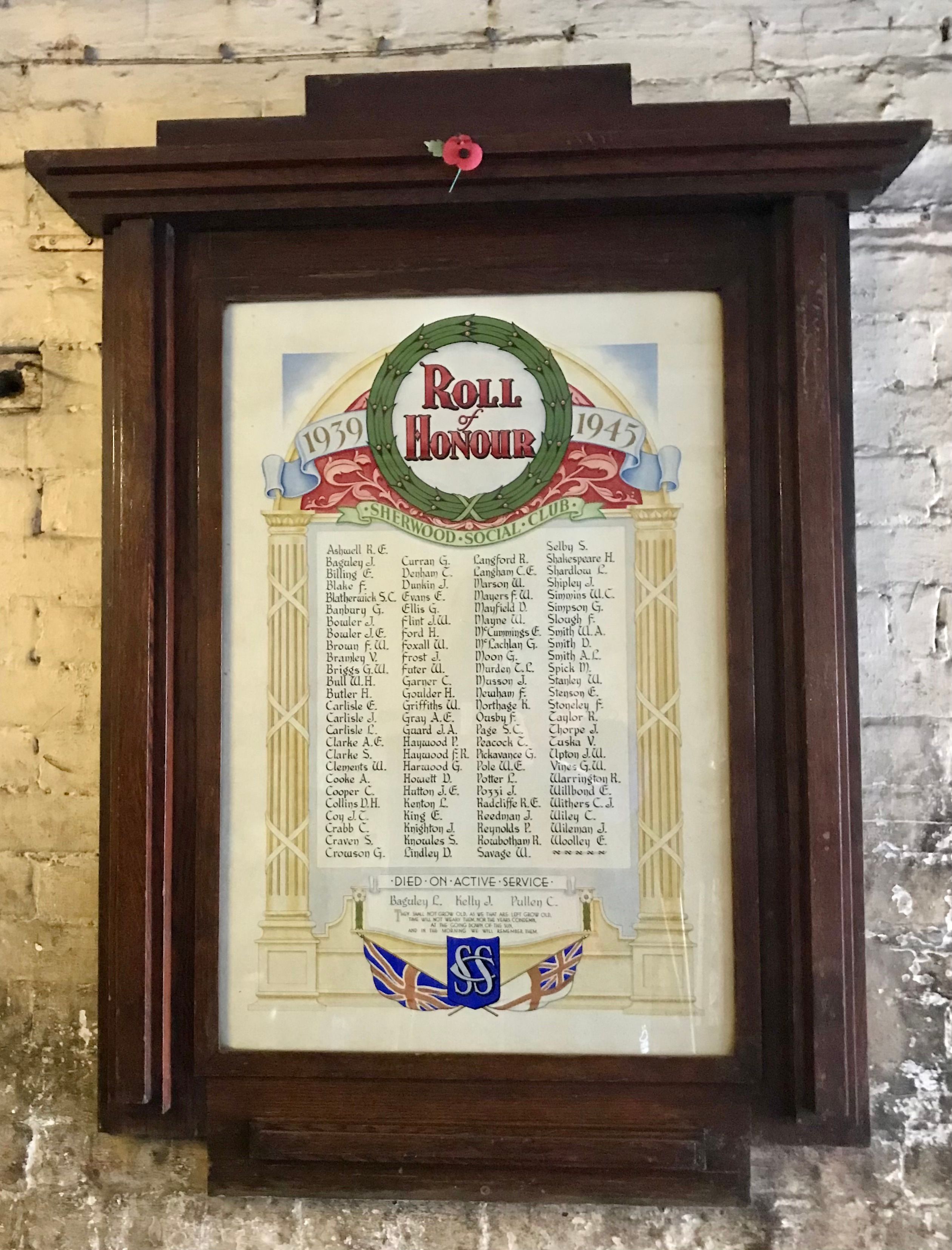 Photo of Sherwood Social Club World War Two Roll Of Honour.
Photograph of the former Sherwood Social Club World War Two Roll Of Honour on which Trooper,Cyril Pullen is Commemorated by Gary Crosby on the 10th December 2025.