

Frederick Meer
- Family History
- Military history
- Extra information
- Photographs
He was the son of Frederick and Rosina Meer and the brother of Norma, Roy, Brian and Rosina Meer of 10, Clifford Street, Radford, Nottingham.
In September 1944, the 7th Battalion, Duke of Wellington's (West Riding Regiment)—serving as part of the 147th Infantry Brigade within the 49th (West Riding) Infantry Division (known as the "Polar Bears")—was actively engaged in the rapid Allied advance across Northwest Europe following the breakout from Normandy.
By late September 1944, his unit moved up into Belgium along the Dutch border near the Antwerp-Turnhout Canal sector. They were heavily engaged in pushing back stubborn German rearguards and clearing the area to safeguard the flanks of the ongoing liberation campaigns. Fredrick Meer was killed on the final day of September during these actions.
The battalion’s operational history during this month is defined by two major actions:
- Operation Astonia: The Siege of Le Havre (10–12 September 1944)
• The Objective: After bypassing several heavily fortified French ports, the Allies launched a massive, coordinated assault to capture the vital port city of Le Havre, which was being fiercely held by an isolated but well-entrenched German garrison.
• The Assault: On 10 September, following an immense preliminary bombardment by the Royal Air Force and the battleship HMS Warspite, the 49th Division assaulted the northern sector of the city perimeter.
• The Outcome: The 7th Battalion successfully penetrated the dense German minefields, anti-tank ditches, and concrete strongpoints. By 12 September, the German garrison surrendered completely, securing the port and yielding over 11,000 prisoners of war for minimal Allied casualties.
- The Advance to Belgium & Operation Market Garden Support (Mid to Late September)
• The Dash North: Following the victory at Le Havre, the 7th Battalion moved rapidly eastward across France and into Belgium to keep pace with the shifting frontline.
• Flank Security: From 17 to 25 September, during Operation Market Garden, the 49th Division was assigned to protect the critical and highly vulnerable western flank of the airborne corridor (the "Hell's Highway") leading up toward Eindhoven and Arnhem.
• Turnhout Canal Sector: By late September, the battalion arrived at the Belgian-Dutch border. They pushed toward the Antwerp-Turnhout Canal sector to clear out stubborn German rearguard resistance, paving the way for the division's subsequent drive into the southern Netherlands.
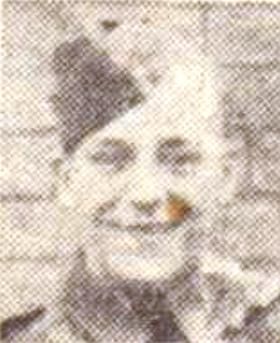 Frederick Meer
Nottingham Evening Post 17/10/1944