

Philip Bonnington Smith
He attended Nottingham Boys' High School.
- Family History
- Military history
- Extra information
- Photographs
Note: Although Philip's father is named as 'Joseph' on the CWGC record, his father's first name appears as 'Albert' on his registration of marriage, census and the probate record as well as other civil records.
Philip was the son of Albert and Constance Elizabeth Smith (née Essex). His father Albert Smith was born in Edingley, Southwell, Nottinghamshire, the son of Joseph Smith whose occupation was given as 'gentleman' on his son's marriage certificate in 1906 but whose occupation on the 1881 census had been 'joiner and wheelwright' and as 'fruiterer and wheelwright' in 1891. Albert was the youngest of at least five children; his siblings were Georgiana, John William, Alice Ann and Lois. His mother Constance Elizabeth was born in Nottingham, the daughter of Thomas Bonnington Essex, a lace manufacturer.
Albert and Constance were married at Hornsey St Luke, Middlesex on 9 August 1906. Albert was a farmer, residence Edingley, and Constance was living in Hornsey. They had three sons, Frederick Joseph b. 1907 (JAS), Albert Ernest birth registered 1909 (JFM) and Philip Bonnington b. 1913 (AMJ), who were all born in Edingley.
Albert, a farmer, and Constance together with their sons Frederick and Albert were living on Greaves Lane, Edingley, in 1911. Their third son, Philip, was born two years later in 1913 (AMJ).
Albert died after a short illness on 17 July 1914 when his youngest son Philip was only a year old.
His widow Constance was still living at Greaves Lane in 1921 along with her three sons, all of whom were school age, and two female domestic servants. She was described as head of household, occupation 'dairy produce and fruit merchant'.
Neither Constance nor her two older sons have yet been positively identified in UK records after the 1921 Census, and few civil records have been found for Philip. The CWGC record names Philip's parents and also his wife Irene Ramona of Asuncion, Paraguay, and the probate record gives Philip's residential address as Calle Cerro Cora, Asuncion, Paraguay.
In support of Canadian forces straining to liberate Calais, in German hands since 1940, 188 aircraft - 101 Lancasters, 62 Halifaxes & 25 Mosquitoes - set out 24 September 1943 to bomb Calais. German positions were covered in cloud at 200 feet and only 126 planes bombed, most using Oboe-aimed sky markers.
However, some, including 12 Lancasters deployed from Mildenhall, came below the cloud to bomb visually. Flak, very accurate at such low altitude, shot down 1 Halifax and 7 Lancasters including LM 109E piloted by Flight Lieutenant Philip Bonnington Smith.
There were three fatalities from LM 109E: PB Smith (P), 1824999 Sgt. John Sinclair Paterson RAFVR (MUAG) age 19 and 1564464 Sgt. William Gilchrist Dufferin Shearer RAFVR (RAG) age 22.
Philip Bonnington Smith was buried in Calais Canadian War Cemetery, Leubringhenm France, grave ref. 3. C. 9. His fellow crew members were buried in the same cemetery, Sgt. Shearer was buried in grave 3.C.8 and Sgt. Paterson in grave 3.C.10.
Four of the crew survived: T Mayer (FE), FS Flower (N), LM Riordan (W/Op), FS Raith (AB).
Note: Australian wireless operator, Sgt. Lex Maitland Riordan (426468), who survived the crash was killed in a flying accident over Norfolk, UK on 17 January 1945 (Cambridge City Cemetery).
15 Squadron's ORB (TNA Air 27/204/18) provides an unusually detailed account of the incident compiled from interviews with the four survivors:
'On the run in to the target, the port outer (Engine) was hit by flak and caught fire, It is thought the rear gunner Sgt Shearer was killed in this attack. The engineer feathered the engine and the fire was extinguished. The bombing run was resumed and bombs dropped. The aircraft was hit again and the pilot (Smith) wounded.
'The order to bale out was given and the mid upper gunner (Paterson) went back to see what had happened to the rear gunner (Shearer). All the crew baled out at 1800 feet except the pilot, mid upper and rear gunners. The pilot appeared to leave the aircraft by the upper escape hatch but his parachute was seen to catch in the hatch.
'On landing, the survivors hid until they were certain that they had landed in our own territory. They were picked up by the Canadian Army and made their way back via various army units who looked after them very well. The finally made contact with an RAF Regiment unit and were passed on to Group on 25/9/1944. They were flown back from Ypres to this country and reported to this unit on 28/9/1944 (only four days after being shot down).'
Newark Herald, ‘Death’, 18 July 1914: ‘We sincerely regret to record the demise of Mr Albert Smith, of Grave’s (sic)-Lane, which occurred yesterday morning after an illness extending over a week. The deceased occupied a small farm, and dealt largely in poultry, butter and eggs, and attended markets at Nottingham, Lincoln, Newark and Mansfield. Mr. Smith was 34 years of age, and leaves a widow and three young children, for whom much sympathy is felt.’ (www.britishnnewspaperarchive.co.uk)
Probate (abbrev.): Smith Albert of Greaves-lane Edingley Nottinghamshire died 17 July 1914 Probate London 19 January to John William Smith [?brother] market gardener and Constance Elizabeth Smith widow. Effects £3850 0s 4d.
CWGC Additional information: Son of Joseph (sic) and Constance Elizabeth Smith; husband of Irene Ramona Smith, of Asuncion, Paraguay.
CWGC headstone personal inscription: 'Always remembered by his wife and chid in Paraguay, and family in England'
Probate. Smith Philip Bonington of Calle Cerro Cora Asuncion Paraguay died 24 September 1944 on war service Administration (limited) Llandudno 1 September to sir George Stanley Pott knight and Norman Croom-Johnson solicitors attornerys of Irene Ramona Comas de Smith widow. Effects £1813 11s. 4d.
The Liberation of Calais - September/October 1944
RAF Bomber Command provided critical support to Canadian forces during the capture of Calais (Operation Undergo) in September 1944. As part of the efforts to clear German-occupied channel ports, Bomber Command conducted heavy bombing raids to break German resistance.
• Operation Undergo (September 1944): The 3rd Canadian Infantry Division led the assault on Calais. Bomber Command was called upon to soften up defences, including Fort Lapin, which were strongly held by German forces.
• Key Support Action: On September 28, 1944, Bomber Command delivered a heavy attack on the city's defences, which severely impacted German morale and led to a temporary truce requested by the German commander, Lt.-Colonel Ludwig Schroeder.
• Progressing the Siege: Following continued Canadian advances—such as the Canadian Scottish crossing the canal and the Regina Rifle Regiment attacking the southern fringes —further Bomber Command air attacks were scheduled to coincide with the expiration of a truce on September 30, 1944.
• Canadian Participation: The operation was a crucial part of the First Canadian Army's mandate to open Channel ports to Allied shipping.
Calais was eventually liberated on October 1st 1944 by the Canadian First Army, having been heavily bombed to break the German hold.
Additional information RF (July 2026)
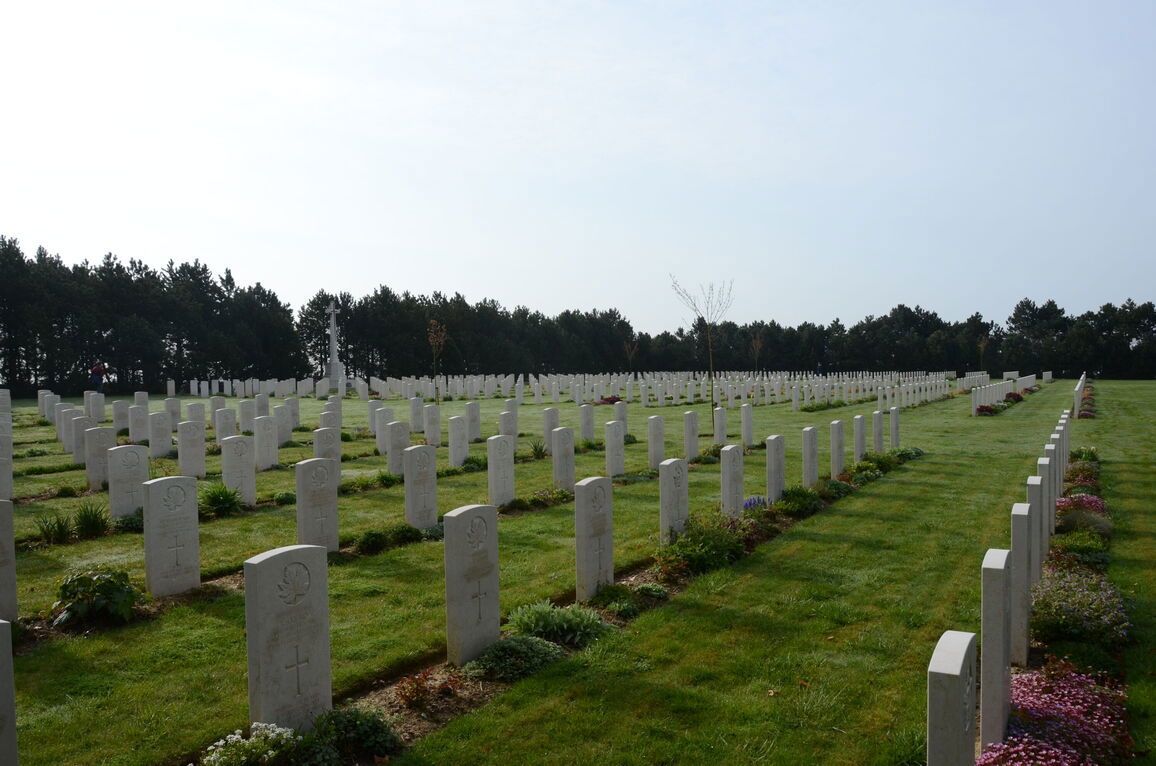 Photo of Philip Bonnington Smith
Buried in Calais Canadian War Cemetery (www.cwgc.org)
Photo of Philip Bonnington Smith
Buried in Calais Canadian War Cemetery (www.cwgc.org)