

Alonzo Thomas Williamson
Alonzo Williamson worked as a brass bobbin winder.
- Family History
- Military history
- Extra information
- Photographs
Alonzo Thomas Williamson was born in 1878 in Nottingham, and married Sarah Jane Harris (b. 1884, Ilkeston, Derbyshire) in 1901 (JAS Nottingham).
A newspaper report of Alonzo's death recorded that he and Sarah had seven children and these are named on the Army pension record of Sarah's second husband, John George Smith: Nellie, b. 1 June 1902, Frances b. 21 October 1904, George b 27 February 1906, Alonzo Thomas b. 20 June 1908, Alice b. 11 April 1911, Norah Winifred b. 2 October 1912 and Roy b. 17 January 1915. The surnames of the four oldest children were given on John's Army record as 'Williamson Smith' while the surnames of the youngest three (Alice, Norah and Roy) were given as 'Smith'. All the children were born in Nottingham.
In 1911 Alonzo, a brass bobbin winder, and Sarah were living at 44 Duncombe Street, Nottingham, with their four children, Nellie (8), Frances (7), George (5) and Alonzo (2). They later lived at 76 Norland Road, Nottingham.
Alonzo's widow married John George Smith at Nottingham Register Office on 7 February 1916. John was a regular soldier who had joined the Sherwood Foresters in August 1904 and after service at home served in India. His battalion served with the British Expeditionary Force in France in 1914. John Smith was not demobilised until 30 May 1919 when he was transferred as a Class 'Z' Reservist until 31 March 1920.
Sarah and John had at least one child, Joseph Smith, b. 10 December 1916. The family home was at 2 Ada Street off Meredith Street, St.Ann's Well Road, Nottingham.
Sarah probably died in 1936 (June Nottingham) aged 52.
Williamson had served with the Notts. and Derby Regiment for six years and a further year with 1st Notts. V.R.C. He joined the the Territorial Army on 1st March 1909, at Nottingham serving with 'C' Company, 7th Battalion, Sherwood Foresters he was 31 rs of age and a lacehand . He attended the annual camp from 1909 to 1912.
He arrived in France with his unit on 28th February 1915.
In April 1915 both 'C' and 'D' Companies were in reserve, occupying farms in the vicinity of Lindenhoek. The lines were mainly breastworks as the ground was too waterlogged to dig trenches, and relieving troops had to pass over open ground under constant fire.
Williamson was killed on 6 April while in the trenches and was buried in Lindenhoek Chalet Military Cemetery, Belgium (grave ref.I.B.9). The service was taken by an Army chaplain, Rev. H Hales.
He qualified for the 1914/15 Star, British War Medal and Victory Medal.
CWGC history of Lindenhoek Chalet Military Cemetery (extract): the Cemetery is 9km from the town of Ieper (Ypres). 'The first burials were made in the cemetery in March 1915 and it continued to be used by fighting units and field ambulances until October 1917. It was enlarged after the Armistice when over 100 graves were brought in from the battlefields surrounding Kemmel.' (www.cwgc.org)
CWGC Additional information: Son of Sarah Williamson, of Nottingham; husband of Sarah Jane Smith (formerly Williamson) of 2, Ada St., St. Ann's Well Rd., Nottingham.
CWGC headstone personal inscription: 'Too far away thy grave to see not too far for us to think of thee'
Nottingham Evening Post, 15 April 1915:
'Robin Hoods in the Trenches. Shell Fire Experiences. Three Casualties.'
'Writing home to his friends in Nottingham an officer of the Robin Hoods, who commenced his letter on Easter Tuesday, says that just at the moment of beginning the epistle he was interrupted by the killing of Lance-Corporal T. Williamson, of his company (C).
'Proceeding, the writer states that Williamson’s company was to have been relieved at midnight, but owing to the terrible state of the communication trench, the relieving company could not get in to take over until after daybreak, so that there was nothing for C Company to do but to remain, without food or water. It redounded to their credit that not one of them was heard to grumble.
'They were wonderful," continues the officer, "and it was bad luck having to remain, as in addition to Williamson being killed by a shell, two others were wounded. We got let in for a regular shelling, but those were the only men who were hit. Being shelled, while not pleasant, is not necessarily dangerous in the trenches. The men stood the strain magnificently, and are fit to go anywhere.
'It is difficult to describe one’s feelings under heavy shell fire. Personally, I was not conscious of any feeling, having my men to watch. I certainly don’t think there was anywhere. It was mostly interest to see exactly where the shells exploded.'
Nottingham Evening Post,'Roll of Honour', 14 April 1915: 'Williamson. Killed in action April 6th, Lance-Corporal A. T. Williamson, late Robin Hood, the devoted brother of Marion King, 37, Norland-road. He has fought the good fight and finished his course.'
Above courtesy of Jim Grundy facebook pages Small Town Great War Hucknall 1914-1918.
Nottingham Evening Post, 14 April 1915, photograph with caption: 'Lance-Corpl. AT Williamson, C Company, first of the Robin Hoods reported killed in the trenches. He leaves a wife and seven children one of whom was born since he was called up.' (www.britishnewspaperarchive.co.uk)
His personal effects were returned to Mrs Sarah Jane Williamson, 76 Norland Road, Nottingham, 15 September 1915, and comprised: 2 hair brushes, razor strop, razor, scissors (haircutting), scissors (nail), 2 shears (haircutting) spoon, lamp (flash), lotters (two), bag (American leather).
A second list of personal effects is held with his service papers: bolt x1, box (tobacco) x1, diary x1, disc (identity) x1, knife (jack) x1, pipe x1, pipe lighter x1, purse (leather) x1, watch (metal) x1, bundle of postcards x1
Registers of Soldiers' Effects: his widow, Sarah Jane, was his sole legatee.
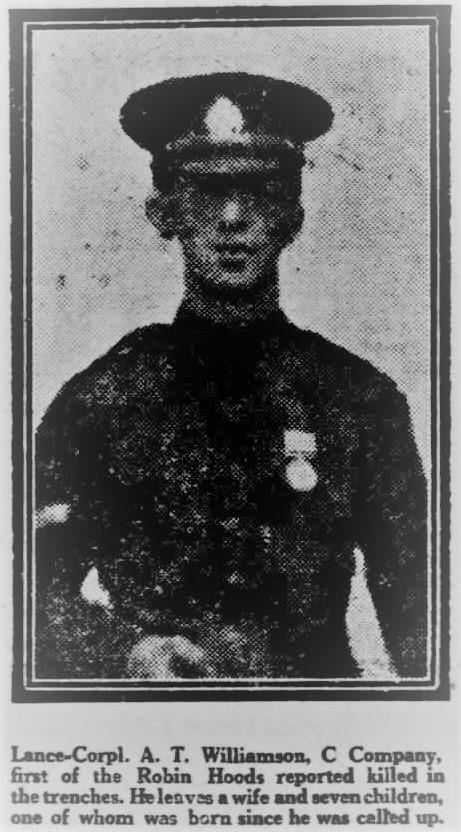 Alonzo Thomas Williamson
Nottingham Evening Post, 14 April 1915. Source: Jim Grundy facebook pages Small Town Great War Hucknall 1914-1918.
Alonzo Thomas Williamson
Nottingham Evening Post, 14 April 1915. Source: Jim Grundy facebook pages Small Town Great War Hucknall 1914-1918.