


Alfred Bexon
In 1911 he was a pit pony driver below ground.
- Family History
- Military history
- Extra information
- Photographs
Alfred Bexon was born in 1892 at Countersthorpe, Leicestershire He was the son of Frederick, a brick burner from Loughborough and Agnes (née Fisher) He was the brother of Isaac (b.1883), George (b.1888), Ethel (b.1892), James Lionel (b.1894), William Arthur (b.1896) and Jane (b.1900) Bexon.
His father Frederick was born in 1860 at Loughborough, his mother Agnes Fisher was born in 1859 they were maried in 1881 at Loughborough they went on to have 9 children, sadly 1 was to die in infancy or early childhood.
In 1911 they lived on New Street Hilcote Blackwell Derbyshire, Frederick 51 yrs is a brick burner, he is living with his wife Agnes 52 yrs and their children, Isaac 28 yrs a brick burner, Alfred 19 yrs a coal miner pony driver, Ethel 18 yrs helping at home, James Lionel 17 yrs a coal miner pony driver, William Arthur 15 yrs a pt bank boy and Jane 11 yrs a scholar.
Alfred was the husband of Annie Smith (born 10th March 1895) they were married in 1915 at Mansfield, they lived 52 Main Street, Huthwaite, Mansfield, they had a daughter Nellie Bexon born 1st February 1915.
Commencing 16th December 1918 his widow was awarded a pension of 20 shillings and 5 pence a week.
Private Alfred Bexon enlisted in Sutton in Ashfield whilst residing at Huthwaite he served with the 9th Battalion Sherwood Foresters Regiment, . His medal index card shows he first entered a theatre of war on 27th August 1915. He probably died of wounds received on 3 June 1918 when there were four casualties from 'A' company during the normal relief in the 'Hay Locality' trench area forward of Mazingarbe, France he is burieat Pernes British Cemetery, France. grave II. F. 42
Notts Free Press - 21st June 1918
PRIVATE A. BEXON, HILCOTE.
On June 7th, Private Alfred Bexon, of Newlane, Hilcote, Blackwell, succumbed to wound received in action four days previously. Private Bexon was one of four brothers who joined up at the beginning of the war, prior to which he worked at the B Winning Colliery. After being wounded and gassed he returned to France last February. He leaves a widow and one child. Mrs. Bexon has received the following letters:-
"It is with heartfelt sympathy I write to you in your great and sad loss. It happened on the 3rd instant, about 12 p.m., when your dear husband met his fatal wound by splinter from shell, and he died later at the Casualty Clearing Station several miles behind the lines. The information I have got is that he never suffered from his wound, as I understand he was unconscious until leaving this world for the better world. All of the platoon send their heartfelt sympathy to you, ..."
Research by Peter Gillings
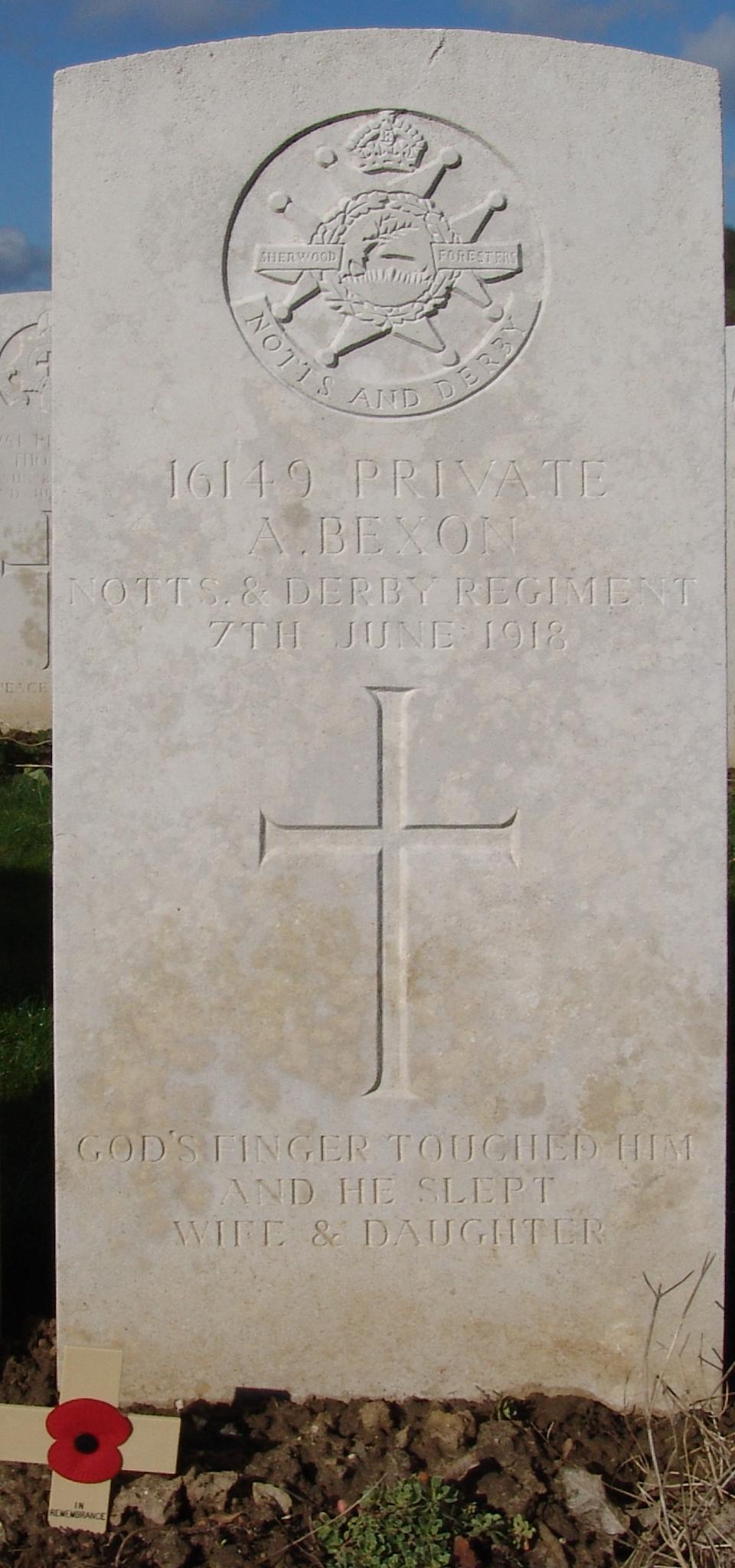 Alfred Bexon's grave
16149 Private Alfred Bexton, Pernes British cemetery, grave II. F. 42. He is one of four men buried in this cemetery from 9th Battalion.
Grave visited and a cross laid in his memory.
Photo courtesy of John Morse.
Alfred Bexon's grave
16149 Private Alfred Bexton, Pernes British cemetery, grave II. F. 42. He is one of four men buried in this cemetery from 9th Battalion.
Grave visited and a cross laid in his memory.
Photo courtesy of John Morse.
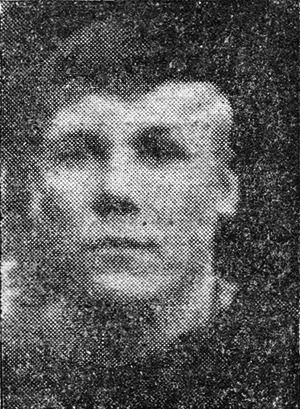 Photo of Alfred Bexon
bexon_alfred_photo courtesy of the Sherwood Foresters Regiment roll of honour website.
Photo of Alfred Bexon
bexon_alfred_photo courtesy of the Sherwood Foresters Regiment roll of honour website.