


Alfred & Rosanna Rogers
1901/1911 - Alfred was wholesalers clothiers stock cutter. His occupation was given as tailor on his son Albert's marriage certificate (1920)
- Family History
- Military history
- Extra information
- Photographs
Alfred Taylor was born in York Street, Nottingham, birth registered 1872 (JFM), the son of Clement and Elizabeth Rogers (née Taylor). He was baptised at Nottingham St Mark on 7 February 1875.
Rosanna (Rose) Rogers (née Smith) was born in Dennett Street, Nottingham, in about 1873, the daughter of James (d. 1892) and Mary Ann Smith (d. 1928). Her parents had five children, one of whom probably died in infancy or childhood. Rosanna had two older siblings, David and Sarah, and a younger brother, Albert. The family was living at 158 Waterway Street, Meadows in 1891 and also in 1911, although in 1901 Rosanna's widowed mother, a shopkeeper (grocer), was living with her two sons at 11 Newthorpe Street.
Alfred and Rosanna were married at Nottingham St Saviour on 25 February 1894 and had two sons, Albert (b. 1894) and James William (b. 1896).
Both sons were born at Waterway Street, Meadows, but in 1901 the family was living at 25 Newthorpe Street, London Road. Alfred and Rosanna and their sons were living at 32 Newthorpe Street by 1911; Albert was a picture frame cutter (Boots Co.) and James an apprentice (hosiery).
Both sons served during the war.
Albert attested on 31 January 1912 in the Territorial Force (Sherwood Foresters) on a 4 years service engagement (UK) but joined 7th (Robin Hood) Battalion on embodied service on 5 August 1914. He served with the Battalion in France from 28 February 1915 but returned to the UK on 2 November 1916. Albert was discharged on 9 April 1917 as a result of wounds received in action (Para 392 xvi KR). Service record: Home 31 January 1912-27 February 1915, 3y 28d; BEF France 28 February 1915-1 November 1916 (1y 247d); Home 2 November 1916-9 April 1917 (159d). He qualified for the 1914/15 Star, British War Medal and Victory Medal.
Albert, occupation circular sawyer, of 11 Newthorpe Street, married Ida Carter, a domestic servant, at Nottingham St Saviour on 18 September 1920. In 1939 when the England & Wales Register was compiled, Albert, a sawyer (timber), and his wife were living in Carlton, Nottingham. He died in 1959.
M2/113155 Driver James William Rogers joined the Army on a Short Service Engagement (Duration of War) and served with 607th Company Army Service Corps. He enlisted 27 May 1915 and was posted to Bridgewater between 7 December 1915 – 12 April 1916 at the 2nd Australian Ammunition Sub Park driving Peerless lorries. He served in France from 12 April 1916; the company later served in Italy. James transferred to 297th Company (No.2 Company), 41st Divisional Train, in France, on 20 February 1918. He was with the unit until the end of the war and then served as part of the Army of Occupation in Germany. He transferred to Class 'Z' Army Reserve on 12 July 1919; discharged to 158 Waterway Street, Meadows (probably the home of his maternal grandmother). He qualified for the British War Medal and Victory Medal.
James married Annie M Melligan in 1924 and had a son, Rex (b. 1925) and also a daughter (probably Joan, birth reg. 1934 JFM). His wife probably died in 1939 (JFM) and the widowed James was recorded on the 1939 Register at Rupert Street, Meadows, occupation hosiery counterman; also in the household was his housekeeper. Rex, who was school age, was living with a family in Cropwell Butler, Nottinghamshire. James' home was still on Rupert Street when he died in hospital in 1961, aged 65. His son Rex was awarded probate. There is a record from Meadows St George's church that arrangements for James's funeral were made by his daughter.
Nottingham was bombed for the only time in the Great War early on Sunday, 24 September 1916.
Zeppelin L-17 dropped a clutch of bombs in a line from Eastcroft through the Meadows to Nottingham Midland Station along Carrington Street, Greyfriar Gate, Wheeler Gate and Lister Gate then Victoria Station where windows were shattered. Canaan Street Primitive Methodist Church was set on fire by an incendiary bomb and business premises, including Haddon's factory in Carrington Street and a warehouse at the corner of Lister Gate, were wrecked. Three people were killed and sixteen injured.
At 32 Newthorpe Street, Alfred and Rosanna Rogers were in bed when a stick of bombs fell on their house and surrounding buildings. Alfred Rogers was killed where he lay, his wife's body was found in the street, having been thrown several yards by the blast. Another eight people were dug out of the wreckage of three homes.
Alfred and Rosanna were buried in Nottingham General Cemetery on 28 September 1916.
Nottingham General Cemetery, headstone inscription: 'In loving memory of Alfred Taylor Rogers, aged 44 years, also Rosanna, wife of the above aged 42 years. Who were killed during air raid Sep. 24th 1916. Also James Smith died Sept. 29th 1892 aged 49 years. Also Mary Ann Smith, wife of the above who died April 19th 1928 in her 84th year. At Rest. And of (-) Smith who died May 23rd 1930, aged 64 years.'
Alfred and his wife had made individual Wills; probate of each was awarded to their eldest son, Albert, 'private in HM Army'.
Nottingham Evening Post, 27 September 1916. Report of the inquest:
An inquest jury ruled that the three victims 'had been murdered by person or persons unknown, through the explosion of bombs dropped from an airship.' Responding to allegations that L-17 had been attracted by lights or shunting sparks from London Road Station, the jury added a rider: ‘The town was exposed to the risk of attack by airships entirely by the action of the railway companies.’
‘Evidence was then called to prove that shunting operations were in progress on railway sidings with six arc lamps burning and throwing reflections upon an adjacent factory. All other lights had been out for some time, but these were kept burning until after a bomb had dropped, when they were extinguished. Shunting was continued for a time with hand lamps, and then it ceased.
'A sergeant-major said that the lights were all out except upon the railway. Here they were burning on the station, and in full glare when the first bombs were dropped. Trains were arriving and departing, but he noticed no light in them.
'Another witness, however, said that a mail train was visible from the fact that all its windows were not screened, and another witness declared that the first bomb dropped within seven or eight minutes of the arrival of the train, and that at this time the lights of the station and in the siding, were still burning.
'The Coroner said that he had given an intimation to the railway authorities of the inquest and of the likelihood that the question of lights would be raised but they were not represented. The point was whether the jury thought that some sort of representation ought to be made to the Home Office.’
Nottingham Evening Post, 27 September 1916, report of inquest: ‘Burned to death ... The third victim was a labourer, 21 years of age. He and his wife were asleep in the middle floor of a three-storeyed house when a bomb came like a ball of flames through the roof of the room above and fell on the deceased. The bed immediately took fire, and the wife ran for a bucket of water which she threw over the bed. A second bucket she also threw but the room was so full of smoke that she could not see the effect. The woman sought for assistance and cried for a quarter of an hour before anyone came, and then the deceased was taken on a barrow to the hospital, but he died on the way. The foreman of the jury expressed the view that the bereaved woman had shown great presence of mind. A neighbour said that she saw the deceased on a landing outside his bedroom. His head and shoulders were in flames.’
Postscript: John Beech writes, 'Police Constable Lory Robert Marsh of Campbell Grove, Robin Hood Street, who had been with the force eight or nine years, had been on duty on the night of the raid. He committed suicide three days later on 26th September 1916. The Nottingham Evening Post reported that, on the morning following the raid, a complaint, the first ever made against him, was brought before the Deputy Chief Constable. It was alleged that had been under the influence of liquor, but at his own request had been given an opportunity to obtain witnesses, and should have appeared before his superiors on the day he was found dead. He was described by a senior officer as ‘a healthy man, and a good officer’. P.C Marsh cut his own throat and then hanged himself at his home. His mother had recently died, and this, together with being on duty on the night of the raid, and the threat of a disciplinary hearing probably contributed to his death.'
Nottingham Evening Post, ‘Deaths’, 26 & 27 September 1916: ‘Rogers. On September 24th, at Newthorpe-street, suddenly, Alfred Taylor, fifth son of the late Clement and Elizabeth Rogers; also Rose, his wife, daughter of the late James and Mary Ann Smith, Waterway-street.’ (www.britishnewspaperarchive.co.uk)
Nottingham Evening Post, 'In Memoriam', (date not confirmed)
'In loving memory of our dear mother and father Rose and Alfred killed in Newthorpe Street September 24th 1916. Sadly missed from their loving sons Albert, Jim (in France).'
'In loving memory of my dear daughter and son in law killed in Newthorpe Street September 24th 1916. Day of remembrance sad to recall. From their loving mother, brothers and sisters.'
Nottingham Evening Post, ‘In Memoriam’, 24 September 1918: ‘Rogers. In loving memory of our dear father and mother, who were killed September 24th 1916, late Newthorpe-street. Sadly missed. From their loving sons Albert and Jim.’ (www.britishnewspaperarchive.co.uk)
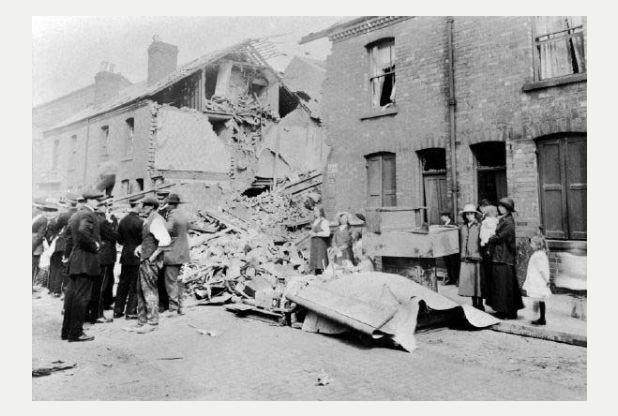 Newthorpe Street Meadows
This photo shows 32 Newthorpe Street, Meadows following The Zepplin Raid on the night of 23rd/24th September 1916
which killed Alfred and Rosanna Rogers
Courtesy of the Nottingham Evening Post
Newthorpe Street Meadows
This photo shows 32 Newthorpe Street, Meadows following The Zepplin Raid on the night of 23rd/24th September 1916
which killed Alfred and Rosanna Rogers
Courtesy of the Nottingham Evening Post
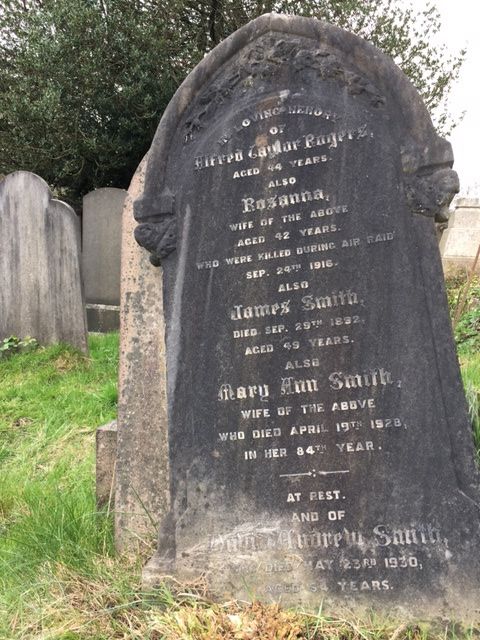 Photo of Alfred & Rosanna Rogers
Buried in Nottingham General Cemetery. Photograph Rachel Farrand (April 2026)
Photo of Alfred & Rosanna Rogers
Buried in Nottingham General Cemetery. Photograph Rachel Farrand (April 2026)
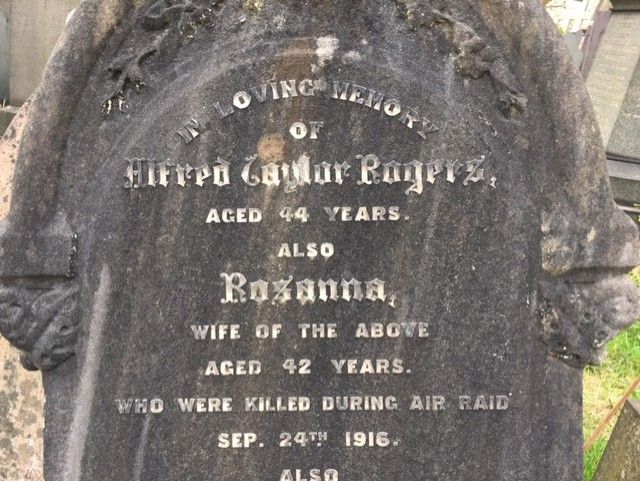 Photo of Alfred & Rosanna Rogers
Buried in Nottingham General Cemetery. Photograph Rachel Farrand (April 2026)
Photo of Alfred & Rosanna Rogers
Buried in Nottingham General Cemetery. Photograph Rachel Farrand (April 2026)