


Thomas Paine Sharp
Sharp attended Mundella School Meadows Nottingham. In August 1914, he was teaching at St Andrews’ Trust School, Nottingham.
- Family History
- Military history
- Extra information
- Photographs
Thomas Paine Sharp was born in 1892 at Nottingham, he was the son of Henry a confectioner and Mary Ann Sharp née Pearce of 97, Derby Road, Long Eaton.
His father was a baker/confectioner/gingerbread maker born in 1855 at Derby, his mother Mary Ann Pearce was born in 1859 at Basford, they were married in 1891 at Nottingham, they went on to have 4 children,
In the 1911 census the family are living at 77 College Street, Long Eaton, Henry 56 yrs is a confectioner, he is living with his wife Mary Ann 52 yrs and their children, Mary Ann 30 yrs a teacher, Henry 25 yrs a draughtsman, Frederick 24 yrs a draughtsman and Thomas Paine 19 yrs a student teacher.
He was the husband of May Robinson (born 18th June 1892) of 5, Plantagenet Street, Nottingham they were married on 18th August 1915 at St Thomas Church, Nottingham.
In 1915 Sharp joined the OTC at University College Nottingham where he trained to teach after obtaining a (London external) B.Sc. Sharp was the youngest of five, with two sisters teaching in 1901 and brothers employed as a draughtsman and an architect’s pupil.
Sharp married in late 1915 around the time Lord Derby and Asquith were pledging that no married men would be conscripted whilst single contemporaries were still available. Marriage probably deferred his call up until the following May.
Sharp was deployed to the Civil Service Rifles in the summer of 1916, after thirteen weeks basic infantry training, as part of a draft replacing original civil service volunteers killed during the spring, notably at Vimy Ridge a year before its capture by Canadian forces.
On September 12th, the battalion marched through Albert and occupied positions south west of High Wood at 1800hrs two days later.
When German forces were finally expelled from Delville Wood in early September, following weeks of brutal struggle, High Wood remained the final important strategic vantage point on the ridge still in enemy hands. The CSR were part of 47th Division whose task was the capture High Wood as part of the opening phase of the Battle of Flers-Courcelette.
The objective was achieved but with terrible casualties; 15 CSR officers and 365 o/rs were lost as 47th Division was ‘met with such heavy fire from unbombarded German machine gun positions that few survived to contribute to their respective war diaries.’
Promised support from tanks degenerated into a fiasco. The king’s congratulatory telegram reflected public celebration of the “success” but a survivor recalled seeing ‘men torn to fragments by the near explosion of bombs and – worse than any sight - I heard the agonised cries of men in mortal pain.’ It is possible that Sharp was a fortunate survivor of this action although it seems more likely, in view of the CSR’s losses in High Wood that he joined the battalion in its immediate aftermath.
After little rest and only three weeks to regroup, the battalion returned to action in a doomed assault on the Butte de Warlencourt, a sixty foot high ancient burial mound two miles north of High Wood.
The Butte was riddled with tunnels and deep dugouts and heavily defended by mortars, machine guns and belts of barbed wire. A survivor of 47th Division’s assault on the Butte de Warlencourt recalled ‘at 2pm on a grey, mournful afternoon of Saturday 7thOctober 1916, I was again over the top. Within a few minutes we had rushed forward with fixed bayonets, a distance of about 60 yards when Jerry’s machine guns caught our sparsely distributed onslaught. I was bowled over, so were men on my left and right.’
At 13.45, the Civil Service Rifles were ordered to attack the Butte de Warlencourt which stood about 2,800 yards from their assembly trenches. ‘A’ Company made some progress on the left but ‘B’, ‘C’ and ‘D’ Companies were bombarded by artillery fire and massacred by machine guns and their own creeping barrage as they emerged from the cover of buildings. ‘Not a man turned back,’ noted the divisional history, ‘and some got right under the Butte but they were not seen again.’ ‘Battalion badly cut up’, recorded the CSR’s war diarist as 354 men became casualties. Listed among the dead was Private Thomas Sharp.
Source: David Nunn, 'Britannia Calls: Nottingham Schools and the push for Great War victory'
Thomas has no known grave and is commemorated on the Thiepval Memorial, France (Pier and Face 13 C).
Thomas Paine's brother-in-law, 235507 Private John Percy Robinson, 6th Battalion Leicestershire Regiment, was wounded and made prisoner of war on 30 September 1918. He died in a German field hospital at Le Cateau on 7 October 1918. (See record on this Roll of Honour)
CWGC Additional information: Son of Mr. and Mrs. H. Sharp, of 97, Derby Rd., Long Eaton, Notts; husband of May Sharp, of 5, Plantagenet St., Nottingham. B.Sc.
Mundella Magazine, Xmas 1916, 'Our Fallen': ‘Another old Mundella boy has fallen in action in France, at the age of 24. Six months ago TP Sharp joined the Civil Service Rifles as a private and after 4 months training was sent abroad. In the ranks he was beloved by all his comrades, who each had a genuine regard for him and he died as he had lived, a comrade to be proud of and one who never shirked a duty. TP Sharp was a graduate of London University and had a brilliant career before him and our sympathy goes out to his young wife and the stricken family.’
Nottingham General Cemetery, Robinson family grave, headstone inscription: Face 1. In loving memory of John William (Jack) the dearly loved husband of Annie Robinson, who died Decr. 11th 1922, aged 58 years. At Rest. Also Annie, wife of the above, who died April 30th 1939, aged 71 years. ‘Reunited’. Face 2. ‘In memory of Thomas Paine Sharp their dearly loved son-in-law killed in action Octr. 7th 1916 aged 24 years. A noble life laid down. Face 3. John Percy the beloved son of John William & Annie Robinson died whilst prisoner of war Octr. 7th 1918, aged 22 years. ‘The supreme sacrifice’
His widow was awarded a pension of 13 shillings and 9 pence a week, payment commencing 30 April 1917.
 Photo David Nunn
5 Plantagenet Street Nottingham the home of Thomas and May Sharp.
Photo David Nunn
5 Plantagenet Street Nottingham the home of Thomas and May Sharp.
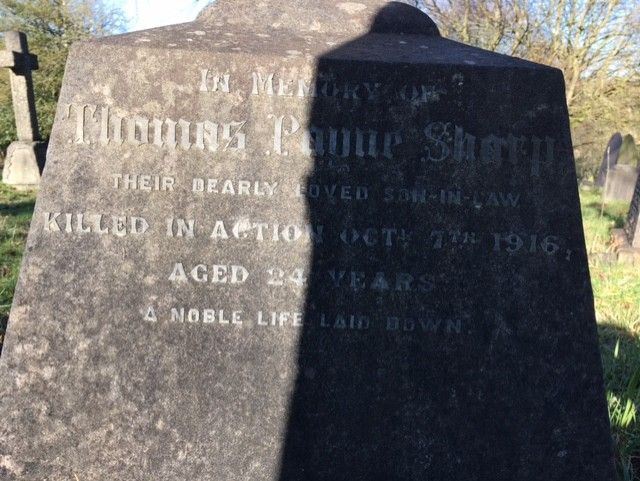 Photo of Thomas Paine Sharp
Nottingham General Cemetery, Robinson family grave commemorating TP Sharpe. Photograph Rachel Farrand (14 Feb. 2026)
Photo of Thomas Paine Sharp
Nottingham General Cemetery, Robinson family grave commemorating TP Sharpe. Photograph Rachel Farrand (14 Feb. 2026)
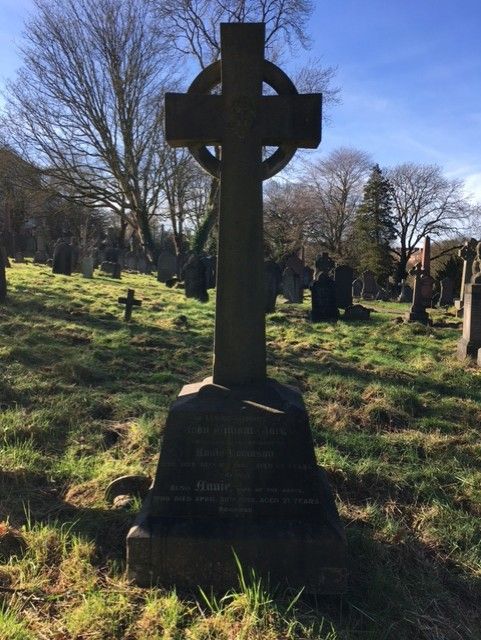 Photo of Thomas Paine Sharp
Nottingham General Cemetery, Robinson family grave commemorating TP Sharpe. Photograph Rachel Farrand (14 Feb. 2026)
Photo of Thomas Paine Sharp
Nottingham General Cemetery, Robinson family grave commemorating TP Sharpe. Photograph Rachel Farrand (14 Feb. 2026)
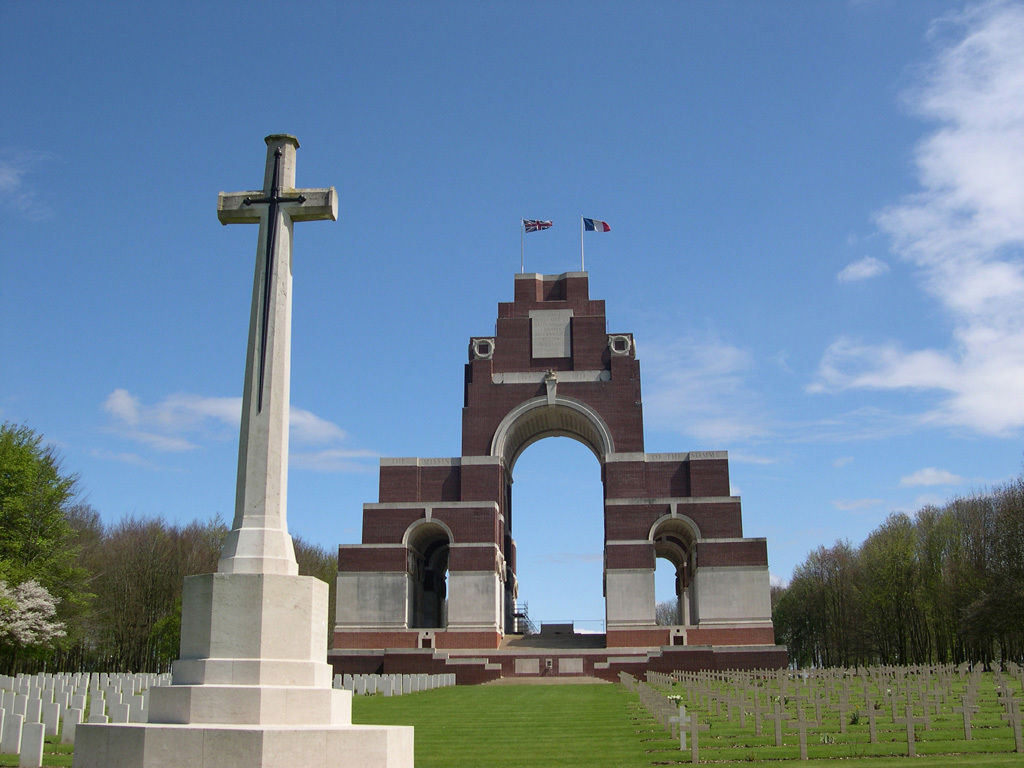 Photo of Thomas Paine Sharp
Commemorated on the Thievpal Memorial, France (www.cwgc.org)
Photo of Thomas Paine Sharp
Commemorated on the Thievpal Memorial, France (www.cwgc.org)