


Frank Lane
1911 - apprentice plumber, probably serving his apprenticeship with F Metcalf and J Radford.
- Family History
- Military history
- Extra information
- Photographs
Frank was the eldest son of Frank and Eliza Lane (née Sims).
Both his parents were born in Radford, Nottingham, his father in 1874 and his mother in 1873. They were married in 1896 (reg. AMJ Nottingham) and had three sons, Frank birth registered 1897 (JFM) and Albert b. 1899 who were born in Radford and William Edward (Bill) who was born in Bulwell, Nottingham, in 1905 (JAS).
In 1901 Frank, a cemetery sexton, Eliza and their two sons, Frank and Albert, were living on Garden Terrace, Denman Street, Radford.
They had moved to Bulwell by 1905 when their third son was born and in 1911 were living at 49 Milton Street, Bulwell. Frank was a cemetery sexton (Nottingham Corporation), his son Frank a plumber's apprentice and the two younger boys were school age.
Frank was later appointed sexton at Nottingham General Cemetery, then owned by the General Cemetery Company. The family had returned to Nottingham by at least the beginning of 1916 when Frank's signature appears on interment certificates, which included certificates for the burial of soldiers who had died in local military hospitals/wards. According to a notice of their son Frank's death in the local paper in December 1916 the family lived at the Cemetery Lodge.
Frank was still employed as cemetery sexton at the Cemetery in 1921 when he, his wife and surviving sons, Albert a wheelwright journeyman (R Clower & Sons) and William a tobacco packer (John Player & Sons), were living at 9 Canning Terrace, Canning Circus. Canning Terrace was built for the General Cemetery Company as the Cemetery's gatehouse with almshouses either side (completed 1840).
Frank died on 8 January 1931 in Nottingham General Hospital, home address 111 Rothesay Avenue, Nottingham. The death certificate gave his occupation as 'formerly cemetery sexton'. Administration of his estate was awarded to his widow Eliza and son Albert, a joiner. Eliza continued to live at 111 Rothesay Avenue until her death on 16 January 1937.
William had married Agnes Hilda Crane (b. 1907) in 1930 and in 1939 when the England & Wales Register was compiled, William, Hilda and William's brother Albert were living at 4 Alnwick Close, Nottingham. William was an auctioneer's porter while Albert was a joiner and coffin maker and also an ARP warden and mortuary attendant.
William and his wife moved to Skegness after the Second World War. Albert probably continued to live with them as he died in Skegness on 2 April 1957 aged 57; he was buried in Nottingham General Cemetery.
William died in Skegness on 20 May 1966 (reg. Spilsby Lincs) aged 60 and was buried in St Clement's churchyard. His widow died in 1980 (reg. Spilsby).
Frank Lane enlisted at Nottingham and served with the 2nd Battalion Grenadier Guards.
Frank, who was serving with No. 1 Company, 2n Battalion, was probably admitted to 34th Casualty Clearing Station on 20 November, suffering from shrapnel wounds, 'loin (L), fract. illium?'. It was recorded in the Admissions & Discharge Record that he was 19 years old and had served for 1y 3m. Frank's condition was described as 'dangerously ill' and he probably underwent several operations before his death which was recorded on 15 December 1916 although other military records, including CWGC, give the date of his death as 14 December.
He was buried in Grove Town Cemetery, Meaulte, France (grave ref. II.E.8).
CWGC history of the Grove Town Cemetery (extract): the Cemetery is close to the town of Albert. 'In September 1916, the 34th and 2/2nd London Casualty Clearing Stations were established at this point, known to the troops as Grove Town, to deal with casualties from the Somme battlefields. They were moved in April 1917 and, except for a few burials in August and September 1918, the cemetery was closed.' (www.cwgc.org)
‘The Grenadier Guards in the Great War of 1914-1918’, Lieut-Colonel the Right Hon. Sir Frederick Ponsonby (late Grenadier Guards), McMillan & Co. Ltd, 1920. Extract, Chapter XX, 2nd Bn November 1916: 'On the 10th the 2nd Battalion proceeded in French motor buses via Méaulte to the Citadel Camp, where it remained for two days, after which it marched to “H.I.” Camp near Montauban. The weather was very bad, and the whole country was a sea of mud, which made marching across country anything but easy. On the 15th the Battalion proceeded to Camps A and B at Trônes Wood, and moved up the following day [16th] into the line, relieving the 1st Battalion Irish Guards in the inside right sector between Lesbœufs and Gueudecourt, where the front line consisted of shell-holes joined up, and was held by a succession of small posts. Owing to the frosty condition of the ground, the relief was carried out quickly and without casualties, but a working platoon that had been sent on ahead had two men killed, and Lieutenant J. D. Wilton, the officer in charge, and two men wounded. The line was not good, and as there were no communication trenches considerable difficulty was experienced in bringing up the rations and trench requirements. The second day in the trenches was one of the most trying the Battalion had experienced, as the snow changed to rain, and a thaw began which converted the whole ground to a morass. No one who has not experienced the difficulties of moving about up to the knee in liquid mud can realise the great fatigue it entails: many men were completely exhausted, while some lost their way owing to the tracks having been obliterated. All the time the shelling continued, causing a certain amount of casualties. On the 19th, after a long and difficult relief, the Battalion returned to H.I. Camp, where hot food and warm water for the feet were provided. During the relief Captain C. N. Newton was slightly wounded, but remained at duty. On the 21st the Battalion marched to Méaulte, where it remained until the end of the month. However, it took some days to clean the clothes, rifles, and equipment which were plastered with mud, and training was not commenced until the 23rd. Every day a certain number of men were detailed for work on improving the roads, each company taking it in turns to supply the necessary fatigue parties.’
According to an 'In Memoriam' notice in the local paper in December 1917, Maurice's brother, Albert, was serving in the Army.
CWGC Additional information: Son of Frank and Eliza Lane, of 9, Canning St., Derby Rd., Nottingham.
CWGC headstone personal inscription: 'Dearly beloved eldest son of Frank and Eliza Lane of Nottingham'
Nottingham General Cemetery, Lane family grave and headstone, inscription: ‘In loving memory of Frank dearly beloved son of Frank and Eliza Lane, who died of wounds in France Decr. 14th 1916, aged 19 years. ‘Christ will link the broken chains closer when we meet again.’ Also of the above Frank Lane who died 8th Jany. 1931 aged (-) years. ‘Thy will be done.’ Also of the above Eliza Lane who died Jan. 16th 1937 aged 64 years. Also of Emily Sims, dearly beloved sister of the above Eliza, who died June 22nd 1950 aged 72 years.’ Separate urn, dedication, ‘Sister Sally’. Separate commemorative stone: 'Also of Albert, dearly beloved son of the above Frank and Eliza. Passed away April 2nd 1957, aged 57 years. Together again.'
Note: The General Cemetery Company went into liquidation after the Second World War. Ownership passed to the Crown then in 1956 the freehold was passed to Nottingham City Council.
Nottingham Evening Post, ‘Roll of Honour’, 21 December 1916: ‘Lane. Died of wounds, December 14th, 1916, Private Frank Lane, Grenadier Guards, age 19 years, dearly loved eldest son of Frank and Eliza Lane, Cemetery Lodge, Derby-road, late of Bulwell. Deeply mourned.’ (www.britishnewspaperarchive.co.uk)
Nottingham Evening Post, 'In Memoriam', 13 December 1917: 'Lane. In memory of a gentleman (Frank Lane), Grenadier Guards, died of wounds December 14th, 1916, in France. – From his sorrowing employers, F. Metcalf, J. Radford.'
Above courtesy Jim Grundy facebook pages Small Town Great War Hucknall 1914-1918
Nottingham Evening Post, ‘In Memoriam’, 14 December 1917: ‘Lane. In loving memory of Private Frank Lane, Grenadier Guards, died of wounds December 14th, 1916. Fondly remembered. Dad, mother, brothers William, Albert (with colours).’ (www.britishnewspaperarchive.co.uk)
Nottingham Evening Post, ‘Deaths’, 9 January 1931: ‘Lane. On January 8th, at the General Hospital, Frank, the beloved husband of Eliza Lane, of 111, Rothesay-avenue, Derby-road. Sorrowing wife and sons,’ (www.britishnewspaperarchive.co.uk)
Probate: Frank Lane. Administration of Will awarded to his widow and son Albert Lane, joiner.
Nottingham Evening Post, ‘Deaths’, 18 January 1937: ‘Lane. On January 16th, at 111 Rothesay-avenue, Eliza, dearly loved widow of Frank Lane, and devoted mother of Albert, Bill, and Hilda [William's wife]. Service Wednesday 2 o’clock, Norton -street Congregational. Interment 2.30, General Cemetery, Derby-road.’ (www.britishnewspaperarchive.co.uk) Notice also from sister, Emily Sims (nee Lane).
Nottingham Evening Post, ‘In Memoriam’, 8 January 1947: 'Lane. In loving memory of Frank, died January 8th, 1931; also Eliza, his wife, died January 16th, 1937. Love’s greatest gift, remembrance. Sons Albert, Bill, Hilda.’ (www.britishnewspaperarchive.co.uk)
Nottingham Evening Post, ‘In Memoriam’, 16 January 1948: ‘Lane. In loving memory of Eliza, who died January 16th, 1937. Love’s greatest gift, remembrance. Sons Albert and Bill, and Hilda (Skegness).’ (wwww.britishnewspaperarchive.co.uk)
Nottingham Evening Post, ‘Deaths’, 4 April 1957: ‘Lane. On Tuesday, April 2nd, at 42 Scarborough-avenue, Skegness, Albert, aged 57, dearly loved son of the late Frank and Eliza Lane and brother of Bill and Hilda, after much suffering. Service Norton-street Chapel, Friday, 2 o’clock. Interment 2.30, General Cemetery.’ (www.britishnewspaperarchive.co.uk)
Skegness Standard, 25 May 1966: ‘Funeral of Sportsman. The funeral service of Mr William Edward Lane, aged 60, of 42 Scarborough Avenue, Skegness, took place at St Clement’s Church, and was followed by burial in the churchyard, yesterday. Mr Lane was born at Bulwell, Notts., but came to Skegness 20 year ago. He worked at Porter and Turners, auctioneers, as a foreman-porter. He had previously worked in a similar job at Nottingham. His hobbies were football, cricket and driving. He leaves a wife, Agnes Hilda, 42 Scarborough Avenue.’ (www.britisnewspaperarchive.co.uk)
Research RF (additional information SR).
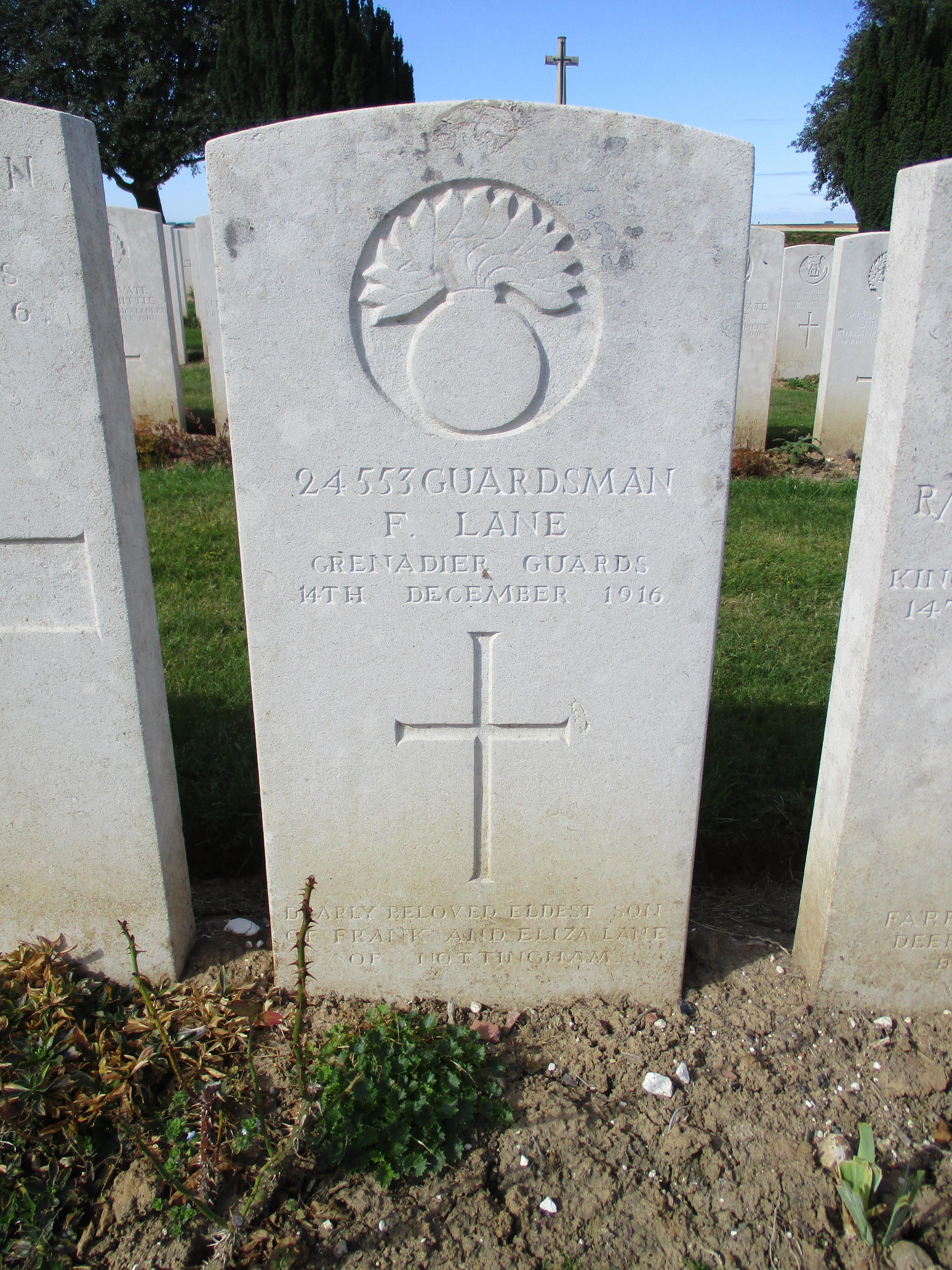 Frank Lane
Buried in Grove Town British Cemetery, France.
Frank Lane
Buried in Grove Town British Cemetery, France.
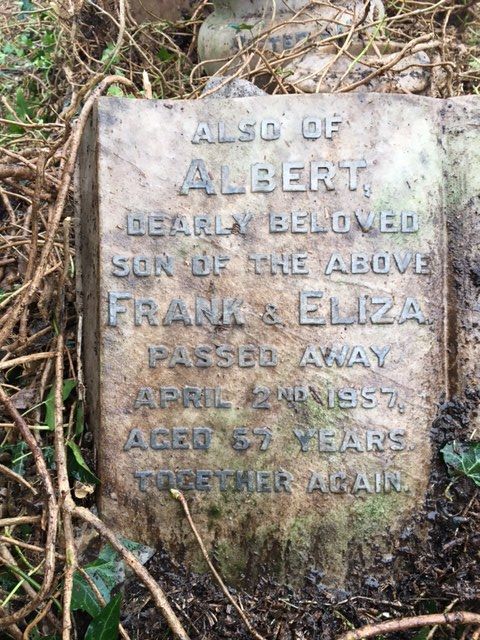 Photo of Frank Lane
Nottingham General Cemetery, Lane family grave - commemorative stone (Albert). Photograph Rachel Farrand (5 February 2026)
Photo of Frank Lane
Nottingham General Cemetery, Lane family grave - commemorative stone (Albert). Photograph Rachel Farrand (5 February 2026)
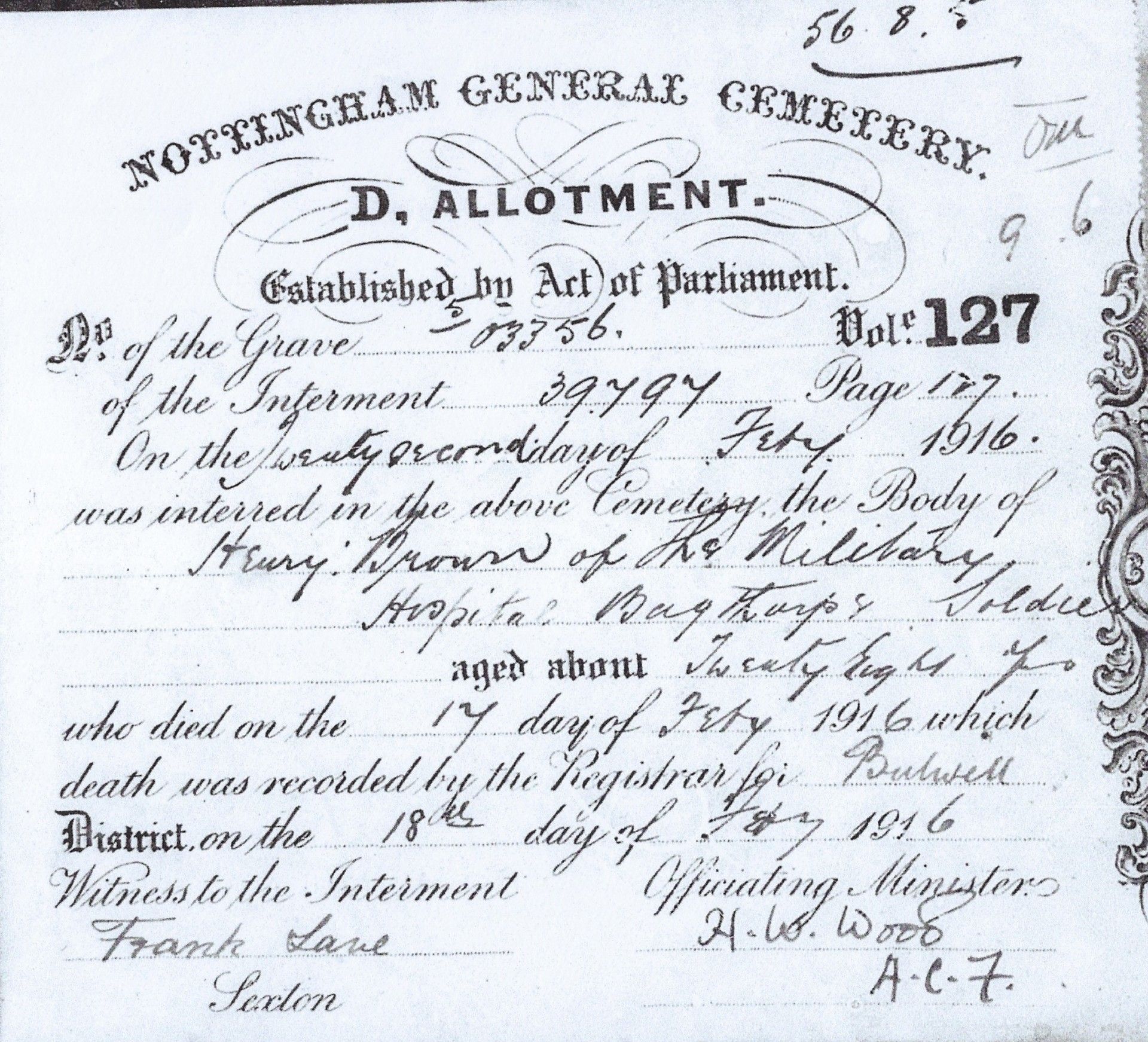 Photo of Frank Lane
Nottingham General Cemetery - interment certificate signed by Frank Lane snr. (Notts Archives)
Photo of Frank Lane
Nottingham General Cemetery - interment certificate signed by Frank Lane snr. (Notts Archives)
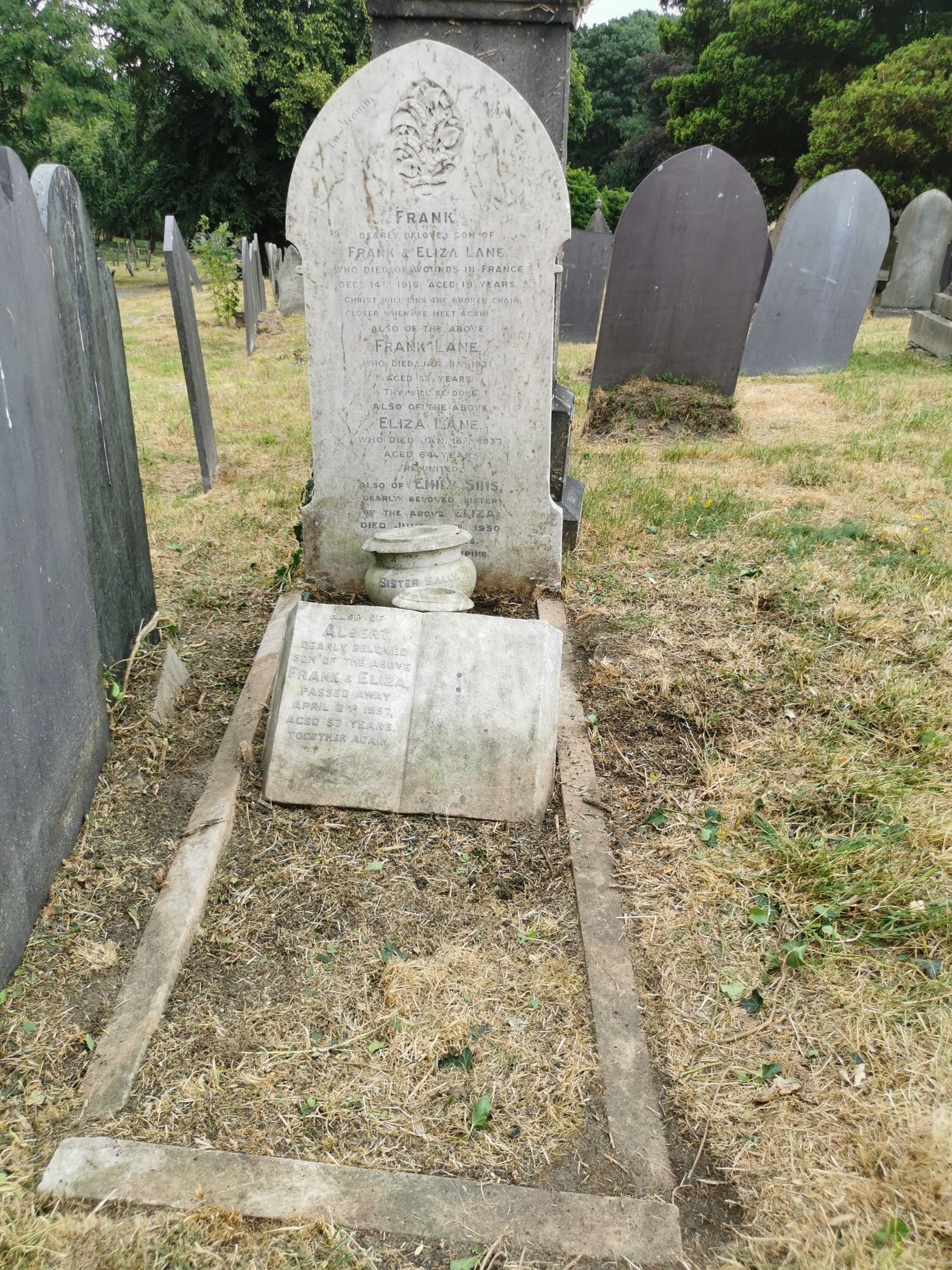 Photo of Frank Lane
Nottingham General Cemetery, family grave/headstone. Photograph Simon Roots (CWGC 'EOHO' project), July 2026
Photo of Frank Lane
Nottingham General Cemetery, family grave/headstone. Photograph Simon Roots (CWGC 'EOHO' project), July 2026