

William Hurst
Steetley Quarry worker
- Family History
- Military history
- Extra information
- Photographs
William Hurst was born in 1883, at Newark the 3rd son of 5 sons of the late Joseph a hawker and Ellen Hurst, née Smith the others being John, Samuel, Edward and Henry. In 1891 they were recorded as all born at Newark and living at Water Lane, with their father,
His father Joseph was born in 1843 at Worksop he died in 1895 at Newark, he was 52 yrs of age, his mother Ellen Smith was born in 1844 at Great Gonerby, Lincolnshire she died in 1919 aged 70 yrs, they were married on 7th September 1870 at Grantham Registry office, they went on to have 9 children.
In 1909, William married Mary Smith (born 10th March 1887 at Newark) at Newark in 1908 and in the same year had a son who they named Joseph born 14th November 1980,Two years later, all three were living at 38 Colbeck Street, Worksop, and were followed at the end of 1911 and again in 1912 with 2 more children, Sarah born 15th July 1911 and Edward born 19th November 1912. . It was whilst a resident in Worksop that he enlisted there being previously a reservist.
commencing 9th August 1915 his wiow was awarded a pension of 20 shillings and 6 pence a week.
His widow re married William Staniland on 18th December 1915 at Worksop.
Private William Hurst was recalled to the colours enlisted at Newark on 2nd August 1914, , he served with the 1st battalion Sherwood Foresters Regimentn he was killed in action on 15th January 1915, having no known grave his name is commemorated on the Le Touret Memorial, Pas de Calais, France.
Private William Hurst Worksop Guardian 9 April 1915:-
Private William Hurst, of the G Co., 3rd Notts & Derbys, of Duck Row, Westgate, Worksop, who was killed in action in the Basse*-road near Neuve Chapelle, on January 15th 1915. To those better acquainted with Private Hurst he was known as “Narrow”. He was a reservist and worked at Steetley Quarry, and was re-called to the colours on August 2nd. He was last heard from a few days previous to being killed. He leaves a widow and three small children.
Research by Colin Dannatt
additional research Peter Gillings
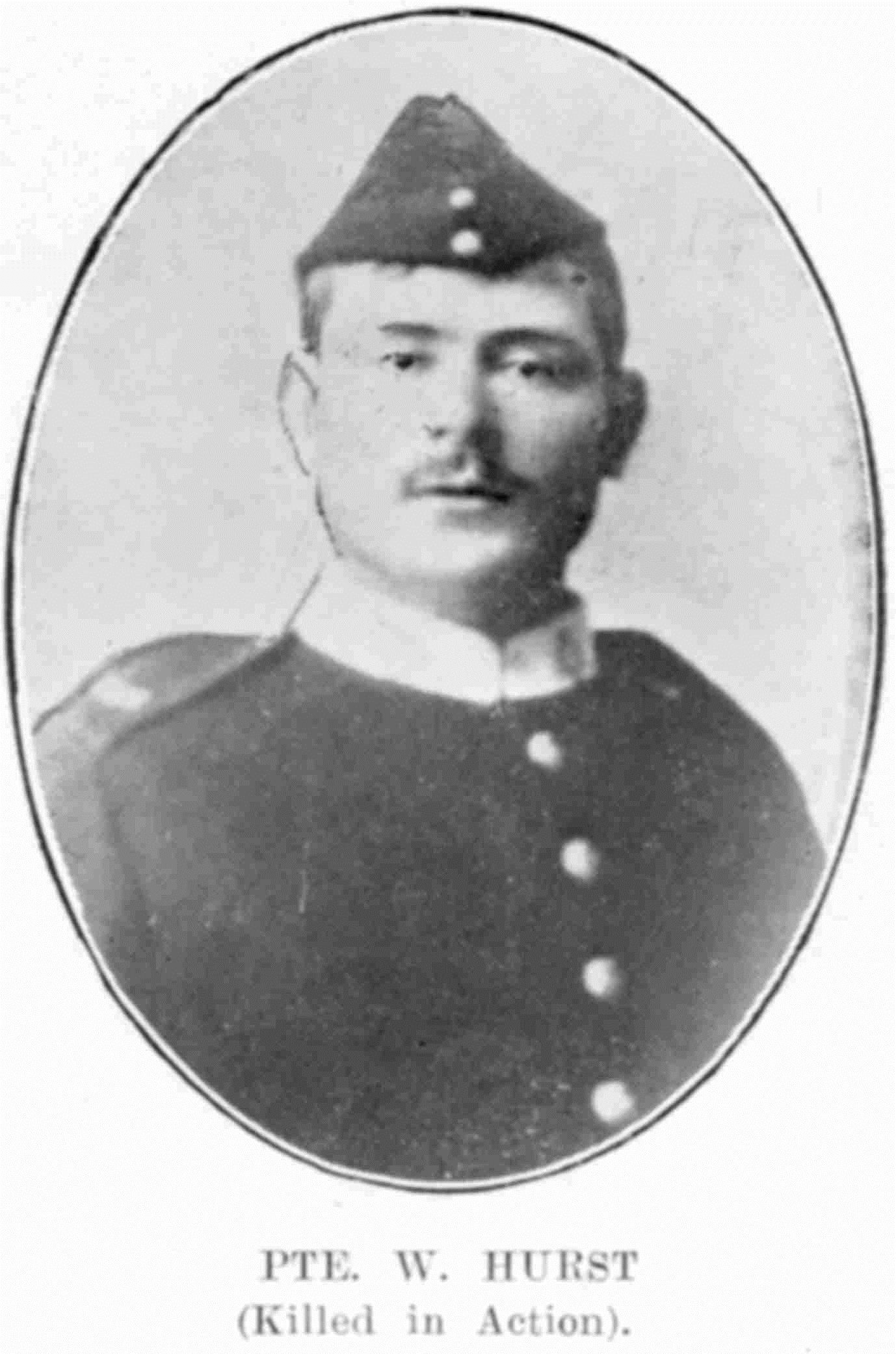 William Hurst
photo originally published in the Worksop Guardian and now in the Borough of Worksop Roll of Honour of the Great War 1914-1918 in Worksop Library.
William Hurst
photo originally published in the Worksop Guardian and now in the Borough of Worksop Roll of Honour of the Great War 1914-1918 in Worksop Library.