


Thomas Edward Crofts
1911 - pony driver, Sutton colliery.
- Family History
- Military history
- Extra information
- Photographs
Thomas Edward Crofts was the son of Thomas Edward and Martha Crofts (née Willbond).
His father Thomas Edward was born in 1868 in Sneinton, Nottingham.
His mother Martha Willbond was the daughter of George Baines Willbond and his first wife Elizabeth (née Hunt). Her father served in India with the 60th Foot and Martha was born in about 1875 in Rawalpindi, India. Martha had two older siblings, Eliza and George Vere, who had also been born in India, Eliza in Calcutta, and George in Peshawar; all three had been baptised in India. Their younger brother, Vere Edwin, was born in Nottingham in 1878 and baptised at the Cathedral Church of St Barnabus. Her widowed father married Elizabeth Chapman (21) at Nottingham St Mark on 8 February 1880 and they had nine children. In 1881 George Willbond (41), a weights and measures inspector, and his wife were living on Wells Road, Nottingham, with his four children by his first marriage, Eliza (12), George (10), Martha (8) and Vere (2), and his son Ernest by his second marriage.
Thomas Edward Crofts and Martha Willbond were married in Nottingham in 1896 and had six children: Thomas b. 1896 Hyson Green, Jessie May b. 1898 Pyebridge, Lily b. 1901 Hyson Green, Daisy birth registered 1904 (JFM) Basford, George Vere birth registered 1911 (JFM) Pinxton, Derbyshire, and Beatrice May b. 1914 Mansfield.
In 1901 Thomas, a labourer (gas works) and Martha were living at 16 Dursley Terrace, Nottingham, with their two children, Thomas and Jessie.
The family had moved to The Wharf, Pinxton, Alfreton, by 1911: Thomas Edward (43), a chemical labourer, his wife Martha (36) and their children, Thomas (14) a pony driver, Jessie (12), Lily (10) and Daisy (7) who were school age and George Vere (3m). Their daughter Beatrice May was born three years later in 1914.
Thomas gave his address as 73 Mason Street, Sutton in Ashfield, when he attested in 1915. He named his mother of the same address as his next of kin.
Martha was still living at the same address in 1921. She completed the census form with the information that she was a 'grass widow' but the enumerator amended this (in pencil) to 'married'. Also in the home were her five surviving children: Jessie (22) and Lily (19) whose occupations were given as 'lady tinker' (employer ironmonger), Daisy (17) a hosiery worker and George (10) and Beatrice (7). Also in the household were two boarders, Fred and Mary King, a married couple.
The newspaper report of Thomas's death in 1918 mentioned that his father was also serving in France although he would have been about 46 years old on the outbreak of war.
Thomas Edward Crofts attested in Mansfield on 3 March 1915. He was aged 19y. 90d, height 5ft 2½ inches, weight 101lbs, occupation pony driver (other record, occupation coal miner).
He was posted to the Sherwood Foresters (Notts & Derby Regiment) and joined at its Derby Depot on 4 March 1915 (23863/89184). Thomas transferred to the 15th (Reserve) Battalion but on 18 August was transferred to the 19th (Reserve) Battalion. On 20 September 1915 he transferred to the 15th (Reserve) Battalion but was discharged on 10 December 1915 after 282 days service 'being unlikely to become an efficient soldier vide para. 392, IIIcc King's Regulations'. However, there is a report dated 30 November 1915 that recorded that he was 'physically unfit (-) appendicitis', suggesting he was medically discharged.
According to a report of his death in the local newspaper, Thomas then returned to work at Sutton Colliery but was called up in June 1917. He served with BEF France (unit not known) but returned to England in the New Year suffering from from trench foot and the effects of gassing. On his return to France in July 1918 he served with 34th Battalion Machine Gun Corps (Infantry).
Thomas and four others in his gun team were killed by shell fire on 31 August 1918 and were buried close to where they were killed before the Battalion advanced.
Thomas's grave was brought in to La Clytte Military Cemetery, Belgium, after the Armistice (grave ref. V.B.26).
He qualified for the British War Medal and Victory Medal.
CWGC history of La Clytte Military Cemetery (extract): The Cemetery is 8km from the town of Ieper [Ypres]. 'The first burial in the cemetery took place on the 1st November 1914, and between that date and April 1918, Plots I, II and III and part of Plot IV were filled' ... Plot IV was completed after the Armistice 'and Plots V and VI formed by the concentration of isolated graves and small graveyards from the area round Reninghelst, Dickebusch, Locre and Kemmel.' (www.cwgc.org)
Martha Crofts half-brother, Clarence Baines Willbond (b. 1898), by her father's second marriage to Elizabeth Chapman in 1880, served in the Machine Gun Corps (117206 Private) and was killed in action on 6 November 1917. (See record on this Roll of Honour which includes additional family details)
CWGC Additional information: Son of Martha Crofts, of 73, Mason St., Sutton-in-Ashfield, Nottingham.
CWGC headstone personal inscription: 'In loving memory of our dear son'
Notts Free Press, 20 September 1918: 'Private T.E. Crofts, Sutton.'
'Joining the army in 1915, Private Thomas Edward Crofts, of 73, Mason-street, Sutton, was discharged after ten months' service, and returned to the Summit Colliery, where he had the misfortune to meet with an accident. He was again called up in June, 1917, and was drafted to France in the following August. He came to England last New Year's Eve suffering from trench feet and the effects of being slightly gassed, and was subsequently drafted into the Machine Gun Corps. He returned to France in July last and was killed in action on August 31st. Private Crofts' father is serving in France, and was wounded in the Battle of the Somme.
'Mrs. Crofts has received the following letter:–
'It is with the greatest regret that I write you now with regard to your son, 154679, Private T. E. Crofts. During the recent fighting your son was one of a gun team which took up a position near Furtive Farm, near La Clyte, behind Kemmel village. Before the advance we were subjected to some artillery fire, and one large shell fell by his team. It was only a moment and we were on the spot only to find that your son and four other members of the team had been instantly killed. With all honour we buried them in the little yard of this ruined building, just before we advanced. This was on the 31st August. Yours is the greatest grief I know, and we can scarce know what it all means to you at home, but we would send you our heartfelt sympathy in your great loss. He had not been long in my section, but long enough for me to find out his qualities. He was a very willing and steady soldier in action. Second-Lieut. V. D. Walker, M.G.C.'
Above courtesy Jim Grundy facebook pages Small Town Great War Hucknall 1914-1918.
Note: There is no CWGC record for [2/Lieut.] V.D. Walker so it is to be assumed that he survived the war.
Additional research, record updated, RF (Aug. 2026)
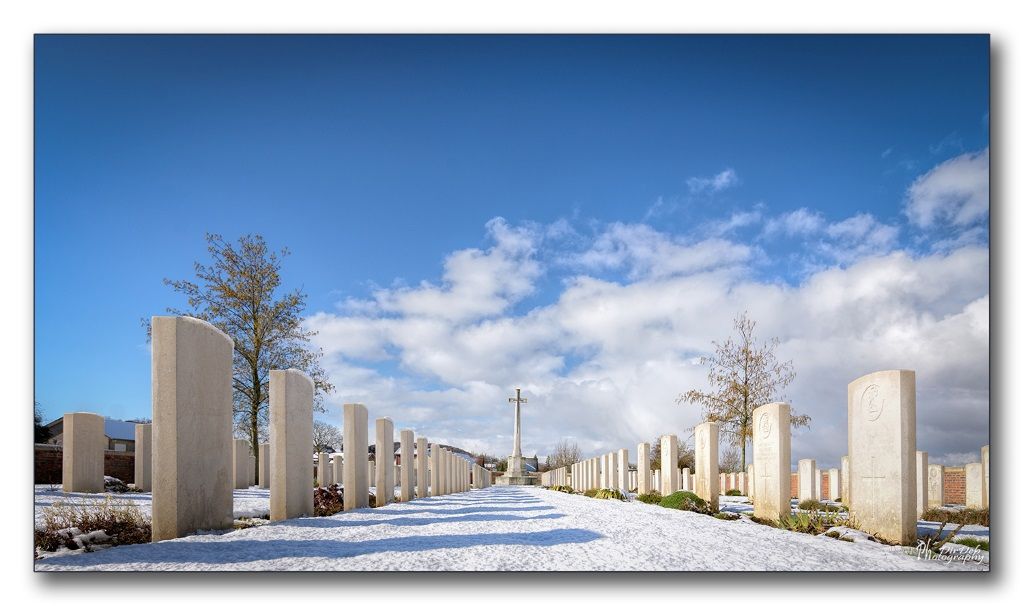 Photo of Thomas Edward Crofts
Buried in La Clytte Military Cemetery (www.cwgc.org)
Photo of Thomas Edward Crofts
Buried in La Clytte Military Cemetery (www.cwgc.org)