


George Henry Tinker
- Family History
- Military history
- Extra information
- Photographs
George Henry Tinker was born in 1894 at Nottingham, he was the son of Arthur Walker Tinker a general carter and Annie Elizabeth Tinker née Herrick of 5 Pipe Street, Sneinton.
His father Arthur was born in 1870 at Leeds and working as a general carter. his mother: Elizabeth Tinker, born in 1872 in Nottingham and working as a lace hand. they were married on 25th December 1893 at St Ann's prish church
The family lived at 5, Pipe Street, Sneinton, Nottingham.
Private George Henry Tinker was called up for service at Nottingham whilst residing at Sneinton he served with the 11th battalion Sherwood Foresters Regiment, following training he was drafted to France. The battalion took part in the Battle of Messines Ridge on 7th June 1917. The Sherwood Foresters attacked over 1200 yards to the top of a ridge known as Tor Top. The attack was successful, but 215 officers and men became casualties. These included George Tinker who was wounded and died on 11th June 1917. He was buried at Lijssenthoek Military Cemetery.
Nottingham Post notice (abridged), 18 June 1917: 'Tinker. Died of wounds June 11th 1917, Private George H Tinker, Sherwood Foresters, son of AE Tinker, 5 Pipe Street. Father (in France), mother, brother.'
In memoriam published 11th June 1918 in the Nottingham Evening Post :-
“TINKER. – In loving memory of our dear son and brother, Pte. G. H. Tinkler, died of wounds June 11th, 1917. Always happy, cheerful, with a heart that knew no fear. He stood to face life's battles, for those he loved so dear. Now God grant him eternal rest. – Sorrowing dad (in France), mother, brother.”
Above in memoriam is courtesy of Jim Grundy and his facebook pages Small Town Great War Hucknall 1914-1918
His father Arthur also served during the 'Great War' he served with the Royal Engineers as a pioneer he enlisted on 17th April 1915 at London, giving his address as 5 Pipe Street, Nottingham, and his age as 45 years and 10 months,he was a navvy he served with the 2nd battalion Labour Corps until the end of the war when he was demobilsed he saw no overesas service.
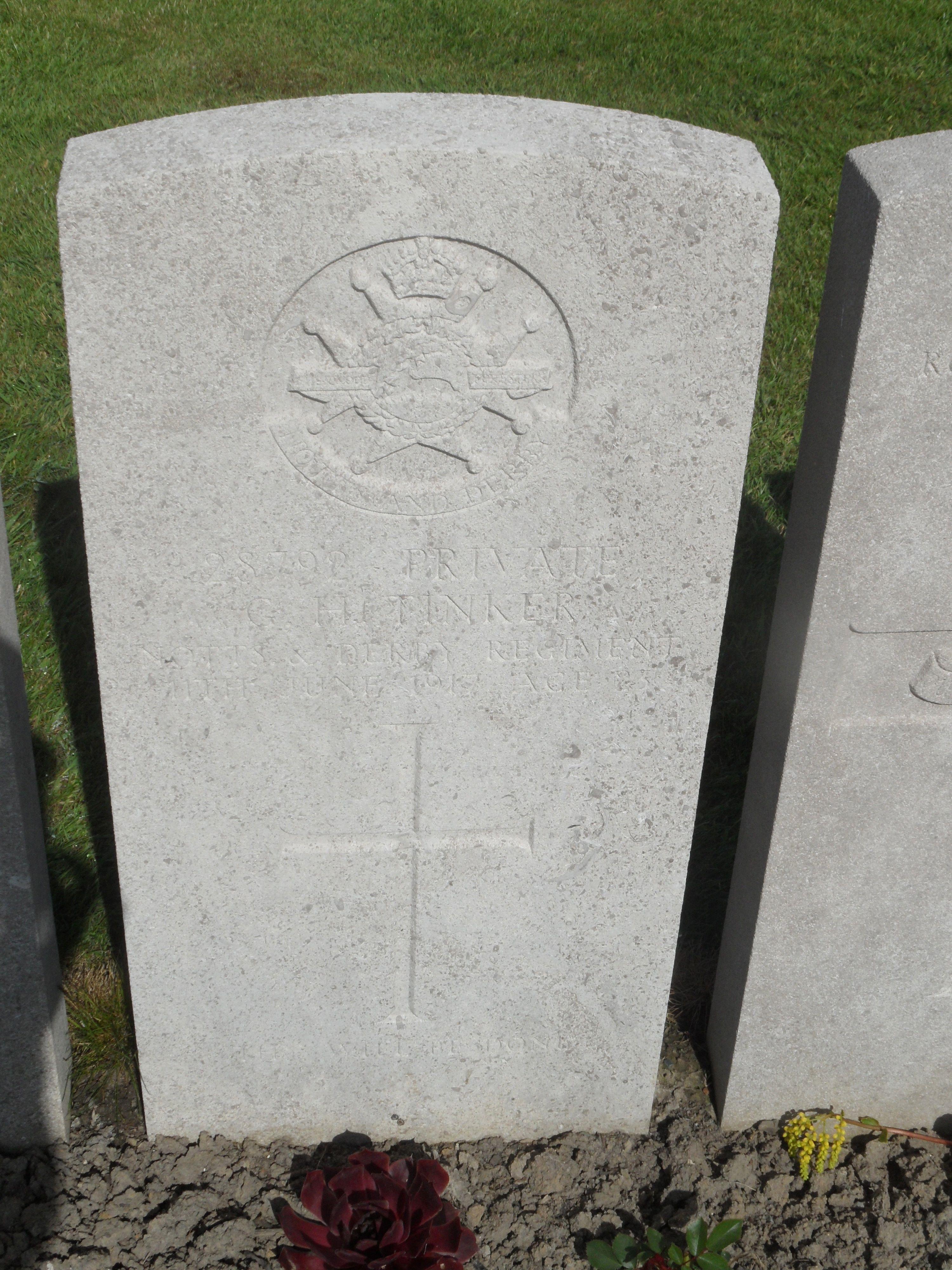 George Henry Tinker
Commonwealth War Graves Commission headstone marking his grave at Lijssenthoek Military Cemetery, Belgium. Courtesy of Murray Biddle
George Henry Tinker
Commonwealth War Graves Commission headstone marking his grave at Lijssenthoek Military Cemetery, Belgium. Courtesy of Murray Biddle