

Virtual memorial to Nottinghamshire men lost in the disaster 14/10/1939.
HMS Royal Oak was one of five Revenge-class battleships built for the Royal Navy during the First World War. Completed in 1916, the ship first saw combat at the Battle of Jutland as part of the Grand Fleet. In peacetime, she served in the Atlantic, Home and Mediterranean fleets, more than once coming under accidental attack. Attempts to modernise Royal Oak throughout her 25-year career could not fix her fundamental lack of speed and, by the start of the Second World War, she was no longer suitable for front-line duty.
On 14 October 1939, Royal Oak was anchored at Scapa Flow in Orkney, Scotland, when she was torpedoed by the German submarine U-47. The infiltration of Scapa Flow 14 October 1939 was a master class in stealth, precise timing, and capitalizing on enemy complacency. Commander Günther Prien relied on a carefully calculated set of tactical maneuvers to bypass defences previously thought to be impregnable.
Stealth Transit and Daylight Submersion
To reach the Orkney Islands without alerting the Royal Navy, Prien enforced absolute stealth during the journey from Wilhelmshaven.
Reverse Routine: U-47 remained submerged on the seabed during daylight hours and surfaced only at night to recharge batteries and navigate. The crew lived in darkness and inverted their schedules, eating breakfast in the evening.
No-Engagement Order: Prien deliberately bypassed any target of opportunity during the transit to avoid revealing the submarine's presence in the North Sea.
Micro-Navigation and Tidal Timing
The British had deliberately sunk "blockships" in the narrow channels around Scapa Flow to obstruct entry. However, German aerial reconnaissance had identified a tiny, hazardous gap in Kirk Sound.
Slack Water Navigation: Prien timed the approach to coincide with slack water (the brief window between tides) to reduce the impact of the region's treacherous 10-knot rip currents.
Surface Infiltration: Because the channel was so shallow, U-47 had to navigate entirely on the surface at night. At one point, the submarine was so close to land that it was briefly illuminated by the headlights of a passing car on shore.
Exploiting the "Invisible" Advantage
Upon successfully clearing the blockships and entering the main anchorage, Prien expected a crowded harbor but found it largely empty, as the British Home Fleet had temporarily dispersed. He spotted the lone HMS Royal Oak anchored near the cliffs. 7
First Attack: At 12:58 AM, U-47 fired a bow salvo of torpedoes. Only one made impact, striking the battleship's bow and damaging the anchor chain.
The Tactical Reset: Because the British assumed the explosion was a minor internal accident (such as a paint locker explosion) and did not raise an anti-submarine alarm, Prien did not flee. Instead, he took advantage of their complacency, calmly turned the submarine around to fire a stern torpedo (which missed), and then reloaded his bow tubes for a second devastating salvo.
The Lethal Volley: At 1:16 AM, U-47 fired three more torpedoes, all scoring direct hits beneath the Royal Oak's armor belt, detonating her magazines and sinking the ship in under 15 minutes. Prien immediately withdrew back through the narrow channels on the surface, making a clean escape before British destroyers could launch a submarine search.
Of Royal Oak's complement of 1,234 men and boys, 835 were killed that night or died later of their wounds. 126 of the crew lost were under the age of 18. Amongst those lost were Boys 1st Class William Hall from Kegworth and Ronald Milnes from North Muskham, Signal Boys Cyril Exton Williams and Norman Billyard, both from East Retford.
Stokers 2nd Class Roy Radford from Mansfield and William Richards from Mansfield Woodhouse,
Signalman John Hudson from Lenton, Nottingham, Assistant Cook George Mather from Mansfield and Ordinary Seaman David Smith from Nottingham were also lost.
Ninety two Royal Marines perished during the sinking of Royal Oak, three from Nottinghamshire - William Lowe King, William Samuel Tuckwood and Arthur Wilson.
The loss of the outdated ship had a considerable effect on wartime morale. The raid made an immediate celebrity and war hero out of the U-boat commander, Günther Prien, who became the first German submarine officer to be awarded the Knight's Cross of the Iron Cross.
Before the sinking of Royal Oak, the Royal Navy had considered the naval base at Scapa Flow impregnable to submarine attack, but U-47's raid demonstrated that the German navy was capable of bringing the war to British home waters. The shock resulted in rapid changes to dockland security and the construction of the Churchill Barriers around Scapa Flow.
The wreck of Royal Oak, a designated war grave, lies almost upside down in 100 feet (30 m) of water with her hull 16 feet beneath the surface. In an annual ceremony marking the loss of the ship, Royal Navy divers place a White Ensign underwater at her stern. Unauthorised divers are prohibited from approaching the wreck under the Protection of Military Remains Act 1986.
- Names on this memorial
- Photographs
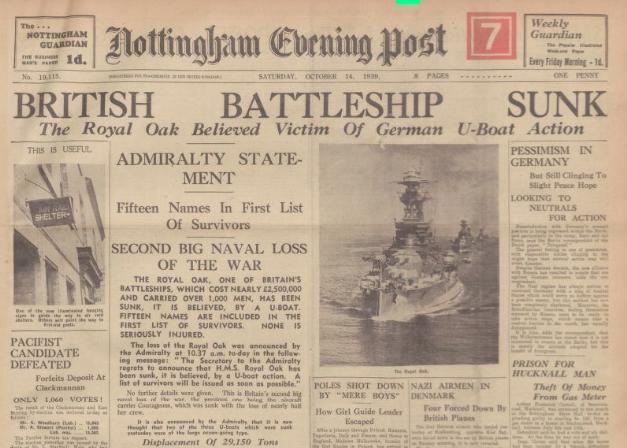 The Sinking of HMS Royal Oak reported locally
Courtesy of The Nottingham Evening Post 14/10/1939
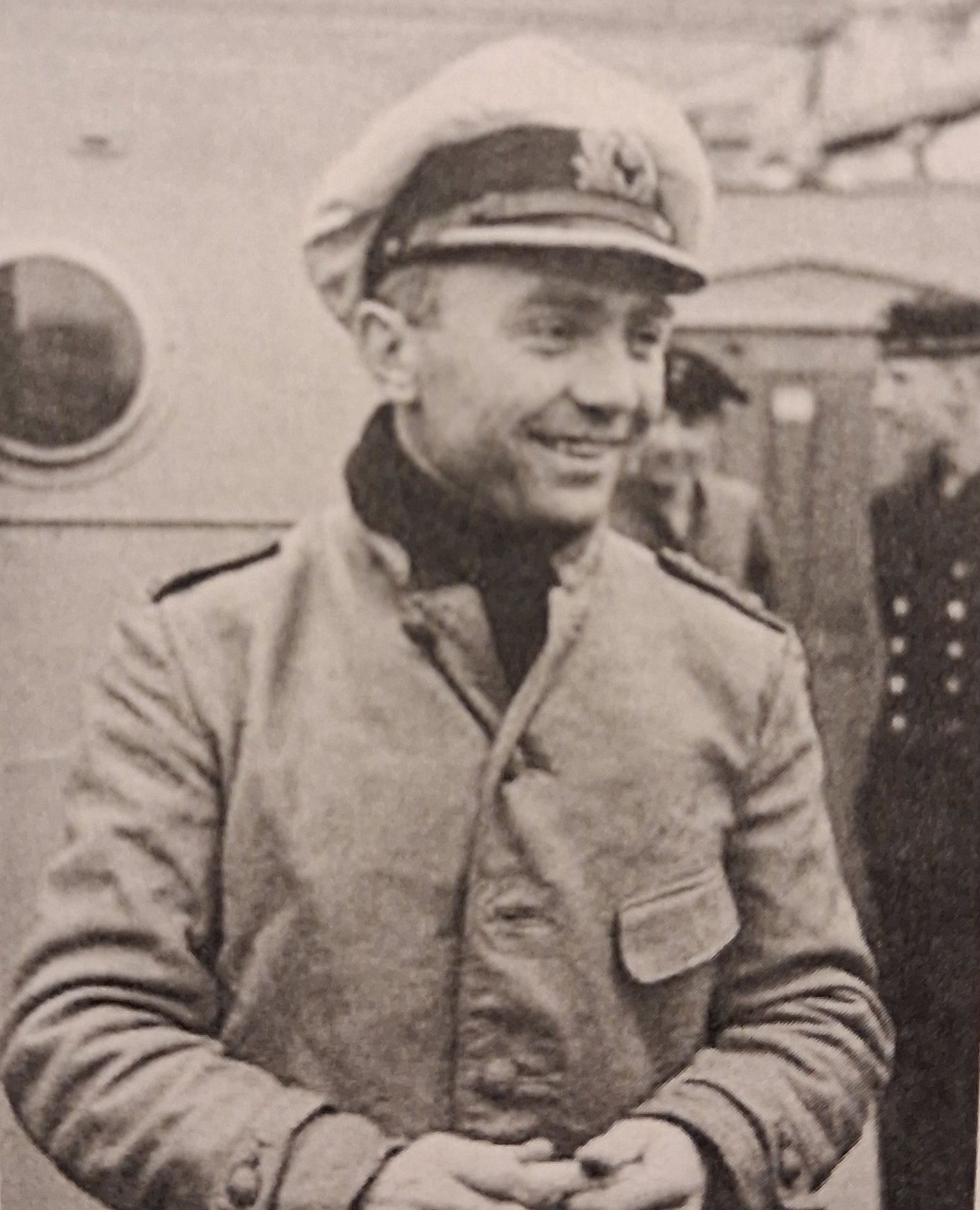 Gunther Prien captain of U-47
U-47 disappeared 7/3/1941 after sending a radio message at 04.54. She had been pursuing convoy OB-293 in the North Atlantic south of Iceland. There were no survivors and the loss remains unexplained.