

This account is courtesy of Steve Duffy and BBC Wales.
The crew of Halifax LK-U MZ519 were part of the 578 Squadron based at RAF Burn near Selby, North Yorkshire.
In the early hours of 6 July they dropped 10 bombs near St Martin L’Hortier in northern France.
They returned to base with 21 other bombers just after 05:30. But after a short rest, by 19:00 that night, the squadron was called on again for another mission to hit a V1 rocket base.
Their Halifax left at 19:11 BST.
There were clear skies and good visibility, and the squadron of 22 aircraft arrived at their targets near Croixdalle at around 21:15.
The bombers attacked from heights of between 12,000 and 15,800ft.
Heavy flak was reported over Dieppe, according to the reports of the raid.
At some point the bomber was hit and it was stricken by the time it arrived back in England.
Witnesses first spotted the aircraft south of Nottingham, with smoke and flames streaming from its port outer engine, escorted by another Halifax bomber.
Flt Sgt Len Roberts, a member of 578 Squadron, was by coincidence on leave in the area and recognised the squadron lettering on one of the bombers, which dived “like a bat out of hell”.
“At about 150-200ft, the pilot put the plane into a climb,” he later recalled.
“By this time I could see the wing on fire at the roots and assumed that he had dived to try to extinguish the flames by wind force – but the opposite had happened.”
By the time the Halifax was over the White Post pub, west of Farnsfield, the fire had rapidly spread and most of the aircraft had been engulfed in flames.
Part of the wing and part of an engine broke away and fell into a field by the pub.
The blazing aircraft then turned sharply and dived into the ground at 22:25.
The RAF operations record for the night reported the Halifax “seen falling in flames, 30 miles north of Nottingham”.
“This was reported by almost all crews,” it reads.
“When first seen it was at approximately 7,000ft with the engine on fire.
“It was seen to dive steeply and explode on reaching the ground.”
Local Home Guard in the next village of Rainworth had not long finished a parade and rushed to the scene after the loud explosion and a cloud of smoke.
One local resident, 32-year-old Hilda Rickett, later recalled the plane going past her window with the wing on fire.
“I was a trained first aider so I ran out across the fields but by the time I got to the gate... it was too late, they had all died," she said.
A local farmer helped recover the bodies and they lay at the farm overnight. He later planted trees in their memory, while his son was involved in creating a permanent memorial.
The crew had been wearing parachutes but had not bailed out and it is thought they were unable to jump clear as the aircraft lost height as it cleared the village.
The views of witnesses at the time led to the belief locally that the crew were aware they were crashing but wished to spare Farnsfield from potential loss of life.
Nigel Hamilton, chairman of Farnsfield's Royal British Legion, said: "We're in a valley with hills around - there's very little flat ground around."
Fate had already intervened to spare two of the squadron's men, who might have been on board that night.
Flt Sgt John Davies had been on the plane's early morning mission, as a standby to cover for the regular flight engineer, who was sick.
He was nearing the end of his tour of duty and was told by his officer that he’d “had enough for one day” and was “virtually ordered” to stand down, to be replaced by the unfortunate Raymond Rolph.
Allan Miles had been part of the usual crew but missed out on the mission because he was away on a course.
“We never thought about death, we were all young and thought we were immortal,” he later recalled.
Fifty years later, a permanent memorial was erected, near the crash site and the land was donated by the son of the farmer.
Among families and ex-service people at the dedication ceremony in 1994 was Sgt John Wadia, a flight engineer on another Halifax, which survived damage, on the same mission.
Over Nottinghamshire, he saw the bomber on fire and “start to break up and then to fall”.
Mr Wadia later recalled: “Talking to some of them who witnessed the accident, it became apparent that they were still convinced that the crew would not leave the aircraft until it had safely cleared the village, by which time it was too late for their own lives to be saved."
Farnsfield also named a road after Reg Parfitt and the names of the crew are read out on every Remembrance Sunday.
The seven were among 219 crew who lost their lives from 578 Squadron and are still remembered., external
An 80th anniversary service was held at the Halifax memorial near Farnsfield, with members of the crew's families due to attend.
They included Alan Knight, cousin of Brian Turnidge.
He said it was "incredible" how young the crew were and it was important to remember them.
"I was only two when he died so I didn't really know him but everyone said what a lovely chap he was," he said.
"My mother and father and all the family were really very fond of him."
Mr Hamilton said the story continued to be passed down the generations in the village.
"There are dozens of airfields dotted around Nottinghamshire, Lincolnshire - and Yorkshire, where this aircraft was from, so there's always been a interest and affinity with Bomber Command," he said.
- Names on this memorial
- Photographs
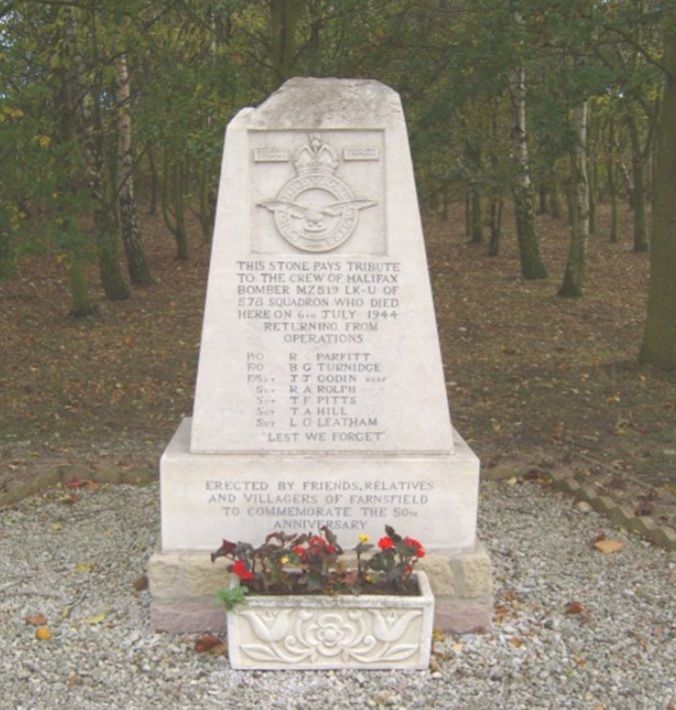 Farnsfield Air Crash Memorial - World War Two